Reasons for the descent of stars from the heavens and their final
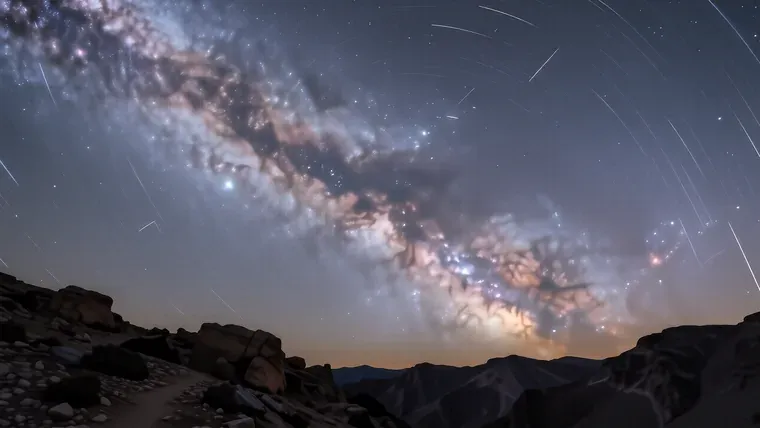
The “falling stars” observed from Earth are not stars at all. They are meteoroids, which are small fragments of rock or ice, entering the atmosphere at speeds exceeding 150,000 km/h. When these objects strike the dense gases of our atmosphere, friction generates intense heat that causes the material to combust and create a visible streak of light.
The Physics of Atmospheric Entry
The term “star” is technically inaccurate in this context. Stars are massive, luminous spheres of plasma held together by gravity, such as the Sun. Meteoroids are much smaller. Most are merely the size of a grain of sand or a small pebble. They travel through the vacuum of space until they encounter the Earth’s atmospheric envelope.
Friction is the primary driver of the light we see. As a meteoroid enters the atmosphere, it compresses the air in front of it so rapidly that the temperature rises to thousands of degrees Celsius. This process causes the object to vaporize. The glowing trail is not just the rock burning; it is also the ionization of the surrounding air molecules.
A meteor is the visible phenomenon. It lasts only seconds. If a fragment survives this intense thermal stress and hits the ground, it is called a meteorite. Most meteoroids are destroyed before they reach the surface. They simply vanish into gas and microscopic dust.
The brightness varies significantly. A bright meteor is often called a bolide. These can be bright enough to rival the magnitude of Venus during a clear night. Because the energy release is so sudden, bolides can sometimes produce sonic booms or even small flashes of light that illuminate the ground.
The Perseid Meteor Shower
Meteor showers occur when Earth passes through a debris field. These fields are left behind by comets as they orbit the Sun. As a comet approaches the Sun, solar radiation causes it to lose material. This material forms a long trail of dust and ice along the comet’s orbital path.
The Perseids are a reliable annual event. They are caused by the debris from Comet 109P/Swift-Tuttle. While this comet only visits the inner solar system once every 133 years, Earth intersects its orbital debris every summer. This intersection creates a predictable window of high activity.
The shower is highly visible in August. For example, during the 2024 cycle, the peak occurs between 12 August and 13 August. During these nights, observers can expect to see between 50 and 75 meteors per hour. The visibility is enhanced because the Moon will be at only 10% illumination, with a new moon occurring on 16 August.
The radiant point for this shower is located near the constellation Perseus. While the meteors appear to originate from this specific area, they can be seen anywhere in the sky. It is often easier to look toward the zenith or the northeast rather than staring directly at the radiant.
Historical records confirm this longevity. Ancient Chinese chronicles documented these sightings centuries ago. In 1835, the Belgian scientist Adolphe Ketle officially recorded the phenomenon. Southern Europeans have also long associated the event with the “Tears of St. Lawrence” due to its timing near his feast day.
- Comet: 109P/Swift-Tuttle
- Peak Dates: 12–13 August
- Expected Rate: 50–75 meteors per hour
- Radiant: Perseus constellation
Observing the Night Sky
You do not need a telescope to see meteors. In fact, telescopes are often counterproductive for this specific task. They have a very narrow field of view. A meteor moves too quickly across a large portion of the sky for a lens to track it effectively.
The naked eye is the best tool. It provides the widest possible field of view. To prepare, you must allow your eyes to adjust to the dark. This process takes roughly 20 to 30 minutes in total darkness. Avoid looking at smartphone screens during this time.
If you must use a light source, choose a red flashlight. Red light does not disrupt night vision as much as white or blue light. This is because red wavelengths do not trigger the same level of pupil contraction. Using a red light allows you to navigate without losing your adaptation to the dark.
Location is everything. Light pollution from cities will drown out all but the brightest bolides. Consult a light pollution map before choosing a site. Seeking a location with a Bortle scale rating of 3 or lower will significantly improve the number of visible meteors.
| Equipment | Necessity | Reason |
|---|---|---|
| Naked Eye | Essential | Wide field of view |
| Tripod | Recommended | For long-exposure photography |
| Red Flashlight | Highly Recommended | Preserves night vision |
| Binoculars | Not Necessary | Too narrow a field |
Techniques for Astrophotography
Capturing a meteor requires patience and specific settings. Handheld photography is rarely successful because even slight movements blur the image. A sturdy tripod is mandatory for any attempt at long-exposure shots. You should also use a camera delay function to prevent shake during the shutter release.
Manual mode is required for control. Set your focus to infinity so that distant stars remain sharp. The aperture should be as wide as possible, which means using the lowest f-number your lens allows. This lets in more light during the short window of time the meteor is visible.
ISO sensitivity must be high. While high ISO introduces digital noise, it is necessary to capture the faint light of a passing meteor. You should experiment with shutter speeds starting at 10 seconds. If the sky is very dark, you might extend this to 20 or 30 seconds.
The composition matters too. Do not just point the camera at a blank patch of sky. Including a foreground element like a mountain silhouette or a tree line provides scale and context. This makes the final image more visually interesting than a simple field of stars.
Vladimir Antropov, a professional photographer, suggests that ideal conditions require a clear sky and minimal artificial light. He notes that even a small amount of ambient light can ruin a long exposure. Always check the local weather forecast for cloud cover before setting up your gear.
Global Observation Destinations
Different regions offer varying qualities of sky. In Russia, Arkhyz is a premier location because it possesses some of the darkest skies in the country. The air there is exceptionally clear due to its high altitude. This makes it an ideal spot for the Astroverts club to host astronomical gatherings.
The Altai Mountains provide another option. Specifically, the Chui Steppe sits at an elevation of approximately 1,800 meters above sea level on the border with Mongolia. The climate is dry, so the skies remain clear for roughly 300 days a year. This provides excellent visibility for summer meteor showers.
Krasnaya Polyana hosts a specific festival called “Perseids Starfall.” This event runs from 5 August to 24 August at the CAMP2050 camp. It combines astronomy lectures with ethnic music performances. It is a social way to observe the sky while staying in relatively comfortable accommodations.
Ladoga offers a different atmosphere. The Sky of the North festival takes place near the sandy beaches of Ladoga. This area has minimal electric light, which is perfect for viewing. Participants often camp on the beach to get a direct view of the horizon.
- Arkhyz: Darkest skies and clear air.
- Chui Steppe: 1,800m elevation and dry climate.
- Krasnaya Polyana: Organized “Perseids Starfall” festival.
- Ladoga: Low light pollution near sandy beaches.
The movement of these particles through our atmosphere is a constant process. Every day, the Earth is bombarded by hundreds of millions of meteors. While most are too small to see, they contribute to a massive amount of cosmic dust. This dust, totaling about 100 tons daily, stays suspended in the upper atmosphere.
Watching the Perseids is a lesson in scale. You are seeing the remnants of a comet that passed by over a century ago. The debris is now part of our local environment. When you see a streak of light, you are witnessing the final moment of a cosmic traveler.
Frequently asked questions
What are falling stars actually made of?
Falling stars are actually meteoroids, which are small fragments of rock or ice. They enter the atmosphere at speeds exceeding 150,000 km/h, causing them to combust due to friction.
What is the difference between a meteor and a meteorite?
A meteor is the visible streak of light caused by a meteoroid vaporizing in the atmosphere. If a fragment survives this process and hits the ground, it is called a meteorite.
When is the best time to see the Perseid meteor shower?
The Perseids peak annually between 12 August and 13 August. During this window, observers can expect to see between 50 and 75 meteors per hour.
What equipment is best for observing meteors?
The naked eye is the most effective tool because it provides the widest field of view. Telescopes are often counterproductive due to their narrow field of view.
More in Stars
How far away is the nearest star in light years?
Discover how far Proxima Centauri is from Earth and learn about its physical characteristics, planetary system, and distance measurements.
Methods used by scientists to calculate the distance to stars
Explore how astronomers use the cosmic distance ladder, from trigonometric parallax to standard candles and redshift, to measure stellar distances.
Shooting stars: An enigmatic phenomenon explained
Discover the science behind shooting stars, from the mechanics of atmospheric entry to the chemical composition of meteorites and predictable meteor showers.
Is the Big Dipper the most luminous star?
Learn why the Big Dipper is an asterism in Ursa Major and explore the distinct magnitudes and distances of its seven primary stars.