How far away is the nearest star in light years?
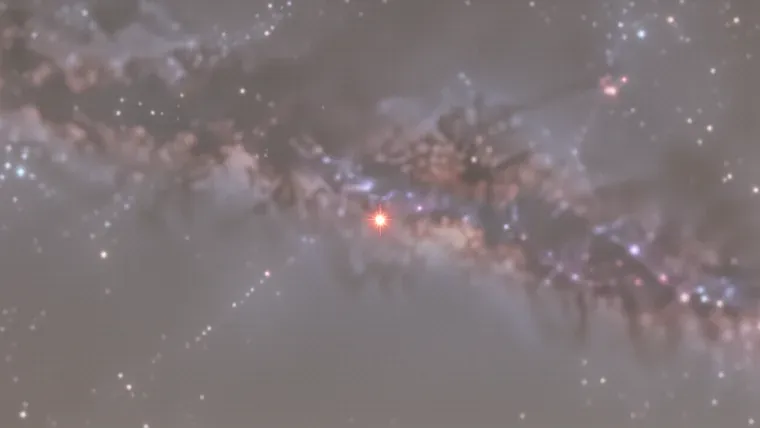
Proxima Centauri is the closest star to our solar system. It sits at a distance of 4.243 light-years. This red dwarf occupies the Centauri constellation.
The Proximity of Proxima Centauri
The star is dim. Because its apparent magnitude is 11.05, you cannot see it without a telescope. Most people mistake Sirius for the closest star because Sirius has a much higher apparent magnitude of -1.46. Proxima Centauri remains invisible to the naked eye. It requires a minimum aperture of 8 cm for detection.
Distance measurements rely on parallax. Astronomers observe a star’s position from one side of Earth’s orbit and then repeat the measurement six months later after the planet reaches the opposite side of its path. This method provides accuracy for objects within 100 light-years. Robert Innes first identified this specific star in 1915 while he was studying photographs at the Johannesburg Observatory in South Africa.
The distance is vast. It equals approximately 271,000 astronomical units. While a photon travels this gap in 4.243 years, a human-made object moves much slower. Voyager 1 currently travels at 17.3 kilometers per second. If it headed toward Proxima Centauri, the journey would take 73,000 years because its current velocity is insufficient for interstellar transit.
Proxima Centauri belongs to a triple system. It orbits the Alpha Centauri AB pair. The separation between Proxima and the AB binary is roughly 0.21 light-years. This orbital period lasts about 500,000 years.
Physical Characteristics of an M-Dwarf
Proxima Centauri is small. It has a mass that is 12.3% of the Sun’s mass. The star also possesses a diameter that is only 14.1% of the solar diameter. It is roughly 1.5 times larger than Jupiter. This low mass prevents it from becoming a much larger star.
The surface temperature is low. It measures approximately 3042 K to 3500 K depending on the specific observational model used. Its luminosity is only 0.17% of the Sun’s total output. This makes the star appear red because its peak emission falls in the longer wavelengths of the spectrum.
It is a flaring star. In 1951, Harlow Shapley noticed that the star’s brightness increased by 8% when he compared archival images. These flares can reach temperatures of 27 million K. Such high temperatures generate X-rays that can sterilize nearby planets because the radiation intensity spikes suddenly during magnetic reconnection events.
The star is stable. It will remain in its main-sequence phase for approximately 4 trillion years. This duration exceeds the current age of the universe by a factor of 300. Eventually, it will deplete its hydrogen and become a white dwarf.
The rotation is slow. Its period lasts 83.5 days. The rotational velocity reaches 2.7 km/s.
The Planetary System of Proxima Centauri
Three planets orbit this star. They were found using different methods and instruments. Proxima Centauri b was confirmed by the European Southern Observatory in 2016. It orbits at a distance of 0.5 astronomical units. This planet has a mass at least 1.17 times that of Earth.
Proxima Centauri c is colder. Astronomers at the Turin Observatory identified it in 2019. It has a mass of 5.8 ± 1.9 Earth masses. The planet takes about 1900 days to complete one orbit because its semi-major axis is 1.5 astronomical units. It resembles an icy Neptune.
A third planet exists. Scientists named it Proxima Centauri d after observing it with the ESPRESSO spectrograph. Its mass is roughly 26% of Earth’s mass. This world orbits very close to the star. A single year there lasts only 5.15 Earth days.
Habitability remains uncertain. Planets b and d are likely tidally locked. One side faces the star constantly while the other side remains in eternal darkness. Intense stellar flares also pose a threat. These bursts of ultraviolet radiation can strip away atmospheres so that life cannot easily take hold on the surface.
- Proxima Centauri b: 11.2-day orbit, potentially liquid water.
- Proxima Centauri c: 5.2-year orbit, icy composition.
- Proxima Centauri d: 5.15-day orbit, 26% Earth mass.
Measuring the Void
Parallax is the primary tool. Scientists measure the tiny shift in a star’s position against more distant background objects. This angle changes as Earth moves around the Sun. John Voyut used this method in 1917 to find the distance to the Alpha Centauri system. Harold Alden improved these calculations in 1928. He found a parallax of 0.783” for Proxima Centauri.
The math is precise. Distance equals one divided by the parallax angle. This trigonometric approach works well for nearby stars. We can use it to map the local stellar neighborhood within our galaxy.
Light years are useful. One light year is 9.64 trillion kilometers. While this unit sounds large, the distances between stars are even larger. Proxima Centauri is 270 times further from us than the Sun is from Earth.
Proper motion matters too. The star moves at 22.2 kilometers per second toward our solar system. It will reach its closest approach in 26,700 years. At that time, the distance will drop to 3.11 light-years.
Comparison with Other Nearby Stars
Barnard’s Star is also close. It resides in the Serpens constellation. It is a red dwarf located 5.96 light-years away. Many northern observers consider it their closest neighbor. It has an exceptionally high angular velocity. This motion causes it to shift 0.5 degrees in the sky over 174 years.
Luhman 16 is a different case. It is a binary brown dwarf system located 6.516 light-years away. Kevin Luhman discovered it in 2013. Brown dwarfs are not true stars because they lack the mass to sustain hydrogen fusion. They occupy the space between large planets and small stars.
Wolf 359 is another neighbor. It sits 7.78 light-years from Earth. Max Wolf identified this star in 1918. It has a mass of only 10% of the Sun’s mass. This star exhibits periodic luminosity changes.
Ross 154 is located 9.7 light-years away. Frank Elmar Ross discovered it in 1925. It emits intense X-rays. Its mass is 17% of the Sun’s.
The sky changes over time. Proxima Centauri has been the closest star for 32,000 years. It will hold this title for another 33,000 years. Afterward, Ross 248 will take its place. Ross 248 is a red dwarf in the Andromeda constellation.
The stellar neighborhood is dynamic. Stars move through space in complex patterns. While we see them as fixed points, they are actually traveling at high velocities. This motion changes which star appears closest to us over tens of thousands of years.
Sirius remains the brightest. It is 8.6 light-years away. It is a double star. You can see it without a telescope. Its luminosity is 25 times that of the Sun.
The distance to Proxima Centauri changes as the stars move through the Milky Way. Astronomers continue to refine these values using data from the Gaia DR3 mission. We await more precise measurements from future infrared surveys to confirm if any undiscovered brown dwarfs lie in the gap between us and our nearest neighbor.
Frequently asked questions
How many light years away is the closest star?
The closest star to our solar system is Proxima Centauri, which is located 4.243 light-years away.
Can you see Proxima Centauri with the naked eye?
No, Proxima Centauri is invisible to the naked eye due to its apparent magnitude of 11.05; it requires a minimum aperture of 8 cm for detection.
How many planets orbit Proxima Centauri?
There are three known planets orbiting the star: Proxima Centauri b, c, and d.
What is the method astronomers use to measure stellar distance?
Astronomers primarily rely on parallax, which involves observing a star's position from opposite sides of Earth's orbit to calculate its distance.
More in Stars

Methods used by scientists to calculate the distance to stars
Explore how astronomers use the cosmic distance ladder, from trigonometric parallax to standard candles and redshift, to measure stellar distances.
Reasons for the descent of stars from the heavens and their final
Learn why meteoroids appear as falling stars, how friction creates light during atmospheric entry, and where these cosmic fragments ultimately end up.
Shooting stars: An enigmatic phenomenon explained
Discover the science behind shooting stars, from the mechanics of atmospheric entry to the chemical composition of meteorites and predictable meteor showers.
Is the Big Dipper the most luminous star?
Learn why the Big Dipper is an asterism in Ursa Major and explore the distinct magnitudes and distances of its seven primary stars.