Where is the Earth located in the Milky Way galaxy?
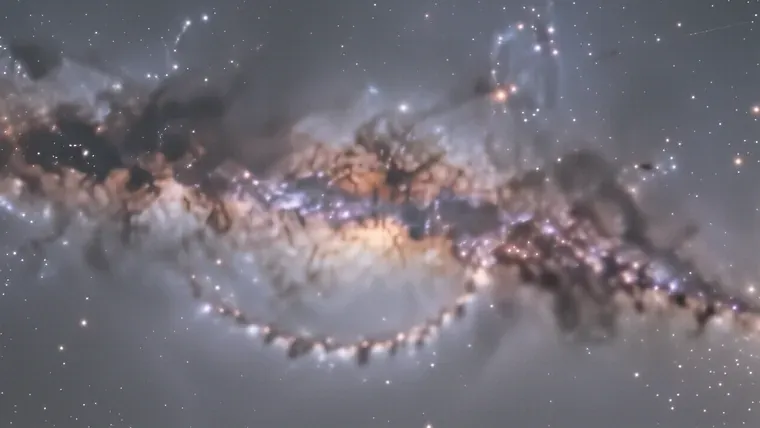
Earth sits in the Orion Arm. This specific region of the Milky Way galaxy lies approximately 25,000 to 28,000 light-years from the galactic center. We reside in a relatively quiet zone between the Sagittarius and Perseus spiral arms because this location protects our solar system from the intense ultraviolet radiation that frequently erupts near the more active, crowded galactic core.
The Geometry of Our Galactic Home
The Milky Way is a disk. It is large. While many older models estimated its diameter at 100,000 light-years, recent data suggests the structure may actually extend much further. We live on the outskirts. This placement provides a stable environment for life because the star density in our vicinity is only 1 to 2 luminaries per 16 cubic parsecs.
The center is crowded. It is dense. In the central region of the disk, the stellar density reaches approximately 10,000 stars per cubic parsec, although this concentration drops significantly as you move toward the periphery where our Sun orbits. We are far away. The central bulge contains a billion stars of varying ages.
The galaxy rotates. It moves fast. Stars in the outer parts of the disk reach speeds of 200 to 250 km/s while the Sun maintains an orbital velocity of roughly 220 km/s around the galactic nucleus. We are traveling. It takes the solar system about 250 million years to complete a single revolution around the center.
The structure is complex. It has arms. The Milky Way follows an SBbc classification, which means it possesses a central bar-like structure called a “jumper” that spans roughly 27,000 light-years. This bar contains ancient red giants. These stars draw material from nearby black holes so that they can continue their long evolutionary cycles.
The disk deforms. It shifts. The gravitational pull of the Large and Small Magellanic Clouds causes vibrations that warp the galactic plane, although these dwarf galaxies are technically satellite systems orbiting our primary galaxy. They are close neighbors. Hubble Space Telescope observations confirm their high-speed orbits around the Milky Way.
Measuring the Cosmic Void
Distance is difficult. It is hard. Early astronomers used parallax to estimate distances, but this method fails once objects move beyond a few hundred thousand parsecs because the apparent shift in position becomes too small to detect with standard equipment. We need better tools. The Hipparcos satellite mission in 1989 provided a massive leap forward by determining distances to one million stars near our Sun.
Ernst Epik changed everything. He was smart. In the 1920s, this Estonian astrophysicist calculated the distance to a bright star cluster by measuring its rotational velocity, which allowed him to prove that the cluster existed far outside the boundaries of the Milky Way. It was Andromeda. This discovery revealed that our galaxy is just one of many in a vast, expanding universe.
Cepheid variables offer hope. They pulse. These stars change their luminosity in predictable patterns so that astronomers can use them as “standard candles” to measure distances to much more remote galaxies. We find them everywhere. Thousands of these stars help us map the cosmos where parallax cannot reach.
The universe is porous. It has holes. Space resembles a sponge because most of it consists of filaments and massive voids where the density of matter is 15% to 50% lower than the cosmic average. Matter is concentrated. Most galaxies cluster together in long strands or walls, leaving enormous empty stretches between them.
The KVS void exists. It is huge. Researchers Ryan Keenan, Amy Barger, and Lennox Cowie identified a massive void spanning approximately 1.5 billion light-years in 2013 because they compared the radiation levels of nearby galaxies against much more distant ones. This discovery challenges our models. If we live inside such a void, it might explain why measurements of the Hubble constant vary depending on the method used.
The Large-Scale Structure and Laniakea
We are not alone. We belong. The Milky Way is a member of the Local Group, which includes the Andromeda and Triangulum galaxies, although this group is actually just a small part of the much larger Virgo Supercluster. Gravity pulls us. These structures form a hierarchy of cosmic architecture that stretches across millions of light-years.
Laniakea is our home. It is vast. This supercluster contains the Milky Way and its neighbors within a massive gravitational web, although the sheer scale of Laniakea makes it difficult to map with total precision. We are small. The supercluster represents a significant portion of the local cosmic environment.
The Tallinn Symposium was vital. It happened in 1977. During this meeting in Estonia, scientists began to move away from the idea of a uniform universe because they started to observe the “cellular structure” of galaxies and voids. Jaan Einasto led this charge. He faced initial rejection from journals when he proposed that the universe was filled with filaments rather than being a smooth soup of matter.
Dark matter dominates. It is invisible. Approximately 90% of the Milky Way’s mass consists of dark matter, which creates a massive halo around the visible disk so that the galaxy can maintain its rotational speeds. We cannot see it. Only its gravitational influence allows us to detect its presence through the movement of stars and gas.
The structure grew. It evolved. Yakov Zeldovich and Jaan Einasto proposed that early perturbations in dark matter led to the formation of “pancakes” or large-scale structures, after which baryonic matter was pulled into these gravitational wells over billions of years. The process is slow. This redistribution of mass created the filaments we see today.
The Fate of Our Galaxy
Andromeda is coming. It moves fast. This massive spiral galaxy is approaching the Milky Way at a speed of roughly 200 km/s, which means a collision is inevitable in approximately 4 to 5 billion years. We will merge. The two galaxies will eventually combine into a single, large elliptical galaxy.
The Sun will change. It will grow. In about 5 billion years, our star will exhaust its hydrogen and expand into a red giant, after which it will likely consume the inner planets of our solar system. Earth may perish. This transformation is a standard part of stellar evolution for stars of our mass.
The Magellanic Clouds are coming too. They are near. The Milky Way will likely absorb the Large and Small Magellanic Clouds within the next 4 billion years because their orbits bring them closer to our galactic center. We are growing. This process of cannibalism is how most large galaxies increase their mass over time.
The Big Dog galaxy was eaten. It is gone. This dwarf galaxy once resided near us at a distance of only 25,000 light-years, although it has since been assimilated into the Milky Way’s structure. We see its remnants. Astronomers can reconstruct “star streams” from the broken bones of these deceased galaxies.
The nucleus is active. It is dark. At the very center of our galaxy lies Sagittarius A*, a supermassive black hole with a diameter of roughly 22 million kilometers. It is powerful. Matter falling into this void forms an enormous disk that can be five million times more massive than our Sun.
The Dynamics of Galactic Motion
Rotation is constant. It never stops. The entire Milky Way rotates at a speed of approximately 600 km/s relative to the cosmic microwave background radiation, which serves as a benchmark for measuring the velocity of celestial bodies. We are moving. This motion is part of the larger expansion of the universe.
The arms are distinct. They swirl. The Orion arm contains our solar system, while other structures like the Perseus branch and the Sagittarius arm extend outward from the galactic center. These arms are not solid. They are density waves that move through the disk of gas and stars.
Gas clouds exist. They are thick. About 15% of the galaxy’s components consist of interstellar gas and dust, although this material often blocks visible light so that we must use infrared telescopes to see through it. We can map it. Infrared observations allow us to peer into the dense regions where new stars are born.
Stars move fast. Some are hypervelocity. Certain stars in the constellations of Sextant and Leo move at extreme speeds, which suggests they were ejected from the galactic center by the intense gravitational influence of the central black hole. They are travelers. These stars may eventually leave the galaxy entirely.
The Milky Way is old. It is ancient. We estimate its age to be around 14 billion years, although this number is derived from the oldest known stars which are approximately 13.2 billion years old. The galaxy formed in stages. It began with a central bulge and eventually developed its characteristic spiral arms over billions of years.
Frequently asked questions
How far is Earth from the center of the Milky Way?
Earth is located approximately 25,000 to 28,000 light-years from the galactic center.
Which part of the galaxy does our solar system reside in?
Our solar system sits within the Orion Arm, a region located between the Sagittarius and Perseus spiral arms.
How fast does the Sun orbit the galactic nucleus?
The Sun maintains an orbital velocity of roughly 220 km/s, taking about 250 million years to complete one full revolution.
What is at the center of the Milky Way galaxy?
At the very center lies Sagittarius A*, a supermassive black hole with a diameter of roughly 22 million kilometers.
More in Galaxies
A comprehensive list of names for celestial objects
Explore how astronomers use astronymics and cosmonymics to name stars, planets, and galaxies according to strict IAU protocols.
Methods for measuring the distance to celestial bodies
Explore the cosmic distance ladder, from trigonometric parallax and radar ranging to standard candles like Cepheid variables and Type Ia supernovae.
Methods for measuring the mass of celestial bodies
Explore how astronomers use orbital mechanics, binary star systems, and spectral broadening to calculate the mass of planets, stars, and galaxies.
Exploring the science of cosmology and the universe
Discover how modern cosmology explains the Big Bang, dark energy, and the evolution of our universe from its 13.8 billion year history to its eventual fate.