Which category of galaxy does the Andromeda Nebula fall under?
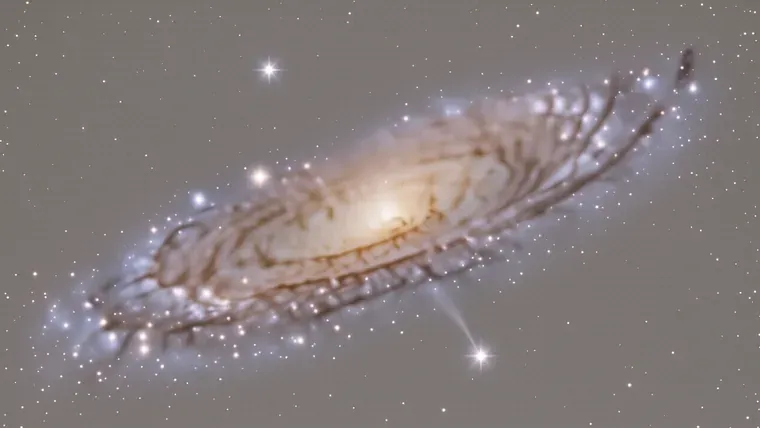
The Andromeda Galaxy (M 31) belongs to the Sb type of spiral galaxies. It is a massive, rotating disk of stars, gas, and dust located approximately 772 kiloparsecs or 2.52 million light-years from Earth. While it appears as a fuzzy patch in amateur telescopes, it contains roughly one trillion stars according to data from the Spitzer Space Telescope.
Morphological Classification and Structure
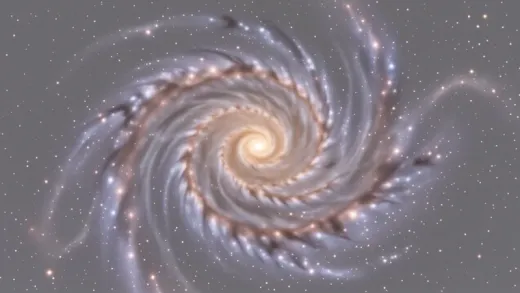
The galaxy is an Sb spiral. This classification describes its specific structure. It possesses a prominent central bulge and well-defined spiral arms that wrap around the core because the gravitational influence of the central mass dictates the orbital paths of the stellar populations. The disk shows an inclination of 15 degrees relative to our line of sight.
The structure is complex. Observations using the Spitzer Space Telescope in the late 1990s helped define the distribution of its stellar mass. The disk contains 56% of the total stellar mass while it contributes 70% of the galaxy’s total luminosity.
Large scale features exist. The galaxy spans approximately 260,000 light-years across. This diameter makes M 31 about 2.6 times larger than the Milky Way in terms of linear extent.
A bar might exist. Although astronomers have not observed a central bar directly, the orientation of the galaxy suggests that such a structure could be aligned nearly parallel to our line of sight.
The arms rotate. They move in a clockwise direction. This rotation is somewhat distorted because the gravitational pull from satellite galaxies like M 32 and M 110 tugs on the outer edges of the disk.
Observational History and Discovery
Ancient records exist. The Persian astronomer As-Sufi described a “small cloud” in his Catalog of Fixed Stars in 946 AD. He did not realize he was looking at a separate galactic system because the resolution of the naked eye is limited to diffuse light.
Telescopes changed everything. Simon Marius recorded the first telescopic observations in 1612. Charles Messier later included the object in his catalog as M 31, although he mistakenly credited Marius with the discovery.
Spectroscopy provided clarity. William Huggins studied the spectrum of M 31 in 1864. He discovered that the light was composed of individual stellar spectra rather than the continuous emission lines found in gas nebulae, so he concluded it was a collection of stars.
Photography revealed detail. Isaac Roberts captured the first images of the galaxy in 1887 using his observatory in Sussex. These images provided the first visual evidence of its spiral structure, even though Roberts incorrectly believed the object was a solar system with developing planets.
Supernovae occur here. The event SN 1885A, also called S Andromeda, remains the only recorded supernova in M 31. This explosion occurred in 1885 and provided a vital data point for understanding the stellar evolution within the galaxy.
The Central Nucleus and Black Hole
The core is dense. It contains a double nucleus consisting of two concentrations labeled P1 and P2. These two points are separated by only 4.9 light-years, although the P1 region appears brighter to observers on Earth.
A black hole resides there. Calculations indicate a supermassive black hole (SMBH) with a mass exceeding 140 million solar masses. This object exerts immense tidal forces on the surrounding environment because its gravity is strong enough to prevent gas clouds from collapsing into new stars.
Blue stars surround it. In 2005, the Hubble Space Telescope identified a disk of young, blue stars orbiting the SMBH. These stars are only about 200 million years old, which creates an astrophysical puzzle since the tidal forces should inhibit star formation so close to such a massive object.
X-ray sources exist. A study using the XMM-Newton Space Telescope identified 63 distinct X-ray sources in the nucleus. Most of these 46 objects are low-mass X-ray binaries, while the others may be neutron stars or black holes in binary systems.
The core is active. It acts as a radio source. The luminosity of this radio emission is approximately 30 times fainter than the radio output of our Milky Way.
Stellar Populations and Clusters
Globular clusters abound. M 31 contains approximately 450 documented globular clusters. These dense groups of ancient stars orbit the galaxy in a spherical halo.
Mayall II is massive. Also known as G1, this cluster is the most luminous in the Local Group. It sits 130,000 light-years from the center and contains at least 300,000 stars because it likely represents the remnant core of a dwarf galaxy that M 31 swallowed long ago.
New clusters exist. Astronomers found three unusual clusters in the halo in 2005. These systems are larger than standard globular clusters but possess lower mass, so they may represent a transitional state between globular clusters and dwarf spheroidal galaxies.
Metallicity varies. The stars in the bulge have high metallicity due to many generations of stellar evolution. In contrast, the stars in the outer halo contain fewer heavy elements because they formed in less dense environments or were acquired through galactic mergers.
The galaxy hosts planets. A star named PA-99-N2 has a detected exoplanet. This object represents the first exoplanet identified outside the Milky Way.
Galactic Dynamics and Future Collision
Movement is rapid. M 31 moves toward the Sun at a velocity of approximately 300 km/s. This motion creates a blue shift in its observed light spectrum.
The Local Group is small. Andromeda is the largest member of this galactic group. It shares this space with the Milky Way and the Triangulum Galaxy (M 33).
A collision is inevitable. The Milky Way and Andromeda are approaching each other at a rate of 100-140 km/s. We expect a major merger to occur in approximately 3 to 4 billion years after the two systems begin to interact gravitationally.
The merger will change everything. The two galaxies will likely form a single, larger elliptical or disk galaxy. While the stars themselves rarely collide due to the vast distances between them, the gravitational disturbances may fling our solar system into intergalactic space.
Satellite interactions occur. M 32 is a compact elliptical galaxy that orbits M 31. Some researchers suggest that M 32 collided with Andromeda roughly 210 million years ago, which left behind a distorted stellar disk and triggered new star formation.
Observational Methods and Visibility
Winter is best. The constellation Andromeda is most visible from October to December. You can find the galaxy by locating the stars in Cassiopeia and drawing a line toward the Great Square of Pegasus.
Naked eye viewing works. M 31 has an apparent magnitude of +3.4. It appears as a faint, elongated smudge in dark skies because human eyes lack the ability to resolve individual stars at that distance.
Binoculars help. A pair of 10x50 binoculars will reveal the bright nucleus and the general shape of the disk. You might also see the satellite galaxies M 32 and M 110 if the sky is sufficiently dark.
Telescopes provide detail. An amateur telescope with an aperture of 150-200 mm can show dusty lanes in the spiral arms. However, you will not see the vibrant colors found in professional photographs because the human eye’s night vision sacrifices color sensitivity to detect low light levels.
To find it:
- Locate Polaris.
- Find the “W” shape of Cassiopeia.
- Identify the star Alpha Cassiopeia.
- Follow an imaginary line from Polaris through Alpha Cassiopeia toward the Andromeda constellation.
The galaxy remains a subject of intense study. Even with modern instruments like the James Webb Space Telescope, the sheer scale and history of M 31 continue to provide new data regarding how galaxies grow through mergers and accretion.
Frequently asked questions
What type of galaxy is Andromeda?
The Andromeda Galaxy (M 31) is classified as an Sb type spiral galaxy, characterized by a prominent central bulge and well-defined spiral arms.
How large is the Andromeda Galaxy?
The galaxy spans approximately 260,000 light-years across, making it about 2.6 times larger than the Milky Way in terms of linear extent.
Does Andromeda have a black hole?
Yes, calculations indicate that Andromeda contains a supermassive black hole with a mass exceeding 140 million solar masses.
Will the Milky Way collide with Andromeda?
A major merger is expected to occur in approximately 3 to 4 billion years as the two galaxies approach each other at a rate of 100-140 km/s.
More in Galaxies
A comprehensive list of names for celestial objects
Explore how astronomers use astronymics and cosmonymics to name stars, planets, and galaxies according to strict IAU protocols.
Methods for measuring the distance to celestial bodies
Explore the cosmic distance ladder, from trigonometric parallax and radar ranging to standard candles like Cepheid variables and Type Ia supernovae.
Methods for measuring the mass of celestial bodies
Explore how astronomers use orbital mechanics, binary star systems, and spectral broadening to calculate the mass of planets, stars, and galaxies.
Exploring the science of cosmology and the universe
Discover how modern cosmology explains the Big Bang, dark energy, and the evolution of our universe from its 13.8 billion year history to its eventual fate.