Methods for measuring the distance to celestial bodies
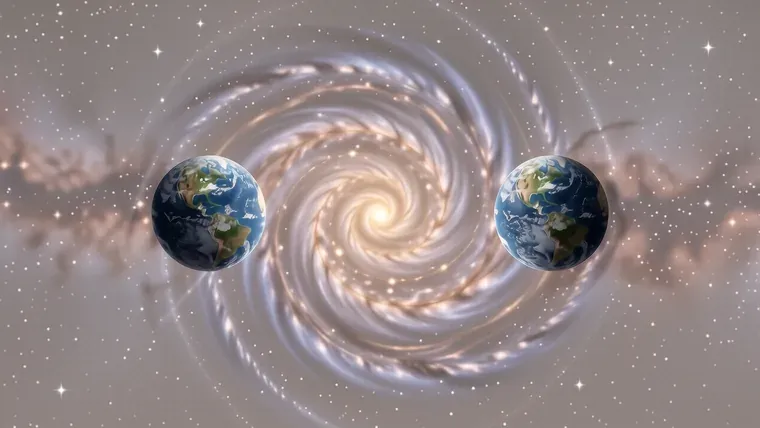
Astronomers use a “cosmic distance ladder” because no single instrument or technique can measure everything from a nearby moon to a distant galaxy. This hierarchy of methods relies on overlapping calibrations where the accuracy of one step provides the foundation for the next.
Geometric Foundations and Parallax
Distance measurement begins with geometry. It is simple. We use trigonometry to turn angles into physical lengths.
The most fundamental method is parallax. This technique measures the apparent shift of a nearby object against a background of much more distant, “fixed” stars as the Earth moves in its orbit around the Sun. Because the Earth travels approximately 300 million kilometers from one side of its orbit to the other, this provides a massive baseline for observations. The angle of this shift is called the trigonometric parallax (p). A star with a parallax of 1 arcsecond is exactly 1 parsec away. One parsec equals 206,265 astronomical units (a.u.) or approximately 3.086×10¹⁸ centimeters.
Small angles require precise math. When an angle ρ is expressed in radians, the sine of that angle is nearly identical to the angle itself (\sin ρ ≈ ρ). If we work in arcseconds, the conversion factor becomes 1/206,265. This allows us to calculate distance (r) using the formula r = 206,265” / p when measuring in astronomical units.
Proxima Centauri is a useful benchmark. It is a red dwarf with a magnitude of 12. Its parallax is measured at 0.762 arcseconds. This measurement places it as the closest star to our solar system.
The parsec and the light-year are the primary units for stellar distances. A light-year is the distance light travels in one vacuum year, which equals 9.46×10¹⁷ centimeters. While both are useful, astronomers prefer the parsec because it is derived directly from the parallax angle.
- 1 parsec (pc) = 206,265 a.u.
- 1 light-year (ly) ≈ 0.307 pc
- Parallax (p) is half of the total annual apparent displacement.
Radar and Planetary Radiometry
We can reach further with radio waves. This method provides extreme precision for objects within our solar system.
Radar ranging involves transmitting a short pulse of radio waves toward a planet or moon and measuring the time it takes for the signal to reflect back to Earth. Since the speed of light in a vacuum (c) is exactly 299,792,458 m/s, the distance is simply half the travel time multiplied by c. This technique has allowed us to refine our understanding of the solar system’s scale. For example, radar observations of Venus have helped define the astronomical unit with high accuracy.
The astronomical unit (a.u.) is the mean distance between the Earth and the Sun. In 1976, the International Astronomical Union (IAU) established a fixed value for 1 a.u. as 149,597,870 ± 2 km. Modern radar measurements can narrow this down further, showing a value of 149,597,867.9 ± 0.9 km.
Planetary distances also follow Kepler’s Third Law. This law states that the square of a planet’s orbital period (T) is proportional to the cube of its average distance (r) from the Sun. If we measure T in Earth years, we can find r in astronomical units using the relationship derived from Kepler’s observations.
We can also determine the physical size of celestial bodies through angular diameter. If we know the distance (D) to a body and its angular radius (ρ), the linear radius (R) is found via R = D \sin ρ. This was used to calculate that the Sun’s radius is approximately 109 times larger than Earth’s radius when observing an angular radius of 16 arcminutes.
The Moon provides a classic calculation example. Using a horizontal parallax of 57’02” and the Earth’s equatorial radius (R_\oplus) of 6,378 km, the distance to the Moon is approximately 384,400 km. This calculation assumes the Earth is a sphere for the purpose of the geometric model.
The Scale of the Earth
Before we look up, we must know our own dimensions. Measuring the Earth was the first step in human astronomy.
Eratosthenes achieved this in the 3rd century BC. He worked in Alexandria and Syene (modern-day Aswan). He observed that on the summer solstice, the Sun passed directly overhead in Syene, casting no shadow in deep wells. Meanwhile, in Alexandria, he used a scaphysis to measure a solar deviation of 1/50th of a circle, or 7.2 degrees. Because Alexandria was located approximately 5,000 stadia from Syene, he calculated the Earth’s circumference to be 250,000 stadia.
His math was remarkably accurate for the era. He estimated the Earth’s radius to be roughly 6,400 km. Modern measurements place the equatorial radius at 6,378 km.
We can replicate this by measuring arc lengths on the surface. If we know the linear distance (l) between two points on the same longitude and the angular distance (n) in degrees between them, the radius is: R_\oplus = 180 × l / (π × n).
This method remains a fundamental exercise in geodesy. It proves that local observations can reveal global truths.
Standard Candles and Extragalactic Distances
Parallax fails at great distances. The angles become too small for even the best telescopes to resolve.
To measure galaxies, we use “standard candles.” These are objects with a known intrinsic luminosity. If we know how bright an object actually is (absolute magnitude) and compare it to how bright it appears from Earth (apparent magnitude), we can calculate the distance. This follows the inverse-square law of light.
Cepheid variables are the primary standard candles for nearby galaxies. These are pulsating stars that brighten and dim with a regular period. In 1912, Henrietta Swan Leavitt discovered the period-luminosity relationship, which allows astronomers to determine a Cepheid’s absolute magnitude by measuring its pulsation cycle. This discovery transformed cosmology because it allowed us to map the scale of the universe beyond our own galaxy.
Type Ia supernovae serve as even more powerful candles. These stellar explosions occur when a white dwarf in a binary system reaches a critical mass limit. Because these explosions always occur at roughly the same mass, they always have nearly the same peak luminosity. This consistency allows us to measure distances across billions of light-years.
The Hubble constant (H_0) relates these distances to the expansion of the universe. It represents the rate at which galaxies are receding from us. While there is ongoing debate regarding the exact value of H_0—often called the “Hubble Tension”—the methods used to find it rely on this ladder of standard candles.
- Parallax for nearby stars.
- Cepheids for nearby galaxies.
- Type Ia supernovae for distant galaxies.
- Redshift for the expansion of the universe.
Redshift and Cosmological Expansion
The universe is expanding. This movement creates a measurable effect on light.
When a galaxy moves away from us, the light it emits is stretched toward longer, redder wavelengths. This is known as cosmological redshift (z). The relationship between redshift and distance is governed by Hubble’s Law, which states that the velocity of recession is proportional to the distance of the galaxy.
We measure this shift by looking at spectral lines. Atoms emit light at very specific frequencies. If a hydrogen-alpha line appears at a wavelength longer than its laboratory value, we can calculate the redshift: z = (λ_{observed} - λ_{emitted}) / λ_{emitted}.
This method is not used for local objects like planets. It is a tool for deep space. The expansion of space itself stretches the photons as they travel through the vacuum. This effect is cumulative over billions of years.
The accuracy of these measurements depends on our understanding of dark energy and dark matter. Observations from the Planck satellite and the Hubble Space Telescope have provided constraints on the universe’s composition, although different measurement techniques sometimes yield slightly different results for the expansion rate.
The distance to a galaxy is often expressed in megaparsecs (Mpc). One Mpc is one million parsecs. This scale is necessary because the distances involved are so vast that using kilometers or even light-years would result in unwieldy numbers.
The Interconnected Ladder
No single measurement exists in isolation. Every distance we know is part of a chain.
If our measurement of the astronomical unit is off by 0.9 km, every subsequent calculation involving planetary orbits carries that error. If our calibration of Cepheid variables is slightly incorrect, our estimate for the distance to the Andromeda Galaxy will shift accordingly. This interdependence is why astronomers spend decades refining the “zero point” of the distance ladder.
We use different tools for different regimes. Radar works for the Moon and Venus. Parallax works for Proxima Centauri. Supernovae work for distant clusters. Each method fills a gap left by the limitations of the previous one.
The complexity of the ladder is evident in modern astrophysics. When we observe an exoplanet, such as the ultra-low density planet WASP-17b described in research from 2010, we must first know the distance to its host star. This requires a combination of stellar parallax and transit photometry.
The pursuit of precision continues with new instruments. The Gaia mission by the European Space Agency (ESA) is currently providing the most accurate parallax measurements ever recorded for over a billion stars. By mapping the positions and motions of these stars, Gaia is effectively rebuilding the bottom rungs of the distance ladder with unprecedented detail. This data will refine our understanding of the Milky Way’s structure and the local cosmic neighborhood for decades.
Frequently asked questions
What is the cosmic distance ladder?
It is a hierarchy of overlapping astronomical methods where the accuracy of one technique provides the calibration for the next, ranging from nearby moons to distant galaxies.
How does parallax work to measure star distances?
Parallax uses trigonometry to measure the apparent shift of a nearby star against distant background stars as Earth moves in its orbit, with one parsec equaling an angle of 1 arcsecond.
What are standard candles in astronomy?
Standard candles are objects with known intrinsic luminosity, such as Cepheid variables or Type Ia supernovae, used to calculate distance by comparing their actual brightness to their apparent brightness.
How is the distance to a galaxy determined using redshift?
Redshift measures how much light from a receding galaxy is stretched toward longer wavelengths; this shift is used with Hubble's Law to relate recession velocity to distance.
More in Galaxies
A comprehensive list of names for celestial objects
Explore how astronomers use astronymics and cosmonymics to name stars, planets, and galaxies according to strict IAU protocols.
Methods for measuring the mass of celestial bodies
Explore how astronomers use orbital mechanics, binary star systems, and spectral broadening to calculate the mass of planets, stars, and galaxies.
Exploring the science of cosmology and the universe
Discover how modern cosmology explains the Big Bang, dark energy, and the evolution of our universe from its 13.8 billion year history to its eventual fate.
The study of celestial objects: Astronomy and its foundations
Explore the scientific discipline of astronomy, from historical observations and telescope types to specialized branches like astrophysics and cosmology.