Shooting stars: An enigmatic phenomenon explained
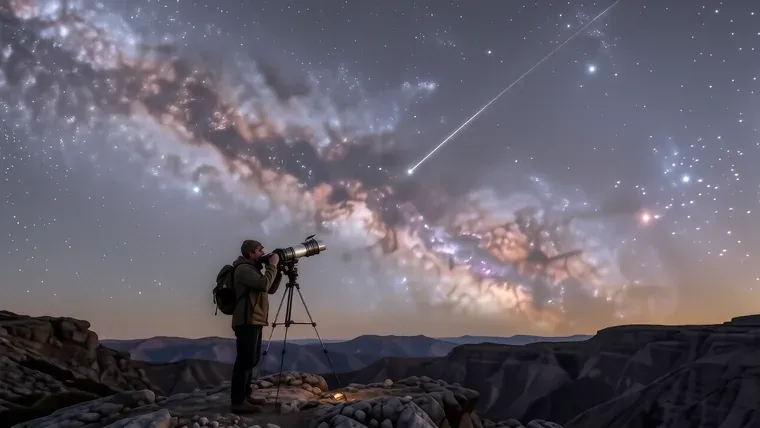
Shooting stars are not stars. They are small fragments of rock or ice, known as meteoroids, that enter Earth’s atmosphere and burn up due to friction. While the term suggests a stellar descent, actual stars remain at massive distances because their gravitational influence is negligible compared to the forces holding them in orbit.
The Mechanics of Atmospheric Entry
Meteors ignite upon contact with air. Most become visible at an altitude of approximately 96.5 kilometers. This heat occurs because the high-velocity object compresses the surrounding nitrogen and oxygen, creating intense friction that can raise temperatures to 1,648 degrees Celsius.
The process is violent. Although many fragments vaporize completely, larger masses survive the descent to strike the ground as meteorites.
A fireball is a bright event. These specific meteors can shine more brightly than Venus while they traverse the sky at speeds reaching 48,280 kilometers per hour.
Most objects are small. They often resemble grains of sand, so they disintegrate long before they reach the surface.
The Earth collects much debris. NASA and other researchers estimate that approximately 44,000 kilograms of meteoric material arrive on our planet every single day.
Composition and Classification
Space travelers vary in chemistry. Meteoroids consist of metals, carbon, or silicates like olivine and pyroxene. Because these alloys often differ from terrestrial compositions, they provide a chemical record of the early solar system.
Iron meteorites are dense. They contain iron mixed with nickel traces because these elements frequently bond in the vacuum of space.
Stone fragments are common. If a scientist cuts a stony meteorite, they might see chondrules, which are small, granular inclusions formed during the cooling of the parent body.
Classification depends on survival.
- Meteoroid: The object in space.
- Meteor: The light streak in the atmosphere.
- Meteorite: The physical rock on the ground.
Predictable Meteor Streams
Earth crosses debris trails. These paths often follow the orbits of comets or asteroids so that we see them at the same time every year. Astronomers have verified 64 specific meteor streams, although over 300 others remain unconfirmed by formal observation.
The Perseids are reliable. They peak around August 12 because Earth passes through the debris trail left by the Swift-Tuttle comet.
Radiant points exist. A meteor shower appears to originate from a single point in a constellation, which is how we name the specific event.
The Leonids offer intensity. While they occur every November, they can produce massive storms every 33 years when the debris density is highest. The last major storm occurred in 2002, so observers are watching for the next peak in 2028.
Some showers come from asteroids. The Geminid shower originates from the near-Earth asteroid 3200 Phaeton, whereas most other streams derive from icy comets.
Historical and Scientific Impact
Ancient people feared them. Many cultures viewed these lights as divine omens because they appeared suddenly during the dark of night.
The Ensisheim meteorite is old. It fell on November 7, 1492, in France, and it remains a well-documented stone specimen in Europe.
Large impacts change landscapes. A massive iron meteorite hit the Colorado Plateau approximately 50,000 years ago to create the Barringer Crater in Arizona.
The Tunguska event was devastating. On June 30, 1908, an object exploded over Siberia and uprooted trees across 2,000 square kilometers because the air resistance caused a mid-air detonation.
Scientific study yields data. The Allende meteorite, which fell in 1969, is roughly 4.56 billion years old so that it provides a window into the solar system’s birth.
Notable Meteorite Discoveries
The Goba meteorite is massive. It weighs 60 tons and consists mostly of nickel and iron because it crashed in Namibia 80,000 years ago.
Murchison provides organic clues. Scientists found 14,000 organic compounds within this Australian specimen, including 70 different amino acids.
The Chelyabinsk event was sudden. On February 15, 2013, a 17-meter rock exploded 12 to 15 miles above Russia and injured over 1,000 people.
Some meteorites are rare. Collectors seek specific minerals like pangite, which was identified in a 5-ton meteorite that fell in Chihuahua, Mexico, in 1696.
The ocean hides many. Since two-thirds of Earth is water, most fallen fragments land in the sea where they remain difficult to recover.
Observing the Night Sky
Darkness improves visibility. Light pollution from cities obscures faint streaks, so observers should seek rural locations far from urban centers.
Moonlight affects viewing. A full moon can wash out smaller meteors, although a new moon provides the darkest possible background for observation.
Timing is everything. Most showers are best viewed in the early morning hours after midnight because that is when your location on Earth faces the direction of its orbital path.
Preparation helps success.
- Use a reclining chair.
- Avoid looking through telescopes.
- Stay warm during winter months.
The sky remains active. Even without a major shower, individual meteors occur nightly as the planet moves through the solar system’s dust.
Frequently asked questions
What is the difference between a meteoroid, a meteor, and a meteorite?
A meteoroid is an object in space, a meteor is the light streak seen in the atmosphere, and a meteorite is the physical rock that survives to hit the ground.
How fast do shooting stars travel through the atmosphere?
Fireballs can traverse the sky at speeds reaching 48,280 kilometers per hour during their descent.
How much meteoric material does Earth collect every day?
Researchers from NASA estimate that approximately 44,000 kilograms of meteoric material arrive on our planet every single day.
What causes a meteor to ignite and glow?
Meteors ignite due to intense friction caused by high-velocity objects compressing nitrogen and oxygen, which can raise temperatures to 1,648 degrees Celsius.
More in Stars
How far away is the nearest star in light years?
Discover how far Proxima Centauri is from Earth and learn about its physical characteristics, planetary system, and distance measurements.
Methods used by scientists to calculate the distance to stars
Explore how astronomers use the cosmic distance ladder, from trigonometric parallax to standard candles and redshift, to measure stellar distances.
Reasons for the descent of stars from the heavens and their final
Learn why meteoroids appear as falling stars, how friction creates light during atmospheric entry, and where these cosmic fragments ultimately end up.
Is the Big Dipper the most luminous star?
Learn why the Big Dipper is an asterism in Ursa Major and explore the distinct magnitudes and distances of its seven primary stars.