Is the Big Dipper the most luminous star?
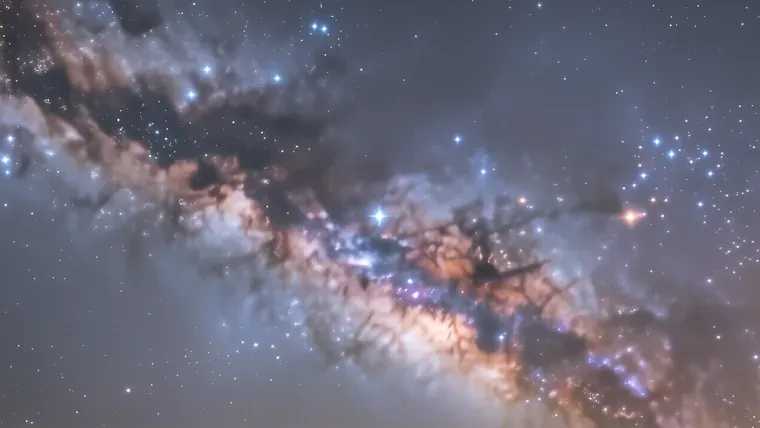
The Big Dipper is not a single constellation but an asterism within the much larger Ursa Major. It consists of seven bright stars that form a recognizable pattern resembling a ladle or bucket. While many people call it a constellation, it actually occupies only a small portion of the 1280 square degrees that define Ursa Major. The stars Dubhe and Merak act as pointers because they provide a direct line to Polaris, which is the primary reference star for the northern sky.
Stellar Composition and Magnitude
The seven primary stars possess distinct physical properties. They are not all the same distance from Earth. Most of these stars sit approximately 120 light-years away from our solar system, although individual distances vary significantly across the group. Dubhe is a red giant located 125 light-years away. It has an apparent sidereal magnitude of 1.8.
Aliot is another bright member. This white star is 108 times more luminous than our Sun so that it remains easily visible to the naked eye even in moderately light-polluted areas. It holds a magnitude of 1.8. The stars are diverse. Merak sits at about 80 light-years away, while Megrez functions as a blue dwarf located more than 80 light-years from Earth.
The brightness levels differ slightly among the group. Six stars in the bucket have a magnitude near 2. Megrez is dimmer. It has a magnitude of 3. This difference becomes apparent after you observe the grouping through small binoculars or a telescope.
Alkaid finishes the handle. This blue dwarf star sits approximately 100 light-years away. Its name translates to “the end of the tail” in various Arabic traditions.
The group moves. A moving cluster exists within these stars because they share common motion across the celestial sphere. This cluster includes five stars: Merak, Fekda, Megretz, Aliot, and Mitsar. Dubhe and Benetnash move in the opposite direction. This divergence means the shape of the ladle will change significantly over a span of 100,000 years.
Navigation and Celestial Reference
The Big Dipper helps travelers. It provides a reliable way to find the North Star. You must connect the two outermost stars of the bucket, Dubhe and Merak, to find Polaris. This method works well in the northern hemisphere.
Arcturus is nearby. If you follow an arc formed by Aliot, Mizar, and Benetnash, you will find Arcturus. This star is the brightest located north of the celestial equator. The arc continues south toward Spica in the constellation Virgo.
The stars guide us. Many cultures used these lights for orientation before modern tools existed. For example, the “Three Leaps of the Gazelle” asterism consists of three sets of closely positioned stars: Alula North and South, Taniyah North and South, and Talitha North and South. These pairs appear in a straight line so that they resemble the hoofprints of a leaping animal.
Mizar is famous. It forms a double star system with its companion, Alcor. Giovanni Riccioli identified this as a double star in 1650. Some people believe Galileo observed it as early as 1617.
Visual acuity tests are common. You can spot the 4th magnitude star Alcor next to Mizar. It is often called “the rider” in various folklore traditions. If you cannot see Alcor, your vision might be slightly below average for a clear night.
Cultural History and Mythology
Legends vary widely. The Greeks tell the story of Callisto. Zeus fell in love with her because she was a beautiful nymph serving Artemis. Hera became jealous and transformed Callisto into a bear.
The hunter Arkas appears later. He unknowingly tried to hunt his mother, so Zeus transformed him into a smaller bear to save him. Zeus placed them both in the sky as Ursa Major and Ursa Minor. This myth explains why the two dippers appear near each other.
Greenlandic stories differ. A hunter named Eriulok lived in a snow-covered dwelling. He was an arrogant man who preferred solitude over his tribe. He eventually sought help from the goddess Arnarkuachssak to cure his loneliness.
The goddess demanded a price. She required a ladle filled with magical berries to restore her youth. After Eriulok retrieved the vessel, the goddess gave him a wife and a family. She threw the empty ladle into the sky so that it snagged on an object and became a constellation.
Names change by region.
- The Germans call it the Great Basket.
- The Chinese name is the Imperial Chariot.
- The Dutch refer to it as the Saucepan.
- In Russia, the North calls it “Sokhaty” or the Elk.
- The Evenks use the term “Moose Haglen.”
Deep Sky Observations
The Big Dipper contains more than seven stars. There are approximately 125 stars within the full constellation of Ursa Major. Most of these appear as faint points of light.
Deep space is visible here. A Hubble Ultra Deep Field image was captured in a region near the star Megrez. This area is only one-twelfth the size of the lunar disk. It shows numerous galaxies that are billions of light years away from Earth.
Specific galaxies exist here. Scientists identified two very distant galaxies within this constellation. The galaxy GN-z11 has light that traveled for 13.4 billion years to reach us. Another galaxy, z8 GND 5296, has a travel time of 13.02 billion years.
Red dwarfs are close. Laland 21185 is a red dwarf near Alula Severnaya. It is one of the closest star systems to Earth, even though it is invisible to the naked eye. It sits closer to the Sun than Sirius A and B.
Binoculars reveal more. You can observe Groombridge 1830 with optical aid. This star moves about a third of the lunar disk over a century because its proper motion is quite high.
Seasonal Visibility and Position
The sky changes daily. The Big Dipper is circumpolar in many northern latitudes. This means it never sets below the horizon in places like Moscow or parts of Canada.
Spring offers the best views. In March and April, the constellation reaches its highest point in the sky. Observers in the middle latitudes can see it directly overhead during late April nights.
The position shifts through the seasons.
- In January, it sits in the northeast at an angle of 30-70°.
- In June, it moves to the northwest at 40-70°.
- In August, it stays low near the northern horizon.
- In October, the bucket tilts upward between 10-30°.
The stars move through the night. During a single winter evening, the constellation follows a semicircular path. It might appear in the northeast at dusk but will reach the northwest by morning.
Finding it is simple. Start by looking north and searching for the seven bright points. Once you find the handle, you can use the pointers to orient yourself toward the North Star.
The Big Dipper remains a fundamental tool for anyone looking upward. Whether you are using a professional telescope or just your eyes, the pattern provides a constant reference point in an ever-changing sky.
Frequently asked questions
Is the Big Dipper a constellation?
No, the Big Dipper is an asterism located within the much larger Ursa Major constellation, which covers 1280 square degrees.
How can I find Polaris using the Big Dipper?
You can find the North Star by following a direct line from the two pointer stars, Dubhe and Merak, which form the outer edge of the bucket.
What is the distance of the stars in the Big Dipper?
Most of these stars are approximately 120 light-years away, though individual distances vary; for example, Dubhe is 125 light-years away and Merak is about 80 light-years away.
Is Mizar a single star?
Mizar is a famous double star system that forms a pair with its companion, Alcor, which can be seen as a 4th magnitude star by those with good visual acuity.
More in Stars
How far away is the nearest star in light years?
Discover how far Proxima Centauri is from Earth and learn about its physical characteristics, planetary system, and distance measurements.

Methods used by scientists to calculate the distance to stars
Explore how astronomers use the cosmic distance ladder, from trigonometric parallax to standard candles and redshift, to measure stellar distances.

Reasons for the descent of stars from the heavens and their final
Learn why meteoroids appear as falling stars, how friction creates light during atmospheric entry, and where these cosmic fragments ultimately end up.
Shooting stars: An enigmatic phenomenon explained
Discover the science behind shooting stars, from the mechanics of atmospheric entry to the chemical composition of meteorites and predictable meteor showers.