What an incredible creature the bear is in nature and sky
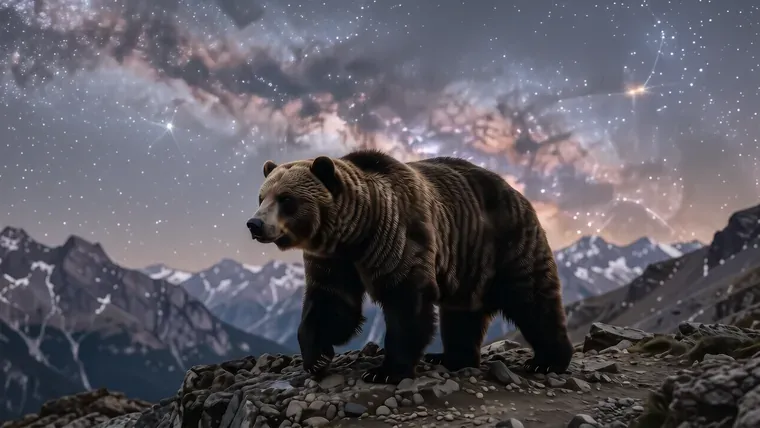
The bear exists as a biological predator and a celestial marker. In the physical world, Ursidae species range from the 40 kg Malayan bear to the 1,000 kg polar bear. In the sky, the constellations Ursa Major and Ursa Minor provide essential navigation points because they contain Polaris, which remains fixed near the North Celestial Pole while other stars rotate around it.
Biological Characteristics of Ursidae
Bears are heavy animals. They possess thick necks and large, round heads that support powerful jaws for varied diets. Most species can grow between 1.2 and 3 meters in length after they reach full maturity. A bear might weigh as little as 40 kg or as much as 1,000 kg because nutritional availability varies significantly across their global habitats.
Their senses differ. While bears often have poor vision and hearing, their sense of smell is highly developed for tracking prey. This olfactory precision allows them to detect faint scents from great distances so that they can navigate dense forests with high accuracy. They are efficient hunters.
The skin color varies. Polar bears possess black skin beneath their white fur because this pigmentation helps them absorb solar radiation in Arctic environments. Brown bears typically have gray skin. Some individuals experience hair loss, such as a female named Dolores at the Leipzig Zoo.
Physical movement is versatile. Every bear species can swim long distances, although polar bears swim faster due to their webbed paws. They also scale trees in seconds. This agility makes them effective predators in both aquatic and terrestrial settings.
Species and Habitats
Eight primary species exist. The polar bear is the largest, reaching lengths of 3 meters in the northernmost reaches of the planet. These animals inhabit the Arctic. They rely almost exclusively on live prey because frozen environments offer very few berries or plant-based alternatives.
Grizzlies are smaller. Native to North America, particularly Alaska, these bears can reach 2.8 meters and weigh 600 kg. They often hunt near rivers. Their long claws help them catch fish, which provides a vital protein source during specific seasonal windows.
The Malayan bear is tiny. It measures no more than 1.5 meters and lives in Indonesia, China, or Thailand. This species features a white patch on its chest. It is considered one of the oldest lineages because DNA analysis shows close ties to ancient ancestral forms.
Other bears occupy niche roles. The spectacled bear lives in South America, specifically in Colombia and Peru, where yellow rings surround its eyes. Himalayan bears inhabit regions like Tibet and Afghanistan. They eat insects and frogs when these are abundant in their local ecosystems.
The black bear, or baribal, is common in North America. It grows to about 2 meters. While it looks similar to the brown bear, its smaller stature and darker coat distinguish it in forested habitats.
The Mechanics of Hibernation
Bears prepare for winter. In autumn, they consume massive amounts of food to accumulate fat reserves because surviving the cold requires significant energy. Some bears eat up to 200 kg of food before entering dormancy. They must reach a specific weight or they might wake up too early.
Hibernation is deep. During this period, which can last 200 days, their bodily functions decelerate by 55%. Their heart rate drops from 50–55 beats per minute to only 8 beats per minute. This state of anabiosis allows them to survive without eating or drinking.
Denning is essential. Bears use caves, ravines, or hollow logs for shelter. They do not need much insulation because their thick fur retains heat effectively. A bear will camouflage its entrance so that other predators cannot easily find the den.
Hibernators face risks. If a bear emerges prematurely due to low fat reserves, it faces extreme hunger. These animals become highly aggressive. They may lunge at any movement they detect while searching for food in the snow.
Celestial Ursa Major and Ursa Minor
The stars form shapes. In the northern sky, the Big Dipper consists of seven bright stars that resemble a ladle or a carriage. Many cultures identified these stars as part of a larger bear. The Greeks named it Ursa Major after the myth of Callisto.
Ursa Minor is smaller. It contains Polaris, which is the most luminous star in the constellation with an apparent magnitude of 1.985. This star stays fixed near the north pole. Navigators use it because its position remains constant while the rest of the sky rotates.
The stars have names. Kohab, or Beta Ursae Minoris, is an orange giant located 130.9 light-years away. It was used as a polar star between 1500 B.C. and 500 A.D. because it sat closer to the pole during that epoch.
The Little Bear is visible year-round in northern latitudes. It borders the constellations Draco, Cepheus, and Camelopardalis. Finding it requires patience. You can locate Polaris by extending a line through the pointer stars, Merak and Dubhe, in the Big Dipper.
The constellation includes many objects. For example, the Small Bear (PGC 54074) is an elliptical galaxy located 200,000 light-years away. It orbits the Milky Way. Hubble Space Telescope observations from 1999 confirmed that this galaxy formed over a period of 2 billion years.
Mythology and Cultural Interpretations
Myths vary widely. Ancient Egyptians associated the Big Dipper with the hip of the god Seth. In China, the stars represented a carriage for the Great Heavenly Emperor. These stories reflect how different civilizations interpreted the same celestial movements.
The Greek tale is famous. It tells of Callisto, a nymph who was transformed into a bear by the goddess Hera. Zeus later placed her and her son, Arcas, in the sky. This created both the Big and Little Bears.
Indian legends offer another view. A boy named Dhruv performed intense meditation to reach the deity Vishnu. Because of his devotion, Vishnu turned him into a radiant star. This star became the Pole Star, remaining fixed in the north.
The stars move slowly. Every 100,000 years, the appearance of the Big Dipper changes significantly. This happens because Dubhe and Benetnash move in different directions than the other five stars. The shape we see today is temporary on a cosmic timescale.
Stellar Data and Deep Space
Polaris is complex. It is not a single star but a multiple star system including Alpha Ursae Minoris A, B, and Ab. The primary component is a yellow supergiant with six times the mass of the Sun. Its brightness has increased since the time of Ptolemy.
Ferkad is also bright. This star, Gamma Ursae Minoris, is an intermediate supergiant located 487 light-years away. It rotates at 180 km/s. Its radius is 15 times larger than our Sun.
Deep space objects reside nearby. Messier 81 is a spiral galaxy situated 11.8 million light-years from Earth. It was discovered in 1774 by Johann Bode. Nearby, Messier 82 shows an accelerated star formation rate because a collision with Messier 81 occurred 200 million years ago.
The Owl Nebula (M 97) is another target. Pierre Mechene first observed it in 1781. It sits 2,300 light-years away. Its two bright spots look like eyes, which gives the nebula its name.
The stars provide a map. By using the Big Dipper as a reference, anyone can find the north. You simply extend the line from Merak and Dubhe five times the distance between them. This method has guided sailors for centuries.
Conservation and Biology
Bears face threats. Poaching remains a challenge for many species despite international protections. The brown bear is listed in the Red Book as a protected species. While they are not currently extinct, their population growth is slow.
Conservation efforts exist. In 1975, several nations began initiatives to protect brown bears. They breed cubs in reserves so that they can be reintroduced to the wild as adults. Currently, about 205,000 brown bears live on Earth.
Russia holds many bears. Approximately 130,000 of the global brown bear population resides there. This large number provides a buffer for the species. However, habitat loss still impacts their ability to roam freely.
Zoological care is specific. Enclosures must include rocks, soil, and logs to mimic natural environments. Providing seasonal diets is necessary because bears require different nutrients throughout the year. A small pool can also improve their well-being.
The bear remains a dominant figure. Whether in the forest or the stars, the image of the bear persists. Its physical strength and its celestial position both command attention from those who study the natural and cosmic worlds.
Frequently asked questions
How much do different bear species weigh?
Bear weights vary significantly, ranging from the 40 kg Malayan bear to the 1,000 kg polar bear.
What happens to a bear's heart rate during hibernation?
During deep hibernation, a bear's heart rate can drop from 50–55 beats per minute to only 8 beats per minute.
How can you find Polaris using the Big Dipper?
You can locate Polaris by extending a line through the pointer stars, Merak and Dubhe, in the Big Dipper.
What is the distance to the star Kohab?
Kohab, or Beta Ursae Minoris, is an orange giant located 130.9 light-years away.
More in Constellations
How to see the appearance of Cassiopeia in the night sky
Learn how to identify the W-shaped Cassiopeia constellation and locate deep sky objects like M52, M103, and the Cas A supernova remnant.
The best time to observe the Hydra constellation
Discover the ideal months for viewing the Southern Hydra constellation and learn about its brightest stars, nearby galaxies, and visibility requirements.

Through which constellations does the sun pass?
Discover the thirteen astronomical constellations the Sun traverses along the ecliptic, including Ophiuchus, and how they differ from astrological signs.

What is the location of the Orion constellation in relation to the
Discover how to locate the Orion constellation relative to the Big Dipper and learn celestial navigation techniques using Polaris and the winter sky.