How to see the appearance of Cassiopeia in the night sky
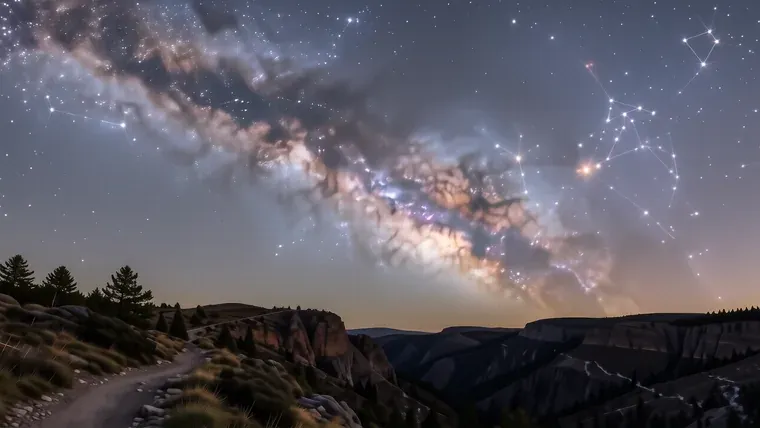
Cassiopeia is a circumpolar constellation located in the northern sky that forms a distinct “W” or “M” shape using five primary stars. It remains visible throughout the year from mid-northern latitudes because its position is tied to the rotation of the Earth around the North Celestial Pole. The most favorable viewing window occurs between September and November when the asterism reaches its highest point near the zenith.
Stellar Composition and Geometry
The constellation’s shape is defined by five bright stars. These are α Cas, β Cas, γ Cas, δ Cas, ε Cas, and ζ Cas. They possess magnitudes between 2 and 3. This range ensures they remain visible even in moderately light-polluted skies.
Shedar, or α Cassiopeiae, is the brightest member. It has a magnitude of 2.2. The star Navi, known as γ Cassiopeiae, is a variable star. Its brightness fluctuates between 1.6 and 3.0 magnitudes over a cycle of roughly 50 years.
The pattern changes based on the time of night. In the autumn, the “W” shape sits high above the observer. During the spring, the constellation appears as an “M” because it is oriented differently relative to the horizon.
- α Cas (Shedar): Magnitude 2.2
- γ Cas (Navi): Variable star
- δ Cas (Rukbah): Part of the main asterism
- β Cas (Kaf): Forms the second peak of the “W”
Deep Sky Objects in the Milky Way
Cassiopeia lies within the summer Milky Way. This placement results in a high density of diffuse objects. There are over twenty exceptional star clusters in this region. A wide-field refractor with an aperture of at least 100mm is ideal for these targets.
Messier identified two specific clusters in this area. These are M52 and M103. Many other objects exist that were not included in his original catalog.
M52 (NGC 7654) sits near the line connecting α and β Cas. If you extend that line toward the North-Northwest, you will find it. Through binoculars, it looks like a bright, shimmering haze. It contains about twelve stars arranged in two chains. One chain forms an inverted “U” shape while the other forms a “V”.
Observing M52
A telescope reveals more detail. You can see approximately twenty stars within the cluster. These stars surround a sparkling fog of unresolved light. At the southwestern edge, a star with a magnitude of 7 or 8 is visible. Using 40x to 50x magnification allows you to see a compressed spot in the northeast.
The M103 Cluster
M103 (NGC 581) is located near Rukbah (δ Cas). It sits about one degree east-northeast of that star. Charles Messier described it simply as an ordinary cluster of stars. He added it to his catalog late in his career.
The stars in M103 are relatively young. They have an estimated age of 25 million years. Their high metallicity suggests they formed from gas enriched by previous stellar generations.
- M52: Open cluster near α and β Cas
- M103: Located near δ Cas
- NGC 663: A noteworthy open cluster nearby
- NGC 457: An open cluster in the region
The Complex Neighborhood of NGC 663 and M103
The sky around M103 is crowded. Less than two degrees to the east-northeast, three dispersed groups form an isosceles obtuse triangle. These are NGC 654, NGC 659, and NGC 663.
NGC 654 is small. It contains only about twelve stars with magnitudes between 8 and 9. NGC 659 also lacks significant visual detail for casual observers.
NGC 663 is different. It is a much more significant object for those using a fast refractor or powerful binoculars. The cluster appears dense and bright compared to its neighbors.
M103 requires specific magnification. While many think scattered clusters need low power, M103 benefits from 40x magnification. At this level, you can count more than fifty stars. A central chain of stars in the southwestern region is often called the “Horseshoe” asterism.
Supernovae and Remnants
Cassiopeia contains one of the most famous supernova remnants in the galaxy. In 1572, Tycho Brahe observed a “new star” near κ Cas. This star was actually a supernova. It remained visible for sixteen months before it faded.
The remnant is now known as Cassiopeia A, or Cas A. It is located between β Cas and δ Cephei. This object is a powerful source of galactic radio emission.
The diameter of the remnant is nearly 20 light-years. Scientists estimate the explosion occurred around 1667 based on the expansion rate. In 1951, red-sensitive photographic plates captured fragments of this radio nebula.
The W5 Star-Forming Region
The W5 region (IC 1848) is another major feature. It is a massive star-forming area. The Spitzer Space Telescope has captured this region in infrared light.
This area contains the “Mountains of Creation.” These are structures within the gas clouds that look like peaks. They are part of the larger IC 1848 complex.
- Cas A: Supernova remnant from 1572
- W5: Star-forming region (IC 1848)
- Bubble Nebula: NGC 7635, a large gas sphere
- Sharpless 2-188: A nebula resembling the Mozilla Firefox logo
Galactic Neighbors and Satellite Galaxies
The constellation hosts objects that are not part of our galaxy. These include dwarf elliptical galaxies. NGC 147 and NGC 185 are satellites of the Andromeda Galaxy. They appear as small, fuzzy patches in a telescope.
The Bubble Nebula (NGC 7635) is also present. It is a massive sphere of gas. The nebula creates a distinct shape that is easily distinguishable from star clusters.
Other nebulae exist in this sector. IC 1805 and IC 1795 are associated with specific radio sources. These objects demonstrate the chemical diversity of the Cassiopeia region.
Navigating the Northern Sky
Finding Cassiopeia is straightforward. You can use the Big Dipper as a guide. Draw a line from ζ Ursae Majoris to Polaris. This path will lead you toward the constellation.
The Big Dipper and Cassiopeia are almost diametrically opposite around Polaris. In the fall, the Big Dipper stays low while Cassiopeia rises high. During the spring, the positions swap.
This relationship makes them excellent markers for celestial navigation. If you know where the Dipper is, you know where the Queen is.
Historical and Cultural Context
The constellation appears in the Almagest by Claudius Ptolemy. It has been recognized for centuries. In Greek myth, Cassiopeia was the wife of King Cepheus.
She was often depicted as being punished for her vanity. She was tied to a chair and forced to rotate around the pole. This rotation explains why she is circumpolar.
Arabic manuscripts used a different name. They called it “The Sitting Woman.” This name came from the way the stars looked like a hand pointing toward the sky.
Literature also references the constellation. Stephen King mentions “Cassie, the lady in the rocking chair” in The Green Mile. The character John Coffey uses this folkloric description to describe the stars.
Observational Summary
To see the best of Cassiopeia, use a telescope or binoculars. Focus on the W-shaped asterism first. This provides the context for the deeper objects.
The clusters M52 and M103 are the primary targets. Use 40x magnification for M103 to resolve the stars. For M52, look for the “U” and “V” shaped chains of stars.
The supernova remnant Cas A requires radio astronomy or specialized equipment for full study. However, its location is easy to find near β Cas. The constellation remains a cornerstone of northern hemisphere astronomy because of its brightness and constant presence.
Frequently asked questions
When is the best time to view Cassiopeia?
The most favorable viewing window occurs between September and November when the constellation reaches its highest point near the zenith.
What stars make up the shape of Cassiopeia?
The distinct W or M shape is formed by five primary stars, including Shedar (alpha Cas) with a magnitude of 2.2 and the variable star Navi (gamma Cas).
What deep sky objects are located in Cassiopeia?
The region contains several notable objects, including the M52 and M103 open clusters, the Cas A supernova remnant, and the W5 star-forming region.
How can I find Cassiopeia in the northern sky?
You can use the Big Dipper as a guide by drawing a line from zeta Ursae Majoris toward Polaris to lead you to the constellation.
More in Constellations
The best time to observe the Hydra constellation
Discover the ideal months for viewing the Southern Hydra constellation and learn about its brightest stars, nearby galaxies, and visibility requirements.
Through which constellations does the sun pass?
Discover the thirteen astronomical constellations the Sun traverses along the ecliptic, including Ophiuchus, and how they differ from astrological signs.
What an incredible creature the bear is in nature and sky
Explore the dual nature of bears as biological predators like the polar bear and celestial markers such as the Ursa Major constellation.
What is the location of the Orion constellation in relation to the
Discover how to locate the Orion constellation relative to the Big Dipper and learn celestial navigation techniques using Polaris and the winter sky.