What is the color of the North Star?
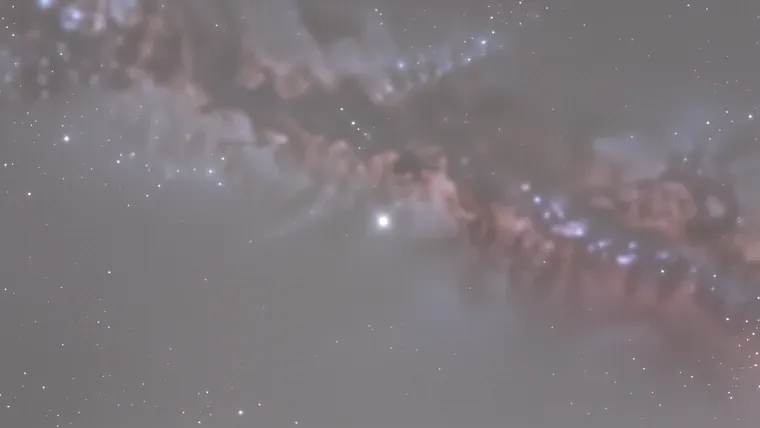
Polaris appears white or slightly yellowish to the naked eye. This visual impression stems from its classification as an F7Ib spectral type supergiant, which means it emits most of its light in the yellow-white part of the spectrum. The star is not a single point of light. It consists of a complex triple system that influences how we perceive its luminosity and color through atmospheric interference.
The Spectral Nature of Polaris
The primary component, Polaris Aa, dominates the visual appearance. It is a yellow supergiant. Although it radiates intensely, the specific temperature of an F7Ib star places its peak emission in a range that human eyes interpret as a steady, bright white with a subtle warm tint. This color remains relatively stable despite the star’s inherent variability.
The star pulsates. Because Polaris Aa is a classical Cepheid variable, its brightness and temperature fluctuate over a period of approximately 3.97 days. These pulsations cause slight shifts in the perceived color as the stellar surface heats and cools during each cycle. Astronomers have noted that the temperature variations range from less than 50 K to at least 170 K.
The amplitude of these changes is shrinking. Before 1963, the brightness fluctuations exceeded 0.1 stellar magnitude, but the amplitude decreased rapidly after 1966 until it fell below 0.05 magnitudes. This reduction in variability makes the star appear more constant to casual observers than it was in previous centuries.
The color is consistent. While the temperature shifts slightly, the overall spectral class remains firmly within the F-type category.
A Triple Star System
Polaris is actually three stars. It is a hierarchical system. In August 1779, William Herschel used his reflector telescope to discover the companion star, Polaris B, which orbits the central pair at a distance of 2400 astronomical units. This outer component is much fainter than the primary supergiant.
The central pair is also a binary. Polaris Aa and its close companion, Polaris Ab, orbit each other very tightly. In January 2006, images from the Hubble Space Telescope resolved these two distinct members of the host system. The separation between Aa and Ab is only 0.17 arcseconds.
The masses vary significantly. Polaris Aa has a mass of approximately 5.4 solar masses (M☉), while its close companion Ab has a mass of 1.26 M☉. Polaris B is a main-sequence star with a mass of 1.39 M☉. This distribution of mass affects the orbital dynamics of the entire system.
The system is complex. Astronomers continue to refine the orbital parameters. For example, in 2019, R.I. Anderson determined an orbital period of 29.32 ± 0.11 years for the Polaris A system because the precision of modern radial velocity measurements allows for such tight constraints.
The components are distinct.
- Polaris Aa: F7Ib yellow supergiant.
- Polaris Ab: F6 main-sequence star.
- Polaris B: F3 main-sequence star.
Distance and Parallax Discrepancies
Measuring the distance to Polaris is difficult. It is far away. While the Hipparcos satellite provided a measurement of approximately 433 light-years (133 parsecs) in the 1990s, other studies have suggested much closer values. Some researchers have proposed distances as close as 323 light-years based on high-resolution spectral analysis.
Gaia provides new data. The Gaia mission changed everything. After the publication of the Gaia Early Data Release 3 on December 3, 2020, the distance to Polaris B was refined to 137.2 ± 0.3 pc (447.6 svL). This measurement offers a more precise anchor for the cosmic distance ladder than previous satellite data.
The discrepancy persists. Scientists disagree on the exact value. Some models suggest the star is closer because the parallax measurements of bright, pulsating Cepheids like Polaris can be influenced by the star’s own atmospheric motions. This creates an uncertainty that spans roughly 35% of the total distance.
The distance matters for science. Because Polaris is the nearest Cepheid variable to Earth, it acts as a fundamental calibrator for measuring the scale of the universe. If we cannot pin down its exact distance, our estimates for more distant galaxies will remain slightly imprecise.
The numbers vary.
- Hipparcos (1990s): ~434 light-years.
- Turner (2006): ~330 light-years.
- Gaia EDR3 (2020): ~447.6 light-years.
Precession and the Moving Pole
The North Star is not permanent. The Earth wobbles. This movement, known as the precession of the equinoxes, causes the celestial pole to trace a large circle in the sky over a 25,700-year cycle. Consequently, different stars will take turns acting as the primary navigational marker for northern observers.
Polaris is currently near the pole. It is not perfectly aligned. In 2018, Polaris was located 0.66 degrees away from the center of rotation, which is about 1.4 times the angular diameter of the Moon. It follows a small circular path with a diameter of 1.3 degrees.
The proximity will change. The star will reach its closest point to the North Pole on April 23, 2102. After this date, the celestial pole will begin to drift away from Polaris because the Earth’s rotational axis continues its slow, circular migration through space.
History shows different poles. Ancient astronomers looked at different targets. Around 2750 BC, the star Tuban served as the polar star, while during classical antiquity, the pole was closer to Cochabus (β UMi) than to Polaris. In approximately 12,000 years, the bright star Vega will become the new North Star.
The shift is slow. You cannot see it happening. However, over several centuries, the position of the “fixed” star in the sky changes significantly enough to require updated navigational tables.
Navigational Utility and Cultural Impact
Navigators use Polaris for latitude. It is a reliable tool. By measuring the altitude of Polaris above the horizon, a sailor can estimate their approximate latitude in the Northern Hemisphere. This technique has been used since at least late antiquity to guide ships across open oceans.
The star has many names. It is culturally significant. In the Middle Ages, it was known as stella polaris, while the Lakota people called it “Wičháȟpi owáŋžila,” which translates to “The star that remains still.” These names reflect the star’s perceived stability in a moving sky.
Literature captures its essence. Shakespeare used it as a metaphor. In his play Julius Caesar, written around 1599, Caesar compares his own constancy to the North Star, even though the star was not perfectly stationary during the Roman era. This shows how the star’s reputation often outpaced its actual astronomical position.
The Big Dipper helps find it. Locate the stars Dubhe and Merak. If you extend an imaginary line through these two stars in the constellation Ursa Major approximately five times, you will arrive at Polaris. This method remains the standard rule of thumb for amateur astronomers.
Finding the star is easy.
- Find the Big Dipper.
- Identify Dubhe and Merak.
- Project a line 5x the distance between them.
- Locate the bright star at the end of that line.
The sky continues to rotate around this yellowish-white point while the Earth’s axis slowly drifts toward new celestial neighbors.
Frequently asked questions
What color does Polaris appear to the naked eye?
Polaris appears white or slightly yellowish because it is an F7Ib spectral type supergiant that emits most of its light in the yellow-white part of the spectrum.
How many stars make up the Polaris system?
Polaris is a hierarchical triple star system consisting of the central binary pair Polaris Aa and Ab, along with the distant companion star Polaris B.
How far away is the North Star from Earth?
Distances vary by study, with Hipparcos measuring it at ~434 light-years, while Gaia EDR3 data suggests a distance of approximately 447.6 light-years for Polaris B.
Will Polaris always be the North Star?
No, due to the precession of the equinoxes, the celestial pole shifts over a 25,700-year cycle; in about 12,000 years, the star Vega will become the new North Star.
More in Stars
How far away is the nearest star in light years?
Discover how far Proxima Centauri is from Earth and learn about its physical characteristics, planetary system, and distance measurements.

Methods used by scientists to calculate the distance to stars
Explore how astronomers use the cosmic distance ladder, from trigonometric parallax to standard candles and redshift, to measure stellar distances.
Reasons for the descent of stars from the heavens and their final
Learn why meteoroids appear as falling stars, how friction creates light during atmospheric entry, and where these cosmic fragments ultimately end up.
Shooting stars: An enigmatic phenomenon explained
Discover the science behind shooting stars, from the mechanics of atmospheric entry to the chemical composition of meteorites and predictable meteor showers.