What is the distance between the Earth and the stars?
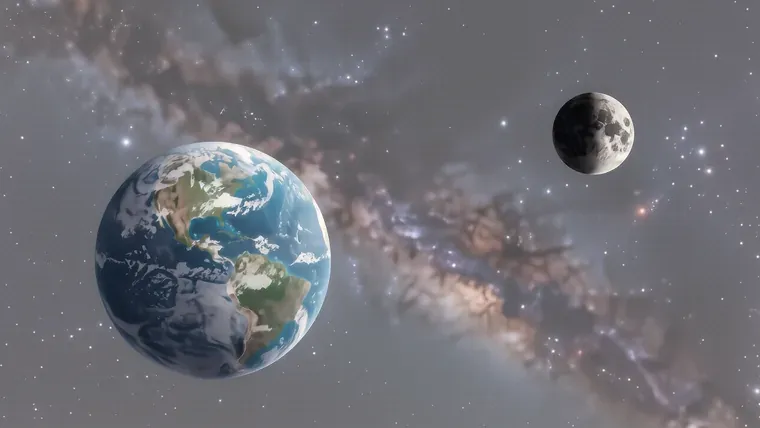
The nearest star to Earth is the Sun. Beyond our solar system, Proxima Centauri sits at a distance of 4.22 light-years because it belongs to the Alpha Centauri triple star system. Measuring the gap between our planet and the stars requires shifting from kilometers to specialized units like parsecs or light-years.
The Cosmic Distance Ladder
Distances in space are immense. We use the astronomical unit (AU) for local measurements. One AU equals 149,597,870,691 meters. This value defines the average distance between Earth and the Sun so that astronomers can calculate planetary orbits with precision. It is a standard.
The scale changes quickly. When we look toward stars, kilometers become useless because the numbers grow too large for practical notation. Astronomers prefer the light-year, which measures the distance light travels in one year. This distance equals 9,460,730,472,580,800 meters. Light moves fast.
Parsecs provide another scale. A parsec, or “parallax of an angular second,” equals 3.26 light-years. Professionals use this unit because it relates directly to the geometric method of trigonometric parallax. It is mathematical.
We measure the Sun’s distance using various methods. In 1672, Jean Dominique Cassini and Jean Richet used the opposition of Mars to estimate the astronomical unit. They compared positions from Paris and Cayenne to create a parallactic triangle. This worked well.
The transit of Venus offered more data. Observations in 1761, 1769, 1874, and 1882 allowed scientists to refine the AU through international cooperation. James Cook led a British expedition in 1769 to observe these transits. They sought accuracy.
Modern precision relies on radar. We use radio signals or lasers to bounce waves off planets or the Moon. Radar measurements of Mars have an error margin of only a few meters. This is exact.
Proximity and Stellar Neighbors
Proxima Centauri is closest. It sits 4.22 light-years away. This red dwarf has a mass less than 0.1 times that of the Sun because it belongs to spectral class M. It is dim.
The Alpha Centauri system is complex. Alpha Centauri A and B orbit each other with a period of 79.9 years. They are 4.36 light-years from Earth although they appear as a single star to the naked eye. They are bright.
Alpha Centauri A is massive. It has 1.1 times the mass of the Sun. Its diameter is 1.2 times larger because it is a G-class yellow dwarf. It is stable.
Barnard’s Star is nearby. It resides 5.96 light-years away in the constellation Serpens. Edward Emerson Barnard discovered it in 1916 while studying stellar motion. He was thorough.
This star moves fast. It has the largest proper motion of any known star at 10.36 angular seconds per year. This speed means it will eventually move closer to our Sun. It is traveling.
Luhmann 16 provides a different perspective. This binary system of brown dwarfs sits 6.59 light-years away in the constellation Sails. Its rotation period spans two decades. It is slow.
- Proxima Centauri: 4.22 light-years
- Alpha Centauri A/B: 4.36 light-years
- Barnard’s Star: 5.96 light-years
- Luhmann 16: 6.59 light-years
Measuring the Void
Trigonometric parallax uses geometry. We observe a star from two different points in Earth’s orbit to create a triangle. This method works for nearby stars although atmospheric interference limits its reach on the ground. It is visual.
Space telescopes improve accuracy. The ESA launched Hipparcos in 1989 to map stars up to 1,000 parsecs. Gaia followed in 2013 with 100 times better precision. It sees everything.
Standard candles help us see further. We use objects with known luminosity to find distances to other galaxies. If we know how bright a star truly is, we can calculate its distance based on its apparent magnitude. This is physics.
Redshift reveals expansion. Edwin Hubble showed that galaxies move away from us at speeds proportional to their distance. The light shifts toward the red end of the spectrum because the space between us is expanding. It is stretching.
A new method uses “twins.” Researchers like Pfeil use stars with identical spectra to estimate distances for remote objects. They compare a known parallax star to its distant twin so that they can bypass statistical errors. This is clever.
We also use the main sequence. Astronomers look at Cepheid variables to measure distances up to 30 megaparsecs. These giant stars pulse predictably. They are reliable.
The Boundary of Space
Where does space begin? The Karman line sits at 100 kilometers. This is the altitude where an object must reach orbital velocity to stay aloft. It is a legal limit.
The atmosphere is thick. The International Space Station orbits between 353 and 400 km within the thermosphere. It is not in a true vacuum because rarefied gases still exist there. It is high.
The exosphere extends further. This layer can reach 10,000 kilometers into the void. It contains hydrogen atoms that drift far from Earth. It is thin.
Solar activity changes things. During intense solar periods, the thermosphere can expand by up to 40,000 kilometers. This expansion happens because the Sun heats the upper atmospheric layers. It fluctuates.
Some define space by gravity. One could argue space begins at 260,000 kilometers where Earth’s gravity yields to the Sun. This transition is gradual. It is complex.
The geocorona is vast. This hydrogen envelope might extend halfway to the Moon. It reaches roughly 190,000 kilometers. It is large.
Planetary Distances in the Solar System
Mercury stays close. It orbits at an average of 0.387 AU. Its distance from Earth varies between 82 and 217 million km. It is hot.
Venus follows Mercury. It maintains an average distance of 0.72 AU from the Sun. This planet has a mass of 4.9 x 10^24 kg. It is dense.
Mars is the fourth planet. Its average orbital distance is 1.5 AU. The closest approach to Earth is 55.75 million km although it can reach 401 million km. It is red.
Jupiter is a giant. It sits 5.2 AU from the Sun. Its mass is 1.9 x 10^27 kg because it formed from a massive amount of gas and dust. It is heavy.
Uranus was found in 1781. William Herschel discovered it at an average distance of 19.18 AU. This planet has a mass 14.54 times that of Earth. It is cold.
Neptune is the furthest major planet. It orbits at 30.1 AU. Johann Halle discovered it in 1846 after mathematical predictions by Urbain Leverrier. It is dark.
Pluto remains distant. It averages 39.44 AU from the Sun. Its mass is only 0.22 times that of Earth because it is a small, icy body. It is tiny.
Farout sits even further. This dwarf planet was found in 2018 at a distance of 120 AU. It orbits the Sun extremely slowly. It is remote.
Frequently asked questions
How far away is the nearest star to Earth?
The Sun is the closest star. Beyond our solar system, Proxima Centauri is the nearest neighbor at a distance of 4.22 light-years.
What units do astronomers use to measure space?
Astronomers use astronomical units (AU) for local measurements, light-years for stellar distances, and parsecs for professional geometric calculations.
How is the distance to stars calculated?
One common method is trigonometric parallax, which uses geometry by observing a star from two different points in Earth's orbit. Other methods include using standard candles and redshift.
At what altitude does space officially begin?
The Karman line is often cited as the boundary of space at 100 kilometers, though the exosphere can extend up to 10,000 kilometers into the void.
More in Stars
How far away is the nearest star in light years?
Discover how far Proxima Centauri is from Earth and learn about its physical characteristics, planetary system, and distance measurements.
Methods used by scientists to calculate the distance to stars
Explore how astronomers use the cosmic distance ladder, from trigonometric parallax to standard candles and redshift, to measure stellar distances.
Reasons for the descent of stars from the heavens and their final
Learn why meteoroids appear as falling stars, how friction creates light during atmospheric entry, and where these cosmic fragments ultimately end up.
Shooting stars: An enigmatic phenomenon explained
Discover the science behind shooting stars, from the mechanics of atmospheric entry to the chemical composition of meteorites and predictable meteor showers.