What is the duration of the journey to Alpha Centauri?
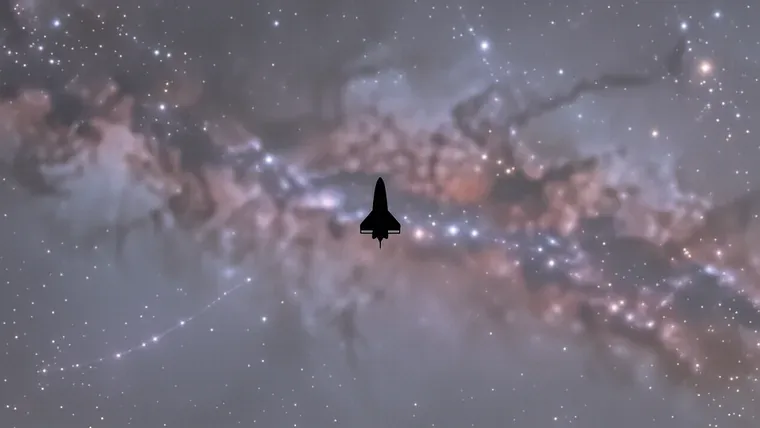
The journey to Alpha Centauri depends entirely on the propulsion method used, as distances of 4.37 light-years require vastly different timescales. Using current chemical rocket technology, a mission would take between 15,000 and 40,000 years because these engines lack the necessary exhaust velocity for interstellar transit. However, theoretical models like the Breakthrough Starshot project aim to reach the system in roughly 20 years by accelerating tiny probes to 20% of the speed of light.
The Physics of Relativistic Travel
Distance is not fixed. It changes based on your velocity because Lorentzian length contraction shrinks the space ahead of a moving observer. If a spacecraft accelerates to 50% of the speed of light, the 4.37 light-year gap appears as only 3.78 light-years to the crew. This contraction happens because the dimensional scale along the axis of motion diminishes as velocity approaches $c$.
Time also warps. An astronaut traveling at relativistic speeds experiences less time than an observer on Earth while they traverse the interstellar void. If the ship accelerates constantly, the “speed of approach” can technically exceed the speed of light in a non-inertial frame. This occurs because the rate of change of the remaining distance includes a dynamic reduction term caused by continuous acceleration.
The math is strange. While the speed of light remains the absolute limit for any object in an inertial frame, the perceived velocity of distant objects can appear superluminal during acceleration. This does not violate Einstein’s postulates because those rules apply to local measurements within a single frame. In a non-inertial, accelerated frame, the geometry of space-time effectively curves, much like the gravity experienced in an Einstein elevator.
Current Propulsion Limitations
Chemical rockets are too slow. A mission using standard propellant would require tens of thousands of years because the energy density is insufficient for high-velocity interstellar flight. We have seen the limits of this technology with the Parker Solar Probe, which reached 343,000 km/h in 2018 to study the Sun. Even at that speed, reaching Alpha Centauri would take approximately 15,000 years.
Ion engines offer more efficiency. The Dawn spacecraft demonstrated this by reaching 39,900 km/h in 2016 using xenon ions. While ion engines provide steady thrust, they are still inadequate for rapid interstellar transit because their acceleration is extremely low. To reach half the speed of light using only ion propulsion, a ship would need roughly 4,900 years of continuous thrusting.
Gravity assists help. We use planetary bodies to sling spacecraft outward, although this method only provides a minor boost compared to the vastness of the target distance. Helios 2 reached 253,000 km/h through such maneuvers. Even with these boosts, the journey remains a multi-generational undertaking that exceeds human lifespans.
- Chemical propulsion: 15,000+ years
- Ion propulsion: ~4,900 years (to reach 0.5c)
- Gravity assist: ~18,000 years
Breakthrough Starshot and Light Sails
Small probes change the math. The Breakthrough Starshot project, proposed by Yuri Milner and Stephen Hawking in 2016, focuses on “StarChips” rather than heavy manned vessels. These thumb-drive-sized probes would use massive light sails to catch laser beams. A ground-based laser array with 100 GW of power could push these chips to 20% of the speed of light.
The speed is high. At 60,000 km/s, the probe reaches Alpha Centauri in about 20 years because the mass is kept extremely low. This approach avoids the massive fuel requirements that plague traditional rockets. However, a collision with even a microscopic dust grain would destroy the probe instantly during its transit.
Deceleration remains a problem. Most current Starshot designs assume the probe will simply fly past the target system after its high-speed transit. If we want to study the stars closely, we need a way to slow down. Researchers like René Heller and Michael Hippke from the Max Planck Institute suggest using the star’s own radiation to brake.
The Heller-Hippke Deceleration Method
The method uses photons. A light sail can harness the radiation pressure from Alpha Centauri A to reduce its velocity as it approaches the system. This technique allows for a controlled deceleration without carrying heavy onboard propellant. If the maneuver succeeds, the probe could enter an orbit around the star after traveling at 4.6% of the speed of light.
The timing is tight. To be captured by Alpha Centauri A, the probe must approach within approximately 4 million kilometers of the star’s surface. This requires extreme precision because any error in the deceleration timing would send the probe flying back into deep space. If successful, the mission could then proceed to study Proxima Centauri or Alpha Centauri B.
The Alpha Centauri System
It is a triple system. Alpha Centauri consists of two bright stars, A and B, and a distant red dwarf called Proxima Centauri. Alpha Centauri A and B orbit each other every 80 years while maintaining a distance of about 23 astronomical units. This distance is roughly 23 times the gap between Earth and the Sun.
Proxima Centauri is closer. Although it is part of the system, it sits 4.22 light-years from Earth, making it the nearest individual star. It is a small red dwarf with a mass only 0.123 times that of our Sun. Because its luminosity is so low, it is not visible to the naked eye from Earth.
Planets may exist there. In 2016, astronomers discovered Proxima Centauri b, an Earth-mass exoplanet orbiting in the habitable zone. The planet has an orbital period of 11.2 days and sits only 7.3 million kilometers from its host star. While the temperature might allow for liquid water, the intense X-ray flares from the red dwarf could make life difficult.
- Alpha Centauri A: Yellow dwarf, 0 magnitude
- Alpha Centauri B: 0.9 solar masses, 1st magnitude
- Proxima Centauri: Red dwarf, 11th magnitude
- Proxima b: 1.1 Earth masses, 11.2-day orbit
Future Prospects and Challenges
Humanity is still learning. We have not even sent humans to Mars yet, although the technical hurdles for such a trip are much lower than interstellar flight. Reaching Alpha Centauri requires us to solve problems in energy production, material science, and long-term communication. The data from a probe would take over four years to return to Earth after it reaches the system.
The cost is high. Building a laser array capable of 100 GW requires billions of dollars in investment. Even if the technology matures, we must ensure that the StarChips can survive the harsh environment of interstellar space. Scientists are currently testing ultralight materials that can reflect 99.9% of light to improve sail efficiency.
The goal is clear. We want to see another solar system with our own eyes. Whether through tiny robotic probes or massive nuclear-thermal engines, the first images of an exoplanet will change our understanding of the universe. For now, we watch the southern sky and wait for the technology to catch up to our curiosity.
Frequently asked questions
How long would it take to reach Alpha Centauri with current technology?
Using current chemical rocket technology, a mission would take between 15,000 and 40,000 years due to insufficient exhaust velocity for interstellar transit.
Can the Breakthrough Starshot project reach Alpha Centauri quickly?
Yes, the project aims to reach the system in roughly 20 years by using a ground-based laser array to accelerate tiny probes to 20% of the speed of light.
How does relativity affect interstellar travel time?
Relativistic speeds cause Lorentzian length contraction, which shrinks the perceived distance, and time dilation, meaning astronauts experience less time than observers on Earth.
What is the closest star in the Alpha Centauri system?
Proxima Centauri is the nearest individual star, located approximately 4.22 light-years from Earth.
More in Stars
How far away is the nearest star in light years?
Discover how far Proxima Centauri is from Earth and learn about its physical characteristics, planetary system, and distance measurements.
Methods used by scientists to calculate the distance to stars
Explore how astronomers use the cosmic distance ladder, from trigonometric parallax to standard candles and redshift, to measure stellar distances.
Reasons for the descent of stars from the heavens and their final
Learn why meteoroids appear as falling stars, how friction creates light during atmospheric entry, and where these cosmic fragments ultimately end up.
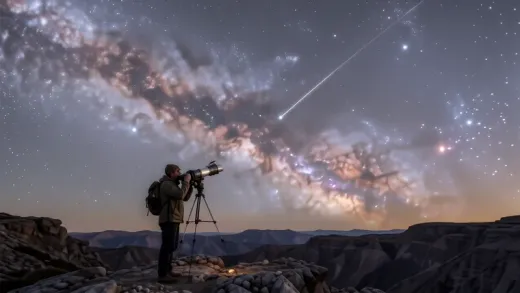
Shooting stars: An enigmatic phenomenon explained
Discover the science behind shooting stars, from the mechanics of atmospheric entry to the chemical composition of meteorites and predictable meteor showers.