What is the star type with the highest density?
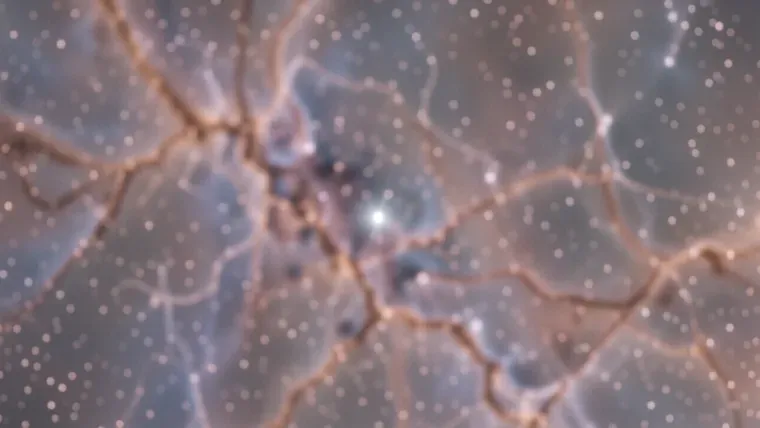
Black holes hold the highest density in the universe because they compress mass into a singularity with zero volume. While neutron stars reach densities of $10^{17}$ kg/m³, a black hole theoretically reaches infinite density as its mass occupies a mathematical point. This state occurs after a massive star undergoes gravitational collapse that even light cannot escape.
The physics of stellar density
Density measures mass per unit volume. It is a fundamental concept. Although we often think of heavy objects as being dense, a large mountain is less dense than a small lead pellet because the mountain occupies far more space relative to its weight. In astronomy, this relationship defines how matter behaves under extreme pressure.
Stars are mostly gas. This gas exists in a state of equilibrium. Gravity pulls inward while gas pressure and radiation pressure push outward so that the star remains stable for millions or billions of years. If these forces fail, the star collapses.
Mass dictates the fate of a star. Most stars have masses between 0.1 and 50 times that of the Sun. A star with less than 0.02 solar masses cannot become self-luminous because it lacks the internal pressure required to trigger nuclear fusion. Small objects like Jupiter never become stars.
The Sun is our baseline. It has a density of 1.4 times that of water. Its core reaches much higher values, specifically around 150,000 kg/m³, because the weight of the outer layers compresses the hydrogen plasma. This central region provides the energy for the entire solar system.
The Sun will change. In about 6 to 7 billion years, it will become a white dwarf. This process happens after the star exhausts its hydrogen and expands into a red giant.
White dwarfs and degenerate matter
White dwarfs are small. They are roughly the size of Earth. Although they have a mass comparable to the Sun, their radius is only about 6,000 to 10,000 kilometers. This compression makes them significantly denser than normal stars.
Degenerate gas provides pressure. Normal stars rely on thermal pressure from heat. White dwarfs use electron degeneracy pressure because the Pauli exclusion principle prevents electrons from occupying the same quantum state. This pressure remains effective even as the star cools down.
Sirius B is a known example. It is a white dwarf orbiting the bright star Sirius. While Sirius A dominates the sky, its companion is incredibly dense, with matter exceeding 50 kg per cm³. This density makes it a compact remnant of a former star.
White dwarfs follow specific limits. They cannot exceed the Chandrasekhar limit of approximately 1.4 solar masses. If they gain more mass, the degeneracy pressure fails so that the object collapses further into a neutron star.
- Density: $\approx 10^9$ kg/m³
- Composition: Degenerate electron gas
- Size: Earth-sized
- Origin: Low to medium mass stars
The extreme regime of neutron stars
Neutron stars are incredibly dense. They contain roughly $10^{17}$ kg/m³. A single tablespoon of this material would weigh over one billion tons because the atoms have been crushed into a state where protons and electrons merge. This merger creates a sea of neutrons.
Gravity wins here. The collapse happens after a supernova explosion destroys a massive star. During this event, the iron core compresses 100,000 times so that the nuclei themselves are crushed into a dense fluid of neutrons.
Neutron stars have layers. The outer atmosphere is only centimeters thick. Below this lies a crust of crystalline iron nuclei, while the deep interior remains a mystery. Some scientists believe the core contains a superfluid because the particles move without friction.
Pulsars rotate rapidly. These are neutron stars that emit beams of radiation. Jocelyn Bell Burnell discovered pulsars in 1967 at the University of Cambridge. These objects flash hundreds of times per second as they spin.
The NICER experiment studies them. This instrument is located on the International Space Station. It launched in June 2017 to measure the mass and radius of pulsars by analyzing X-ray photons. This data helps scientists understand if the core contains strange quarks or hyperons.
Neutron stars have limits. Most fall between 1 and 2.5 solar masses. In 2010, Paul Demorest and his team at the U.S. Radio Astronomy Observatory found a neutron star with a mass of 1.97 solar masses. This discovery challenged previous models of how much mass a neutron star could hold.
The interior might be exotic. Some theories suggest “strange matter” exists in the core. This would involve quarks that have transformed into strange quarks because the pressure is high enough to change their fundamental identity. If this happens, the star becomes “softer” and smaller.
Theoretical densities and quark plasma
Quark plasma is extremely dense. It reaches $10^{19}$ kg/m³. This state existed in the early universe just milliseconds after the Big Bang. We can replicate it in labs, although the conditions are very different from a star.
The LHC creates this matter. Scientists at CERN used the Large Hadron Collider to collide lead atoms. These collisions produce a plasma of quarks and gluons so that researchers can study the fundamental forces of nature.
Preon stars remain hypothetical. They would have a density of $10^{23}$ kg/m³. If a preon star existed, it would be roughly the size of a golf ball but possess the mass of the Sun. No observation has confirmed their existence yet.
Planck particles are even denser. They reach $10^{96}$ kg/m³. These are theoretical subatomic black holes. A Planck particle is trillions of times smaller than a proton, although it carries an immense amount of weight.
- Quark Plasma: $10^{19}$ kg/m³ (Confirmed via LHC)
- Preon Star: $10^{23}$ kg/m³ (Theoretical)
- Planck Particle: $10^{96}$ kg/m³ (Theoretical)
Black holes and the singularity
Black holes represent the limit. They have no measurable volume. Because the mass is concentrated in a single point called a singularity, the density is mathematically infinite. This defies standard physical descriptions of matter.
Gravity is absolute here. Once an object crosses the event horizon, it cannot return. Even light is trapped because the gravitational pull is too strong for any velocity to overcome. This creates a dark region in space.
Black holes form from massive stars. If a stellar remnant exceeds 3 to 5 solar masses, it cannot stop its contraction. The collapse continues until a singularity forms, creating the most compact object possible in the cosmos.
We detect them indirectly. We see their effect on nearby stars or through gravitational waves. On August 17, 2017, the LIGO and Virgo detectors recorded gravitational waves from colliding neutron stars. This event provided data on how dense matter behaves before it potentially collapses into a black hole.
The universe is not empty. Even in deep space, particles exist. However, nothing compares to the density found in a singularity. The laws of physics as we know them break down at this point.
The study of density reveals the nature of gravity. As detectors like the Einstein Telescope improve, we will see more of these extreme events. We are learning how matter transitions from gas to plasma, then to neutrons, and finally to the unknown state of a singularity.
Frequently asked questions
Which celestial object has the highest density in the universe?
Black holes hold the highest density because they compress mass into a singularity with zero volume, resulting in theoretically infinite density.
How dense is a neutron star compared to other stars?
Neutron stars are incredibly dense, reaching approximately 10^17 kg/m³, which is significantly higher than the 1.4 times water density of our Sun.
What prevents white dwarfs from collapsing further?
White dwarfs are supported by electron degeneracy pressure, which is caused by the Pauli exclusion principle preventing electrons from occupying the same quantum state.
Are there any theoretical objects denser than neutron stars?
Yes, theoretical objects like preon stars (10^23 kg/m³) and Planck particles (10^96 kg/m³) are predicted to be far denser than known neutron stars.
More in Stars
How far away is the nearest star in light years?
Discover how far Proxima Centauri is from Earth and learn about its physical characteristics, planetary system, and distance measurements.
Methods used by scientists to calculate the distance to stars
Explore how astronomers use the cosmic distance ladder, from trigonometric parallax to standard candles and redshift, to measure stellar distances.
Reasons for the descent of stars from the heavens and their final
Learn why meteoroids appear as falling stars, how friction creates light during atmospheric entry, and where these cosmic fragments ultimately end up.
Shooting stars: An enigmatic phenomenon explained
Discover the science behind shooting stars, from the mechanics of atmospheric entry to the chemical composition of meteorites and predictable meteor showers.