Discovering what Taurus constellation looks like
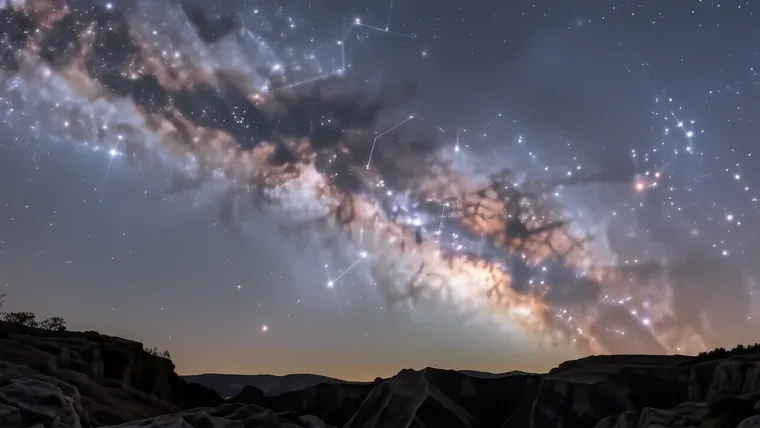
Taurus occupies 797.2 square degrees of the celestial sphere. It sits between Aries and Gemini, positioned northwest of Orion. The constellation contains 216 stars visible to the naked eye. Most observers find it clearest from November to January in the Northern Hemisphere.
Stellar Anatomy of the Bull
Aldebaran dominates the visual field. It is bright. This K5 III giant star has an apparent magnitude of 0.85m, which makes it one of the most prominent objects in the zodiacal constellations. It sits at a distance of approximately 65 light-years from Earth. The star appears orange because its surface temperature and chemical composition favor longer wavelengths of light. It is massive. Aldebaran possesses 2.5 times the mass of the Sun and a luminosity 150 times greater. Its diameter has expanded to 38 times that of our Sun during its current phase of active helium burning.
The star varies slightly. This fluctuation in magnitude stays within a narrow 0.2m range. Astronomers classify it as a variable star although its changes are relatively minor compared to other stellar types. It is often called the “eye” of the bull.
El-Nat provides the second point of light. It is bright. This star, also known as Beta Taurus, maintains an apparent magnitude of 1.65m. It sits 131 light-years away from our solar system. El-Nat belongs to the B7 III spectral class. Because it is a binary system, a companion star exists at an angular distance of 33 arcseconds from the primary. The surface temperature of this evolving giant reaches 13600 K. It has a mass 4.5 times greater than the Sun.
The horns are distinct. They appear sharp. Beta Taurus sits near the border of the constellation Auriga. Ptolemy included this star in his Almagest because it occupies space within both Taurus and Auriga simultaneously. It is a heavy star. Its luminosity reaches 700 times that of the Sun while its radius measures 5 to 6 times larger than our own.
Zeta Taurus adds complexity. It is blue. This binary system sits 417 light-years away from Earth. The primary component shows a magnitude of 2.97m and falls into the B4IIIpe/G8III classification. It possesses a luminosity approximately 5,700 times more powerful than the Sun.
The system is complex. It contains multiple stars. Alcyone A, part of the Zeta Taurus group, functions as a Ve star. Its rapid rotation forces the star into an ellipsoidal shape rather than a sphere. This blue-white giant has a spectral class of B7IIIe. It has an apparent magnitude of 2.87m.
The Hyades and Pleiades Clusters
The Hyades form a V-shape. They look like a bucket. This dispersed cluster spans about 8 degrees in the night sky. It contains approximately 200 stars. The cluster sits roughly 130 to 132 light-years away from Earth. Most of these stars are quite old. The cluster is estimated to be between 620 and 650 million years old.
Aldebaran is a neighbor. It is not a member. While the star appears to sit within the cluster, it is actually just projected onto the Hyades from a much closer distance of 65 light-years. The cluster’s most luminous members include Epsilon, Gamma, Theta, and Delta Taurus.
The Pleiades offer a different view. They are bright. This cluster, also known as M45 in the Messier catalog, consists of roughly 1000 stellar bodies. It is located approximately 440 light-years away from us. The stars appear blue because they are hot, young, and massive.
The group is connected. They move together. Scientific research confirms that the Pleiades are a physically linked group of stars rather than a random alignment. They span a width of about 13 light-years. The nine brightest stars give the cluster its name. Seven of these sisters are named after Greek mythology, while two others represent their parents.
The cluster is visible. It shines clearly. Observers in the Northern Hemisphere see them during winter months. In the Southern Hemisphere, they appear during the summer. You can see them without binoculars if the sky is dark.
Deep Sky Objects and Nebulae
The Crab Nebula is famous. It is M1. This diffuse nebula resulted from a supernova explosion recorded in the year 1054. It sits approximately 6500 light-years away from Earth. The nebula has a diameter of about 11 light-years. It expands at a rate of 1500 kilometers per second.
A pulsar resides there. It is fast. At the center of the nebula, the pulsar PSR B0531+21 emits radio waves and gamma rays as it rotates. This neutron star has a pulsation period of 0.033 seconds. The nebula was first identified in 1731.
T Taurus is a prototype. It is variable. This star represents the T Tauri class of variable stars. It is currently in an early evolutionary stage. Matter precipitates from a slowly rotating circumstellar disk so that it can condense into a protostar at the core. The central protostar has a mass of approximately 1000 solar masses.
Other nebulae exist here. They are faint. NGC 1514 is known as the “Crystal Ball.” It is a planetary nebula located 800 light-years away. William Herschel discovered it in 1790. It has a small size of 1.54 arcminutes.
The sky contains more. They are scattered. NGC 1647 is an unfilled dispersed group containing over 150 stars. It spans 45 arcminutes. You can find it with binoculars by shifting your view left from the Hyades.
Specific Stellar Observations
119 Taurus is a giant. It is red. This M2Iab-Ib supergiant has a visual magnitude of 4.32. It sits 1,802 light-years away. Its diameter is 600 times larger than the Sun’s. It shows semi-regular variability because its brightness changes between 4.23 and 4.54 over 165 days.
Ro Taurus is white. It rotates fast. This A8V main-sequence star sits 152 light-years away. It has a mass 1.88 times that of the Sun. Its rotational velocity reaches 117 km/s. It completes one full rotation every 488.5 days.
Omicron Taurus is a double. It is large. This G6 III Fe-1 giant star sits 212 light-years away. It has a radius 18 times larger than the Sun. The two stars in this system have an orbital period of 1655 days.
Atlas is a triple system. It is distant. Located 381 light-years away, Atlas has a visual magnitude of 3.62. The primary component is a blue-white giant with a spectral class of B8 III. It is a spectroscopic double with an orbital period of approximately 1250 days.
Electra shines brightly. It is blue. This massive star sits 600 light-years away. Its apparent magnitude is 3.705. The star rotates at 181 km/s, which causes it to flatten at the poles. An infrared gas disk surrounds the star because of mass loss from its high rotation rate.
Maya is a mercury-manganese star. It is bright. This B8III blue giant sits 360 light-years away. It has a mass 4 times greater than the Sun. Its luminosity is 660 times higher. The star contains high levels of mercury and manganese, which creates prominent spectral lines.
Merope is a subgiant. It is blue. This B6IVe star sits 360 light-years away. It has a mass 4.5 times that of the Sun. Its magnitude is 4.113. The star undergoes Beta Cepheus-type variability with fluctuations of 0.01 magnitude.
Taygeta is a triple system. It is distant. This B6IV blue-white subgiant sits 440 light-years away. Its visual magnitude is 4.30. The main star is a spectroscopic double with an orbital period of 1313 days.
Pleione is a hot star. It is variable. This B-class star sits 392 light-years away. Its magnitude is 5.048. It shines 190 times brighter than the Sun. The brightness fluctuates between 4.8 and 5.5.
Celeno is hard to find. It is a subgiant. This B7IV star sits 430 light-years away. Its magnitude is 5.448. It rotates at -185 km/s. Astronomers sometimes call it the “Lost Pleiades” because of its difficult location.
The stars are many. They form patterns. 21 Taurus and 22 Taurus are main-sequence dwarfs. They sit 440 light-years away. One has a magnitude of 5.76 while the other is 6.43.
Historical and Mythological Context
Eudoxus documented the sky. He was Greek. He lived before the common era and likely provided the first formal descriptions of these stars. His work survived through Aratus, who wrote about Taurus around 220 BC. The Eudoxus Sphere is lost.
The Greeks saw a bull. Zeus was the actor. In one myth, Zeus transformed into a white bull to carry Europa to Crete. Another version links the constellation to the Cretan bull defeated by Hercules. These stories shaped how people viewed the stars for centuries.
The Pleiades have names. They are sisters. Alcyone, Sterope, Maia, Merope, Taygeta, Keleno, and Electra are the seven daughters of Atlanteus and Pleione. Zeus placed them in the sky to protect them from Orion.
The Hyades were also daughters. They were half-sisters. Their mother was Etra. The name Hyades comes from a Greek word meaning “it’s raining” because they appeared during the rainy season.
Slavic traditions differ. They saw Veles. This deity was a god of livestock. The Pleiades were linked to his worship in ancient religious practices.
The zodiac is mathematical. It is not just stars. Astrology divides the ecliptic into 12 sectors of 30 degrees each. Astronomy uses the actual groupings of stars, which vary significantly in size. Taurus occupies a specific segment of the sky near the ecliptic plane.
The Sun passes through. It moves through Taurus. The Sun enters this region around May 14 and leaves by June 19. This timing defines the astrological period for those born under the sign.
Observers use different tools. Binoculars help. A 150mm telescope can resolve the double star 118 Tau, which has a separation of less than 5 arcseconds. You will need high magnification to see the two individual components clearly.
The sky remains vast. Taurus is just one part. It connects to Gemini, Aries, and Orion in a large celestial web. The stars continue to move through space at different velocities and distances.
Frequently asked questions
What are the most prominent stars in Taurus?
Aldebaran is the most dominant star, acting as the 'eye' of the bull with an apparent magnitude of 0.85m. Other notable stars include El-Nat and the members of the Zeta Taurus group.
How can I identify the Pleiades cluster?
The Pleiades, or M45, is a bright cluster of roughly 1000 stars located about 440 light-years away. It is visible to the naked eye in dark skies and contains nine brightest stars.
What is the Crab Nebula located in Taurus?
The Crab Nebula (M1) is a diffuse nebula created by a supernova explosion in 1054. It is approximately 6500 light-years away and contains a fast-rotating pulsar at its center.
When is the best time to view Taurus?
In the Northern Hemisphere, the constellation is clearest from November to January. In the Southern Hemisphere, it is best viewed during the summer months.
More in Constellations
How to see the appearance of Cassiopeia in the night sky
Learn how to identify the W-shaped Cassiopeia constellation and locate deep sky objects like M52, M103, and the Cas A supernova remnant.
The best time to observe the Hydra constellation
Discover the ideal months for viewing the Southern Hydra constellation and learn about its brightest stars, nearby galaxies, and visibility requirements.
Through which constellations does the sun pass?
Discover the thirteen astronomical constellations the Sun traverses along the ecliptic, including Ophiuchus, and how they differ from astrological signs.

What an incredible creature the bear is in nature and sky
Explore the dual nature of bears as biological predators like the polar bear and celestial markers such as the Ursa Major constellation.