What will the Earth look like in one million years?
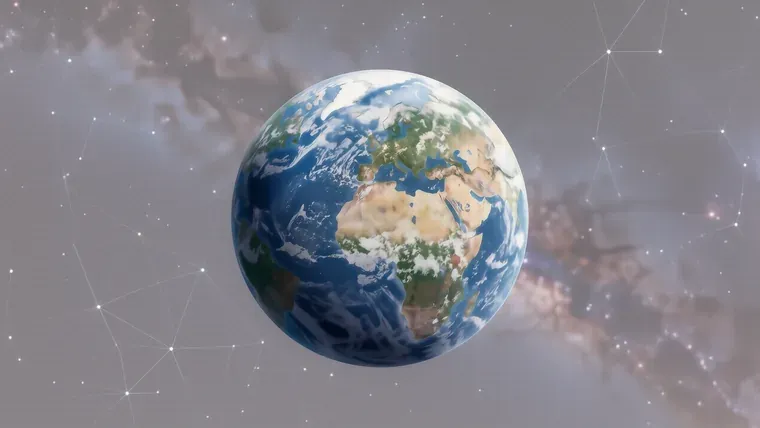
In one million years, Earth will exhibit a geography that remains recognizable to modern observers but contains distinct shifts in coastline and mountain height. Tectonic plates move at rates of roughly 2 to 5 centimeters per year, so the continents will have drifted approximately 45 to 60 kilometers from their current positions. The stars above will have shifted significantly due to stellar proper motion, meaning that familiar constellations like Ursa Major will no longer exist in their current configurations.
Tectonic Shifts and Continental Drift
The Earth is moving. Constantly. While the surface appears static to a human observer, the lithospheric plates undergo continuous motion because internal mantle convection drives these massive slabs of crust across the globe. Africa is currently splitting. This process began long ago, but the separation of the Somali and Nubian plates is accelerating as a massive fissure has emerged in southwestern Kenya. This crevice reaches depths of 15 meters. It remains visible from space.
The map will change. Geologists at Utrecht University have modeled Earth’s shape into the distant future to understand these movements. They predict that the Somali region will eventually detach from the African continent and merge with India, although this specific collision requires millions of years to complete. This movement will create the Somali Mountains. These peaks will follow a curved path similar to the Carpathians.
Continents collide. North America is shifting southwest at a rate of 3 centimeters per year. If this velocity remains constant, the North American plate will eventually strike the South American plate in approximately 10 million years so that a new supercontinent can form. This collision will erase the Caribbean Sea. New mountain ranges will rise where the two landmasses meet.
The Pacific is shrinking. Australia moves north toward Southeast Asia. While the Atlantic Ocean expands by several hundred kilometers, the Pacific Ocean undergoes a simultaneous contraction of a similar magnitude. This creates a massive imbalance in oceanic volume. The world map will require total revision.
The crust is active. In 2021, NASA and Toho University researchers analyzed planetary lifespans to determine how long biological stability lasts. They calculated that all forms of life may cease to exist by the year 1,000,002,021 because solar activity will cause total deoxygenation of the atmosphere. This date relies on models of stellar evolution. It is a distant horizon.
The Evolution of Mountains and Islands
Mountains grow taller. The Arabian Plate moves beneath the Eurasian Plate at about 3 centimeters per year. This pressure forces the crust upward, which causes the Zagros Mountains in Iraqi Kurdistan to increase in elevation by 5 to 10 millimeters annually. These heights change slowly. Most people never notice.
Volcanoes create land. Magma rises through the crust during an eruption. If a volcanic cavity elevates above the ocean surface, a new island emerges from the sea so that it can begin its geological life. Many such islands vanish quickly. Waves erode them within months.
One island survived. A recent Pacific island doubled in size within six years after its initial emergence. NASA researchers led by James Garvin visited the site to assess its soil composition because they wanted to understand if the terrain could support future space colonization efforts. The soil resembles other planets. It is quite barren.
The Hunga-Tonga eruption changed everything. In January 2022, the underwater volcano reawakened with a power equivalent to 10 megatons of TNT. This blast was 500 times stronger than the Hiroshima atomic bomb. Ash covered Tonga. Tsunami waves struck Japan.
New peaks will rise. Africa’s split will eventually form a new ocean. As the Somali plate moves away, the gap will fill with seawater so that a new maritime corridor can exist between Africa and the Indian Ocean. This process mirrors how South America and Africa separated from Western Gondwana. The Earth remains restless.
Celestial Changes and Precession
The sky is shifting. Stars move through space. Because of the Earth’s precession, the North Pole does not always point toward the same celestial marker. Currently, the axis points toward Polaris. This orientation changes every 26,000 years.
Vega will lead. In approximately 13,000 years, the star Vega will become the new indicator of the northern direction. While this change is gradual, it will completely alter how ancient navigational charts are interpreted by future astronomers. The constellations will dissolve. Ursa Major will disappear.
Earth wobbles. This movement is called precession. The axis tilt fluctuates between 22.1 and 24.5 degrees over a 97,000-year cycle. These variations influence how much solar energy reaches the surface. Climate patterns follow these tilts.
Ice ages are cyclical. Glaciation occurs when the Earth’s tilt maximizes solar absorption in certain hemispheres. Currently, we live in an interglacial period. It is expected to end in roughly 25,000 years. However, human activity might delay this.
The atmosphere changes. Carbon dioxide levels are rising. If greenhouse gas emissions continue at current rates, the next ice age could be delayed by 50,000 to 130,000 years because the increased heat traps energy within the troposphere. This creates a complex climate feedback loop. The future is uncertain.
The Long-Term Fate of the Sun
The Sun is warming. It gets brighter. When Earth formed 4.5 billion years ago, the Sun’s luminosity was only 70% of its current level. Over billions of years, this brightness increases steadily. It will eventually destroy life.
Water will vanish. As the Sun’s luminosity reaches higher levels, the oceans will begin to evaporate. This process will turn Earth into a scorched desert so that no liquid water can remain on the surface. The planet will become lifeless. Only rocks will remain.
The Sun expands. In about 5 billion years, it will enter its red giant phase. It will consume Mercury and Venus first. Earth may also be engulfed by the expanding outer layers of the star. This is a certain end.
Microorganisms might hide. Robert Hazen describes in his book, “History of the Earth: From Stardust to a Living Planet,” that life might persist in deep crustal pockets. These organisms could survive for another billion years because they rely on chemical energy rather than sunlight. They will be alone.
The Sun dies. It becomes a white dwarf. This small, dense remnant will occupy the space where our star once lived. The solar system will be silent. Only gravity remains.
Human Impact and Biological Evolution
Humans change things. We move fast. While geological processes take millions of years, human-driven climate change is altering the atmosphere within mere centuries. This speed is unprecedented. It causes rapid melting.
The Arctic is warming. Summer temperatures in the Arctic could increase by 14 degrees Celsius by the year 2100. If this happens, the taiga forest will migrate northward at a rate of 30 kilometers every 10 years. The tundra will shrink. It may vanish entirely.
Only 6% remains. Projections suggest that only 6% of the Siberian tundra belt will exist in 500 years. This loss affects countless species. Animals lose their habitats.
Genetic diversity might fade. Some theories suggest humans could become more homogenous over many millennia. As populations mix, distinct physical traits may diminish so that a single human race emerges. This is highly speculative. Evolution is unpredictable.
Technology will integrate. In one million years, biological and mechanical systems may merge. Humans might not look like us. They will likely use advanced tools to survive in different environments. The definition of “human” will change.
Asteroids and Extinction Events
Space is dangerous. Rocks fly fast. Earth is hit by large asteroids approximately once every million years. These impacts can cause mass extinctions if they strike sedimentary rock because the resulting gas release triggers rapid climate shifts.
Apophis is coming. In 2029, the asteroid Apophis will pass near the Moon’s orbit. It has a diameter of 325 to 340 meters. We must monitor it closely. Scientists are watching.
Supervolcanoes are threats. These eruptions happen roughly every 50,000 years. They can eject enough ash to block the sun for 15 years. This would cause global cooling. Food chains would collapse.
Mass extinctions happened before. An eruption 250 million years ago killed 80% of species. In that event, Siberian salt deposits released ozone-depleting chemicals into the air. The atmosphere became toxic. Life struggled to recover.
We might defend Earth. Humanity may develop technology to deflect incoming threats. If we can redirect asteroids, we can prevent another catastrophe like the one that killed the dinosaurs 65 million years ago. Our survival depends on it.
The planet is a living system. It moves and breathes. While the scale of these changes seems overwhelming, they are simply the next steps in a 4.5-billion-year history of constant transformation. Earth will continue to change long after we are gone.
Frequently asked questions
How much will the continents move in one million years?
Tectonic plates move at rates of 2 to 5 centimeters per year, meaning continents will have drifted approximately 45 to 60 kilometers from their current positions.
Will the constellations look the same in the distant future?
No, stars move due to proper motion and Earth's precession. For example, Vega will become the new indicator of the northern direction in about 13,000 years.
What is the long-term threat to life on Earth from the Sun?
As the Sun's luminosity increases, oceans will eventually evaporate. Models suggest solar activity could cause total atmospheric deoxygenation by the year 1,000,002,021.
How often do large asteroid impacts occur on Earth?
Earth is hit by large asteroids approximately once every million years, which can trigger mass extinctions through rapid climate shifts.
More in Constellations
How to see the appearance of Cassiopeia in the night sky
Learn how to identify the W-shaped Cassiopeia constellation and locate deep sky objects like M52, M103, and the Cas A supernova remnant.
The best time to observe the Hydra constellation
Discover the ideal months for viewing the Southern Hydra constellation and learn about its brightest stars, nearby galaxies, and visibility requirements.
Through which constellations does the sun pass?
Discover the thirteen astronomical constellations the Sun traverses along the ecliptic, including Ophiuchus, and how they differ from astrological signs.
What an incredible creature the bear is in nature and sky
Explore the dual nature of bears as biological predators like the polar bear and celestial markers such as the Ursa Major constellation.