Who determined the intensity of light and its pressure?
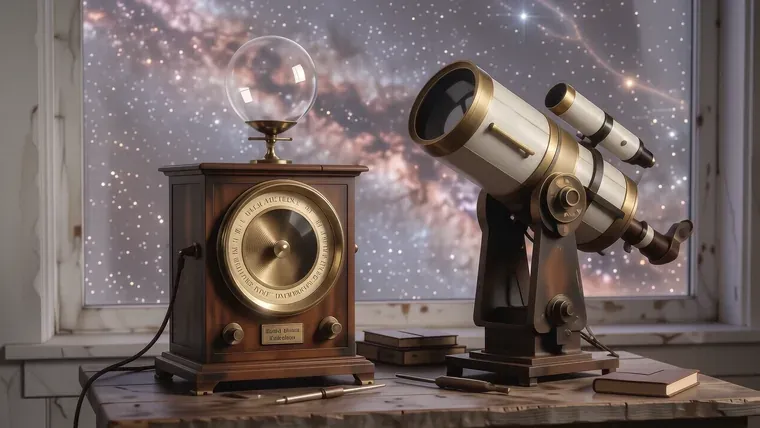
Johannes Kepler first observed the phenomenon in 1619. He noticed that comet tails always point away from the Sun, although he lacked a formal mechanism to explain this orientation. Modern physics identifies this force as radiation pressure. It occurs because photons carry momentum and transfer it to surfaces during interaction.
The Physics of Photon Momentum
Light exerts physical force. This is true. While light appears weightless, every photon carries a specific amount of momentum defined by the ratio of its energy to the speed of light ($c$). When these particles strike an object, they transfer that momentum to the mass of the target. This exchange causes acceleration.
The math is precise. We use $p = E/c$ to define it. If a surface reflects light perfectly, the change in momentum is twice as large because the photons must first stop and then reverse their direction. Absorption results in less pressure. The force depends on the reflection coefficient ($R$) and the energy flux ($E$).
Radiation pressure remains tiny. It is small. Even though these forces seem negligible in a laboratory setting, they accumulate over vast distances in space. For example, if engineers had ignored light pressure during the Viking program, the spacecraft would have missed its Mars orbit by approximately 15,000 km.
The force is measurable. We use Pascals. In early experiments, researchers measured values between $4 \times 10^{-6}$ and $10 \times 10^{-6}$ Pa.
Lebedev’s Experimental Breakthrough
Pyotr Nikolayevich Lebedev solved the problem in 1900. He was a Russian physicist. Before his work, scientists like William Thomson argued that light did not exert pressure, so proving the existence of this force required extreme technical precision. He worked for four years to refine his methods.
The challenge was heat. Convection interfered. Because even slight temperature differences between the illuminated and dark sides of a surface create air currents, Lebedev had to perform his experiments inside a vacuum vessel. He used platinum foil wings suspended by thin threads.
He measured rotation. It worked. By observing the angle of twist in these threads using a mirror and scale, he could quantify the minute force applied by the light. His results aligned with Maxwell’s theoretical predictions within a 20% margin of error initially.
Lebedev improved his setup. He was thorough. After refining his vacuum techniques and using light filters to prevent uneven heating of the vessel walls, he achieved a deviation of less than 1% from theory. This success provided the empirical evidence needed to support classical electrodynamics.
His legacy persists. He was respected. Although he died in 1912 before he could receive a Nobel Prize, his “Lebedev school” of physics influenced generations of researchers in Moscow.
Modern Validation at Synchrotrons
New research tests old theories. It is precise. Researchers from Goethe University Frankfurt recently investigated the nature of light pressure to validate a theory proposed nearly 90 years ago by Arnold Sommerfeld. They used high-energy photon beams to observe how momentum is distributed during ionization.
The experiments were complex. They used synchrotrons. Two specific variations of single-photon ionization were conducted to capture different energy scales:
- Low-energy experiments (300–1775 eV) occurred at PETRA III at the DESY facility in Germany using circularly polarized light.
- High-energy experiments (12–40 keV) took place at ID31 at the European Synchrotron Radiation Facility (ESRF) using linearly polarized light.
The data is clear. It shows asymmetry. While traditional dipole approximations suggest a symmetric distribution, the researchers found that high photon energies break this symmetry because the momentum of the photon itself becomes significant. This shift affects how photoelectrons and photoions move.
The ions recoil. They move back. During the helium experiments, the momentum distributions showed that the ion moves in the direction opposite to the light propagation so that total momentum remains conserved. The researchers used a supersonic gas jet of He or $N_2$ to intersect the beam perpendicularly.
Detectors measured everything. They were fast. An electric field directed the ions toward a detector that recorded both time and position using a delay line device. This allowed the team to calculate the exact momentum vectors of the reaction fragments.
The Sommerfeld Theory and Momentum Conservation
Sommerfeld predicted the recoil. He was right. His theory suggests that the average forward momentum of electrons is greater than the photon momentum, which means the photoion must move in the opposite direction to satisfy conservation laws. This was difficult to prove until now.
The mechanism is subtle. It involves phase factors. When an atom absorbs a photon, the electromagnetic wave “impresses” a local phase factor onto the transition matrix, which effectively imparts an impulse to the center of mass of the atom. This process is not just a simple collision.
We see the shift. It is visible. In the helium momentum space diagrams, the red concentric rings represent the photoelectron impulses, while the blue rings show a forward shift. This shift occurs because the photon momentum is transferred directly to the ion during the ionization event.
The math holds up. It scales predictably. For initial $s$-states, the backward momentum of the ion scales as $-(3/5)k_{\gamma}$, which provides direct confirmation of Sommerfeld’s 1930s mathematical framework. This level of precision was impossible with older technology.
The results are definitive. They confirm recoil. The study proves that the “recoil” of the ejected electron is the true source of the ion’s momentum, although many previous explanations in scientific literature incorrectly attributed the shift to a direct “shock” from the photon.
Practical Applications in Space and Physics
Light pressure drives technology. It is useful. While we cannot yet build massive solar-powered starships, we already use these principles for small-scale propulsion and precision measurements. Solar sails represent the most direct application of this force.
We use it now. It helps navigation. Because radiation pressure exerts a constant force on large, lightweight surfaces, engineers can design spacecraft that navigate the solar system without consuming chemical propellant. This method relies on the continuous momentum transfer from sunlight.
Other uses exist. They are diverse.
- “Optical tweezers” use focused laser beams to manipulate microscopic objects.
- Photon-based random number generators use beam splitters to create unpredictable sequences for cryptography.
- Nuclear physics utilizes these interactions to propel small particles at high velocities.
The future is bright. It requires materials. As we develop lighter and more reflective materials, the efficiency of solar sailing will increase so that long-duration interstellar probes become a technical reality. Current research continues to explore how energy distributes between multiple photons in complex environments.
Frequently asked questions
Who was the first to experimentally prove light exerts pressure?
Russian physicist Pyotr Nikolayevich Lebedev solved this in 1900. He used platinum foil wings in a vacuum vessel to measure the minute force of radiation pressure.
How does photon momentum affect objects?
Photons carry momentum defined by the ratio of energy to the speed of light (p = E/c). When they strike a surface, they transfer this momentum, causing acceleration.
What is an example of radiation pressure in space exploration?
Radiation pressure is used for solar sails to navigate the solar system without chemical propellant. Ignoring it could cause spacecraft, like those in the Viking program, to miss orbits by 15,000 km.
What did modern synchrotron research reveal about photon momentum?
Experiments at facilities like DESY and ESRF confirmed that high-energy photons break symmetry during ionization. This validates Sommerfeld's theory that the photoion recoils in the opposite direction of light propagation.
More in Stars
How far away is the nearest star in light years?
Discover how far Proxima Centauri is from Earth and learn about its physical characteristics, planetary system, and distance measurements.
Methods used by scientists to calculate the distance to stars
Explore how astronomers use the cosmic distance ladder, from trigonometric parallax to standard candles and redshift, to measure stellar distances.
Reasons for the descent of stars from the heavens and their final
Learn why meteoroids appear as falling stars, how friction creates light during atmospheric entry, and where these cosmic fragments ultimately end up.
Shooting stars: An enigmatic phenomenon explained
Discover the science behind shooting stars, from the mechanics of atmospheric entry to the chemical composition of meteorites and predictable meteor showers.