Why do stars emit light and have different colors?
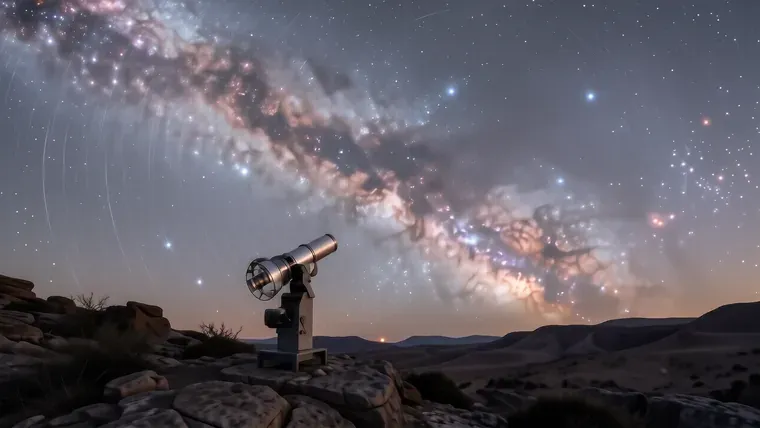
Stars emit light because of thermonuclear fusion occurring within their cores. This process converts hydrogen into helium under extreme pressure and temperatures that can exceed 15,000,000°C. While planets like Venus or the Moon only reflect light from a nearby source, stars function as independent engines of radiation.
The Engine of Stellar Luminosity
Stars are massive spheres. They consist primarily of hydrogen and helium gas held together by intense gravity. A star begins its life when a diffuse mixture of interstellar gas and dust undergoes gravitational compression in dense layers, so that the core temperature rises until fusion becomes possible. This creates a constant outward pressure. It balances gravity. Without this equilibrium, the star would collapse under its own weight.
The energy release is immense. In the core, hydrogen atoms fuse into helium nuclei through a process that releases vast amounts of thermal energy. While the energy travels from the center to the surface, it may take over 100,000 years to reach the outer gas shell because the dense interior is incredibly opaque to radiation. Once it reaches the photosphere, the light escapes into space. It travels at a constant speed.
Fusion provides the power. Physicists and chemists debated the source of this energy for decades before the modern consensus formed. Early chemical theories suggested exothermic reactions could provide heat, although such reactions would exhaust their fuel far too quickly to sustain a star for billions of years. Now we know fusion is the answer. It is stable.
The Sun is our closest example. It is a middle-aged star in its main sequence phase. Although many stars in the galaxy are significantly larger than the Sun, they appear much dimmer because their distance from Earth is so vast. We see the Sun as a large disk. Other stars look like dots.
Temperature and the Spectrum of Color
Color reveals temperature. The surface temperature of a star dictates the specific wavelengths of light it emits most intensely. Hottest stars reach temperatures above 30,000°C and appear blue or blue-white. Cooler stars, with surface temperatures near 4,000°C, appear orange or red. This relationship follows the laws of blackbody radiation.
Light is a spectrum. A star does not emit just one color, but rather a continuous range of wavelengths. If you pass starlight through a prism, you see a progression of hues from violet to red. Astronomer Joseph Fraunhofer observed thin black lines in the solar spectrum in the early 19th century, so he could later identify specific chemical elements within the Sun. These are absorption lines. They are vital.
The Sun appears white. Many people incorrectly label it as yellow. While the Sun’s peak emission occurs in the green-blue part of the spectrum, it also emits significant amounts of red and blue photons simultaneously. Our eyes blend these colors together. We see white. This happens because our biological visual system integrates the various wavelengths into a single perception.
Why are there no green stars? This is a common question. A star that peaks in the green region will still emit plenty of red and blue light, so the human eye perceives the combination as white. Our eyes use three types of cones: red, blue, and green. They work together.
The Mechanics of Human Vision
Cones detect color. Red-sensitive cones respond to long wavelengths, while blue-sensitive cones react to short ones. If a star emitted only green light, we might see it. However, blackbody radiation prevents this single-wavelength emission from occurring in nature. Stars are complex.
The brain interprets signals. When the red and green cones receive equal stimulation, the brain perceives yellow. We see a variety of hues in the night sky. For example, the star Antares appears deep red. Rigel appears blue.
The Illusion of Twinkling
Stars do not twinkle. They emit a steady, continuous stream of light. The flickering effect is an optical illusion caused by Earth’s atmosphere. As starlight enters our atmosphere, it must pass through layers of air with varying densities and temperatures, so the light beam refracts repeatedly before reaching your eyes. This causes scintillation.
Air is always moving. Warm air rises while cold air descends in turbulent vortices. These movements bend the light rays in different directions, which makes the star appear to change position or brightness rapidly. It looks like a flicker. This is why stars near the horizon twinkle more intensely than those directly overhead.
Space is silent and still. If you were standing on the Moon or looking through a window on the International Space Station, the stars would not twinkle at all. There is no atmosphere in the vacuum of space to distort the light. The stars remain steady points. They are constant.
Atmospheric conditions matter. On a very cold or windy night, the twinkling becomes much more pronounced. This happens because the temperature gradients in the air are sharper and more chaotic. You might notice this after a heavy rain. It is quite visible.
- Scintillation increases with wind speed.
- Stars near the horizon show maximum flickering.
- Planets usually appear as steady disks rather than twinkling points.
Distinguishing Stars from Planets
Not everything that shines is a star. Planets are much closer to us than the distant stars. They do not produce their own light through fusion. Instead, they act like mirrors that reflect the light of a nearby star, such as our Sun. They appear as disks.
You can tell them apart by how they move. Stars stay in fixed positions relative to one another within their constellations over long periods. Planets move across the background of the sky because their orbits carry them around the Sun. Their names come from Greek words meaning “wanderer.”
Brightness varies greatly. Astronomers use the term magnitude to describe how bright an object appears. A star might be physically massive, but if it is far away, its magnitude will be low. The Sun has a very high apparent magnitude. It dominates our sky.
| Object Type | Light Source | Visual Appearance |
|---|---|---|
| Star | Nuclear Fusion | Twinkling point |
| Planet | Reflected Light | Steady disk |
| Moon | Reflected Light | Large, bright disk |
| Meteor | Friction/Heat | Brief streak |
The Lifecycle of Stellar Light
Stars change over time. A star’s color and luminosity are tied to its age and mass. During the initial stages of a massive star’s life, it burns through its hydrogen very quickly and emits a brilliant blue-white light. As it ages, it may expand and cool. It becomes red.
Red giants are common. When a star like our Sun exhausts its core hydrogen, it will expand into a red giant. The surface temperature drops as the outer layers move further from the core, so the emitted light shifts toward the red end of the spectrum. This is a predictable phase.
The end is often violent. Some massive stars end their lives in supernova explosions. These events release more energy in a few days than our Sun will emit in its entire lifetime. The remnants might be neutron stars or black holes. They are dense.
Small stars live longer. Red dwarfs are the most common type of star in the galaxy. They burn their fuel so slowly that they can remain on the main sequence for trillions of years, which is much longer than the current age of the universe. They are quiet.
The light we see today left its source long ago. For example, light from Proxima Centauri takes approximately 4.2465 light-years to reach us. We are looking at the past. Every photon tells a story of a journey through the void.
Frequently asked questions
How do stars produce their own light?
Stars emit light through thermonuclear fusion in their cores, where hydrogen atoms fuse into helium under extreme temperatures exceeding 15,000,000°C.
Why are some stars blue and others red?
A star's color is determined by its surface temperature; hottest stars above 30,000°C appear blue, while cooler stars near 4,000°C appear red.
Why do stars appear to twinkle in the night sky?
Twinkling is an optical illusion called scintillation caused by Earth's atmosphere refracting light as it passes through varying air densities and temperatures.
What is the difference between a star and a planet?
Stars produce their own light via nuclear fusion, whereas planets only reflect light from a nearby source like the Sun.
More in Stars
How far away is the nearest star in light years?
Discover how far Proxima Centauri is from Earth and learn about its physical characteristics, planetary system, and distance measurements.
Methods used by scientists to calculate the distance to stars
Explore how astronomers use the cosmic distance ladder, from trigonometric parallax to standard candles and redshift, to measure stellar distances.
Reasons for the descent of stars from the heavens and their final
Learn why meteoroids appear as falling stars, how friction creates light during atmospheric entry, and where these cosmic fragments ultimately end up.
Shooting stars: An enigmatic phenomenon explained
Discover the science behind shooting stars, from the mechanics of atmospheric entry to the chemical composition of meteorites and predictable meteor showers.