Why planets are referred to as wandering stars in astronomy
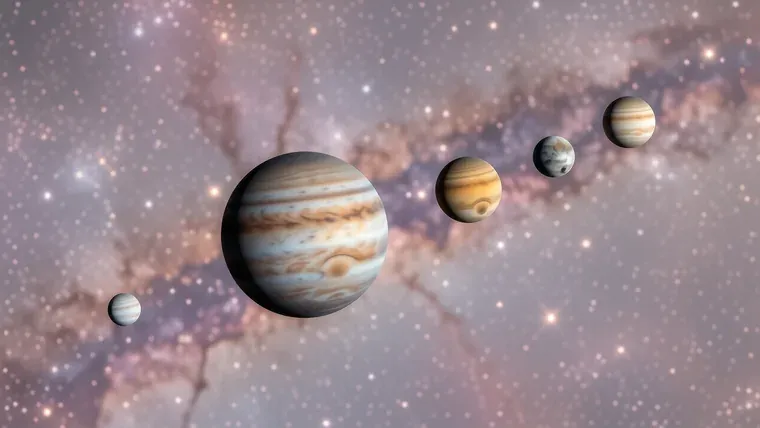
The term “planet” originates from the Ancient Greek word planētēs, which translates directly to “wanderer.” While stars appear fixed in their relative positions within constellations, planets move independently across the celestial sphere because they follow distinct orbital paths around the Sun. This perceived wandering is not a literal drifting but a result of the varying orbital velocities and inclinations of these bodies relative to Earth’s own motion.
The distinction between light and motion
Stars are massive spheres of plasma. They generate their own visible light through nuclear fusion in their cores. Planets do not produce light. Instead, they reflect the sunlight that hits their surfaces or atmospheres. This makes them visible to the naked eye, although they lack the twinkling effect caused by atmospheric turbulence affecting point-source stars.
To an observer without a telescope, a planet can look like any other star. Venus is bright. It often appears as a brilliant white point near the horizon during twilight. Jupiter is also highly luminous. However, planets do not twinkle. They appear as steady discs of light because they have a measurable angular diameter that averages out the atmospheric scintillation.
Ancient observers noticed this difference. They saw that while the stars formed permanent patterns, certain points of light moved through those patterns. This movement was not random. It followed specific paths.
- The Moon moves across the sky.
- The Sun travels the ecliptic.
- Mercury and Venus stay near the Sun.
- Mars, Jupiter, and Saturn traverse the zodiac.
The mechanics of celestial wandering
The apparent motion of planets is complex. Most planets move from west to east relative to the background stars. This is their natural orbital direction. However, observers often see them stop and reverse. This phenomenon is known as retrograde motion.
Retrograde motion is an optical illusion. It occurs when Earth passes a slower-moving outer planet like Mars in its orbit. Because we are moving faster on an interior track, the outer planet appears to drift backward against the distant stars. This creates loops in their apparent paths.
The speed of this wandering varies significantly between bodies. Mercury moves rapidly. Its orbital period is only 87.97 days. In contrast, Neptune takes approximately 164.8 years to complete a single revolution around the Sun. This discrepancy in speed means that some “wanderers” change their position nightly, while others require months or years to show significant movement against the constellations.
The ecliptic is the plane of Earth’s orbit. Most planets stay near this line. They navigate through the zodiacal constellations because their orbital planes are relatively aligned with the solar system’s disk. If a planet were to move far from this plane, its “wandering” would look entirely different to an observer on Earth.
From geocentrism to heliocentrism
For centuries, humans believed Earth was the center of everything. This geocentric model placed the Sun, Moon, and planets in perfect circular orbits around our world. Claudius Ptolemy documented these observations in the Almagest. His system attempted to explain why planets appeared to loop backward.
Ptolemy used epicycles to fix the math. An epicycle is a small circle whose center moves around the circumference of a larger circle, called a deferent. This geometric construction allowed astronomers to predict planetary positions with reasonable accuracy for a time. It was a complicated solution to a problem caused by a wrong premise.
The model eventually failed. Minor errors accumulated in the predicted positions of Mars and Venus. The math became too cumbersome to maintain precision.
In 1543, Nicolaus Copernicus published De revolutionibus orbium coelestium. He proposed that the Sun was the center of the solar system. This heliocentric model simplified the explanation for retrograde motion. It removed the need for many complex epicycles because the “loops” were simply a result of Earth overtaking other planets.
Johannes Kepler refined this further. He realized orbits are not perfect circles. In 1609, Kepler published his first two laws of planetary motion, stating that planets move in ellipses with the Sun at one focus. This corrected the remaining inaccuracies in the Copernican system.
Later, Sir Isaac Newton provided the physical reason for these paths. His law of universal gravitation showed that the mass of the Sun dictates the orbital mechanics of the entire system. Gravity keeps the wanderers on their tracks.
Orbital perturbations and the search for Neptune
Planets do not move in total isolation. They exert gravitational pulls on one another. These tiny tugs are called perturbations. If a planet’s observed position deviates from its predicted path, it usually means another mass is nearby.
This was exactly what happened with Uranus. Astronomers noticed that Uranus was not following the orbit predicted by Newtonian physics. It was veering off its expected trajectory. This suggested an unseen influence was tugging on it.
In 1846, Urbain Le Verrier calculated where this unknown mass should be. He sent his coordinates to Johann Gottfried Galle at the Berlin Observatory. Galle pointed his telescope toward the predicted spot and found Neptune within one degree of the calculated position. This discovery proved that mathematics could predict the existence of unseen “wanderers” based solely on their gravitational influence.
The solar system is vast. It is also remarkably stable. Some theories suggest the existence of rogue planets or massive objects like “Nibiru” passing through our system every few millennia. There is no evidence for such an object in current astronomical data. If a large body were approaching, its gravity would disrupt the orbits of the known planets long before it reached Earth.
We can track the solar system with extreme precision. The Gaia DR3 mission provides highly accurate parallax and position data for billions of stars. This level of mapping makes it impossible for a large, undetected mass to hide in our local neighborhood.
Measuring the scale of the wanderers
The distances between these wandering bodies are immense. We measure these distances in Astronomical Units (AU). One AU is the average distance from the Earth to the Sun, roughly 149.6 million kilometers.
Mercury sits at an average distance of 0.387 AU. Neptune is much further out at approximately 30.07 AU. The scale of these orbits explains why their “wandering” appears so slow to us. Even though they move at high velocities, the sheer volume of space they must traverse makes their progress seem gradual.
The following table provides a snapshot of planetary characteristics:
| Planet | Orbital Period (Earth Days) | Mean Distance from Sun (AU) |
|---|---|---|
| Mercury | 87.97 | 0.387 |
| Venus | 224.7 | 0.723 |
| Mars | 686.98 | 1.524 |
| Jupiter | 4,332.59 | 5.203 |
| Saturn | 10,759.22 | 9.537 |
The movement of these bodies is a constant. We see it every night.
Observers often use the term “opposition” to describe a planet’s position. This occurs when Earth sits directly between the Sun and a planet. At opposition, the planet is at its closest point to Earth and appears at its brightest. For Mars, this happens roughly every 780 days. During these windows, the planet’s retrograde motion is most apparent to amateur astronomers using small telescopes.
The study of these wanderers has transitioned from mythology to physics. We no longer see them as gods or omens. We see them as massive bodies governed by the same laws that apply to a falling apple or a spinning top. The “wandering” is simply the visible signature of gravity in action across the vacuum of space.
Frequently asked questions
What does the word planet actually mean?
The term originates from the Ancient Greek word 'planētēs', which translates directly to 'wanderer'.
Why do planets appear to move backward in the sky?
This phenomenon is called retrograde motion and is an optical illusion that occurs when Earth passes a slower-moving outer planet in its orbit.
How do planets differ from stars to the naked eye?
Unlike stars, planets do not twinkle because they have a measurable angular diameter that averages out atmospheric turbulence, appearing as steady discs of light.
What is the difference between geocentric and heliocentric models?
The geocentric model placed Earth at the center with planets orbiting it, while the heliocentric model proposed by Copernicus correctly placed the Sun at the center of the solar system.
More in Stars
How far away is the nearest star in light years?
Discover how far Proxima Centauri is from Earth and learn about its physical characteristics, planetary system, and distance measurements.
Methods used by scientists to calculate the distance to stars
Explore how astronomers use the cosmic distance ladder, from trigonometric parallax to standard candles and redshift, to measure stellar distances.
Reasons for the descent of stars from the heavens and their final
Learn why meteoroids appear as falling stars, how friction creates light during atmospheric entry, and where these cosmic fragments ultimately end up.
Shooting stars: An enigmatic phenomenon explained
Discover the science behind shooting stars, from the mechanics of atmospheric entry to the chemical composition of meteorites and predictable meteor showers.