Calculating the Earth's mass: A complex task
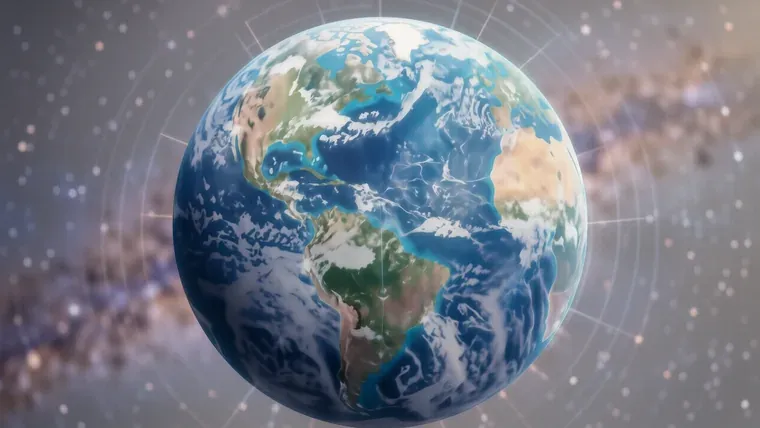
The mass of the Earth is 5.9722×10²⁴ kg. This value carries a standard uncertainty of 6×10²¹ kg according to the Astronomical Almanac Online as of 2016. Because we cannot place the planet on a physical scale, scientists rely on the gravitational constant (G) and the orbital mechanics of celestial bodies to derive this number.
The distinction between mass and weight
Mass is an intrinsic property. It remains constant regardless of location. Weight is a force. It depends on the local gravitational field. Earth has no support to provide weight in a traditional sense, so we discuss its mass instead.
The concept of a planetary weight is often misunderstood in popular literature. In 1859, Masius described the Earth’s mass using the term “14 septillion pounds,” which equates to roughly 6.5×10²⁴ kg. This was an early attempt at quantification. It was not a precise measurement of mass.
Gravity is subtle. Most people do not feel it acting between small objects. We only perceive its strength because the Earth is massive. The force of gravity between two small spheres is nearly impossible to measure without specialized equipment.
If you hang a small weight on a thread, it will stay still. If you place a one-ton lead mass nearby, the tiny weight will shift by less than 0.00002 mm. This displacement is incredibly small. However, measuring this infinitesimal movement allows us to calculate the gravitational constant G and, subsequently, the mass of the Earth.
- Mass: An amount of matter measured in kilograms.
- Weight: The force exerted by gravity (W = mg).
- Gravitational Constant (G): Approximately 6.674 × 10^{-11} m^3 kg^{-1} s^{-2}.
Historical attempts at quantification
Ancient views were often mythological. Some cultures imagined the Earth as a flat plate resting on elephants or turtles. These ideas lacked mathematical rigor. They did not attempt to calculate mass through physics.
Eratosthenes changed this approach in ancient Greece. He used the shadows of sticks in different cities to determine the Earth’s circumference. While he focused on volume and size, his geometric logic laid the groundwork for later physicists. He proved the Earth was a sphere.
Calculations became more formal in the 18th century. In 1774, a Scottish scientist named Dr. N. Makelin estimated the Earth’s mass to be approximately 5.879×10²⁴ kg. This figure was remarkably close to modern values. It showed that early mathematical models were functional.
The 19th century brought more specific data. In 1871, Beckett recorded the “weight of the earth” as 5.936×10²⁴ kg. These variations occurred because scientists lacked a precise value for G. Every new measurement of G shifts our understanding of Earth’s total mass.
The Encyclopedia Britannica’s New Volumes (Vol. 25, 1902) provided a different kind of data. It listed a value of 3.98586 × 10^{14} m^3s^{-2}. This was not the mass itself. It was the standard gravitational parameter, which is the product of G and the Earth’s mass (GM).
The Cavendish method and modern precision
Henry Cavendish developed a method to measure the density of the Earth using a torsion balance. This experiment remains the foundation for modern calculations. We still use repetitions of the Cavendish experiment to refine our values today.
The torsion balance measures the tiny twisting force between lead spheres. It is a delicate process. Because the forces are so weak, even small vibrations or temperature changes can ruin the data. Scientists must isolate the experiment from all external interference.
Modern uncertainty stems from G. Since the 1960s, measuring the gravitational constant has been notoriously difficult. High-precision trials conducted between 1980 and 2010 produced conflicting results. These discrepancies exist because G is one of the least precisely known fundamental constants in physics.
NIST recommended a value for G of 6.674 × 10^{-11} m^3 kg^{-1} s^{-2} in 2014. This recommendation helps standardize the calculation of planetary masses. Without a stable G, our mass estimates would drift.
Recent data from Gaia DR3 and other astronomical surveys allow us to check these terrestrial measurements against celestial movements. We can observe how the Earth moves relative to the Moon. This provides an independent way to verify our math.
The Earth and Moon orbit a shared center of gravity, known as the barycenter. This point is located inside the Earth. Precise observations show this center is approximately 4635 km from the Earth’s center. We use this distance to calculate the mass of the Earth by observing the Moon’s orbital period.
Internal distribution of mass
Earth is not a uniform sphere. Its density changes with depth. The mass is distributed unevenly between the crust, mantle, and core. This unevenness affects the local gravity we experience at the surface.
The crust is very thin. It accounts for only 0.026×10²⁴ kg of the total mass. Most of the planet lies beneath our feet. The mantle contains the bulk of the Earth’s matter.
Layered composition
- Mantle: 4.043×10²⁴ kg (silicates, iron, calcium, and magnesium).
- Core: 1.93×10²⁴ kg (iron and nickel).
- Crust: 0.026×10²⁴ kg (silicate rocks).
- Hydrosphere: 0.0014×10²⁴ kg (liquid water and ice).
- Atmosphere: 5.15×10¹⁸ kg (gases).
The core is extremely dense. It holds nearly one-third of the planet’s mass. Although it occupies a small volume, its high density of iron and nickel drives the planet’s magnetic field. This field protects the atmosphere from solar wind.
The hydrosphere is negligible in terms of total mass. The oceans are vast to us. However, they represent only a tiny fraction of the Earth’s total composition. Even the entire atmosphere weighs very little compared to the rocky interior.
Mass flux and planetary changes
Earth’s mass is not static. It changes every second. We gain mass from space and lose mass to space. These two processes do not balance perfectly.
We gain material through cosmic dust and meteorites. This influx adds between 37,000 and 78,000 tons per year. While this sounds large, it is a drop in the ocean. The total mass remains largely unaffected by these gains.
We lose mass through atmospheric escape. Hydrogen and helium atoms are light enough to leak into space. Approximately 95,000 tons of hydrogen escape annually. About 1,600 tons of helium also leave the atmosphere each year.
The net result is a loss. The Earth loses about 5.5×10⁷ kg every year. This loss is primarily due to gas escaping into the vacuum. The gain from dust is not enough to offset the atmospheric depletion.
Mass change factors
| Source | Process | Estimated Annual Change (kg) |
|---|---|---|
| Cosmic Dust/Meteors | Influx (Gain) | +37,000 to +78,000 tons |
| Hydrogen Escape | Atmospheric loss (Loss) | -95,000 tons |
| Helium Escape | Atmospheric loss (Loss) | -1,600 tons |
| Net Total | Annual Loss | ≈ -5.5 × 10^7 kg |
Extreme events can change this math instantly. The Chicxulub Impactor event added massive amounts of material to the Earth. It delivered an estimated 2.3×10¹⁷ kg in a single strike. This event added 900 million times the usual annual dust accumulation. Such impacts are rare.
The margin of error for our current mass calculation is 6×10²⁰ kg. This error is much larger than the annual net loss of 5.5×10⁷ kg. Therefore, the tiny fluctuations in mass do not change our fundamental scientific models.
Comparative planetary masses
Earth is a medium-sized planet. It is the largest of the terrestrial planets. We can compare its mass to others in the solar system to understand its scale.
The inner planets are much lighter. Mars has only 10.8% of Earth’s mass. Venus is larger, with 81.5% of Earth’s mass. Mercury is the smallest, possessing only 5.5% of our planet’s mass.
The gas giants dwarf us. Jupiter is 317.8 times more massive than Earth. Saturn is 95.1 times heavier. Neptune and Uranus are also significantly larger, with masses 17.2 and 14.5 times that of Earth, respectively.
- Mercury: 0.055 × M_{\oplus}
- Mars: 0.108 × M_{\oplus}
- Venus: 0.815 × M_{\oplus}
- Earth: 1.000 × M_{\oplus}
- Neptune: 17.2 × M_{\oplus}
- Uranus: 14.5 × M_{\oplus}
- Saturn: 95.1 × M_{\oplus}
- Jupiter: 317.8 × M_{\oplus}
Mass determines orbital behavior. The mass of a planet dictates how much it pulls on its moons and other nearby bodies. This gravitational influence is why we can use the Moon to calculate Earth’s mass. We observe the Moon’s movement because the Earth’s gravity acts as an invisible tether.
The Sun holds most of the solar system’s mass. To find the Sun’s mass, we use Kepler’s third law. By observing the orbital period of a planet and its distance from the Sun, we can solve for the central mass. This same logic applies to Earth and the Moon.
We continue to refine these numbers. New instruments and better measurements of G will eventually reduce our uncertainty. For now, the value of 5.9722×10²⁴ kg remains our most reliable standard.
Frequently asked questions
What is the current estimated mass of the Earth?
The mass of the Earth is approximately 5.9722 x 10^24 kg, with a standard uncertainty of 6 x 10^21 kg.
How do scientists calculate the mass of a planet?
Scientists rely on the gravitational constant (G) and the orbital mechanics of celestial bodies, such as observing the Moon's orbit relative to Earth's barycenter.
Is the Earth's mass constant or does it change?
Earth's mass is not static; it loses about 5.5 x 10^7 kg annually due to atmospheric escape of hydrogen and helium, which is not fully offset by incoming cosmic dust.
How is Earth's mass distributed among its layers?
The mantle holds the most mass at 4.043 x 10^24 kg, followed by the core at 1.93 x 10^24 kg, and a much thinner crust at 0.026 x 10^24 kg.
More in Solar System
Discovering the current location of Voyager in interstellar space
Learn about the current location of Voyager 1 and 2, their distances from Earth, and how they navigate the harsh environment of interstellar space.
How many natural satellites does the earth possess?
Explore Earth's celestial companions, from the permanent Moon to transient quasi-satellites and cosmic dust clouds located at Lagrange points.
How many planets orbit the sun in second grade lessons
Learn how many planets orbit the sun and discover key facts about the eight official planets, from Mercury to Neptune, for students and educators.
Finding the location of the Chelyabinsk meteorite impact
Discover where the Chelyabinsk meteorite landed, including details on the Lake Chebarkul fragment and the primary debris field in Russia.