Discovering the current location of Voyager in interstellar space
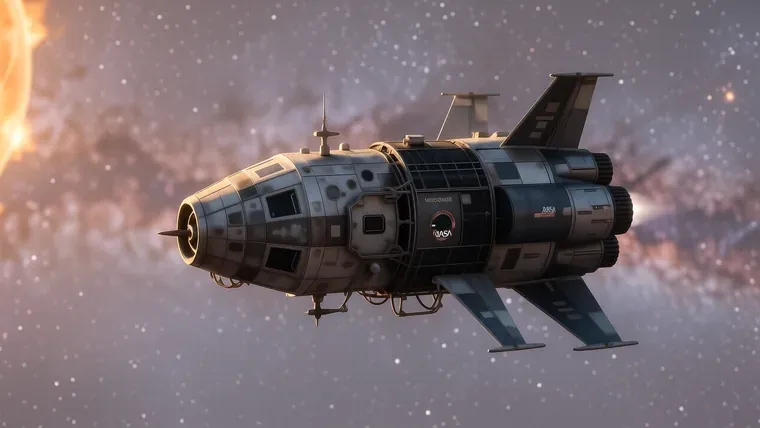
Voyager 1 is currently located in interstellar space, approximately 24 billion kilometers from Earth. It passed the heliopause boundary on August 25, 2012, after its cosmic ray instrument detected a sharp increase in galactic particles. The spacecraft continues to transmit data despite aging hardware and a significant communication delay that now exceeds 22 hours one way.
The current trajectory and distance
Space is vast. Voyager 1 moves through the interstellar medium at a high velocity while it slowly drifts further from the Sun. On January 1, 2023, the spacecraft sat at a distance of 23,830,940,000 km from Earth. This measurement changes throughout the year because Earth orbits the Sun faster than the probe moves away from our solar system.
The distance fluctuates. While we measure the straight-line distance between the probe and the Sun, the Earth’s position creates a seasonal variation in how far the signal must travel. Voyager 2 is slightly closer. It was located more than 19,890,790,000 km from Earth on that same date in early 2023.
The probes are lonely. They navigate a spiral path through the galaxy rather than a straight line so that their movement remains influenced by the complex gravitational forces within our solar system. This trajectory means they occasionally appear closer to Earth during specific months.
Communication takes time. A single command sent from the Deep Space Network requires nearly 23 hours to reach the probe, after which the response must travel all the way back to Earth. Engineers at JPL must plan maneuvers days in advance because they cannot react to real-time telemetry.
Engineering the interstellar survival
The hardware is old. Voyager 1 uses the HYPACE control computer, which combines digital and analog circuitry to manage its orientation. This system performs one million operations per second using a 10 MHz cycle so that it can maintain three-axis stabilization. It utilizes a 4K-28bit board similar to the one found on the Viking Orbiter.
Redundancy saved the mission. The spacecraft carries 16 primary hydrazine thrusters and 8 backup engines to maintain its attitude. JPL engineers successfully activated the backup MR-103 trajectory correction engines on November 28, 2017, although these units had not been used since 1980. This maneuver allowed the probe to continue its mission after the primary thrusters showed signs of deterioration.
Power is finite. The probes rely on radioisotope thermoelectric generators (RTGs) fueled by plutonium-238. These generators provide electricity by converting heat from radioactive decay into usable power for the instruments. Power levels drop steadily as the plutonium decays, so scientists expect the spacecraft to lose the ability to transmit data around 2025.
The instruments are protected. RITEGs sit on external brackets to prevent radiation from leaking into the sensitive scientific tools. The magnetometer is also mounted on a long boom because it must avoid interference from the magnetic fields generated by the probe’s own electronics.
- Plutonium-238 decay provides steady heat.
- Hydrazine thrusters manage orientation.
- The HYPACE computer processes logic.
- RTGs power all active systems.
Navigating the heliosphere boundaries
Voyager 1 reached a milestone in 2012. It crossed the heliopause, which is the region where the solar wind meets the interstellar medium. This transition occurred after the spacecraft’s sensors recorded a significant drop in solar particles and a spike in cosmic rays.
The boundary is complex. Voyager 2 followed this path later, crossing into interstellar space in 2018. Both probes have now passed through the terminal shock, which is the area where solar wind particles drop to subsonic speeds.
Interstellar space is harsh. High-energy radiation constantly hits the spacecraft, which can cause bit errors by flipping a binary 0 to a 1. These errors confuse the onboard software because the hardware was not designed for such intense cosmic ray bombardment.
The environment changes. As the probes move deeper into the galaxy, they encounter different densities of gas and dust. Scientists use the data from the cosmic ray instrument to map this “celestial shoreline” so that we can understand how our Sun interacts with the rest of the Milky Way.
The future of the Voyager mission
The end is coming. By 2025, the power output will likely fall below the threshold required to operate the scientific instruments and the high-gain antenna. Once the transmitters fail, the spacecraft will become silent, drifting through the dark without any way to tell us what it sees.
Voyager 1 has a long journey ahead. It will eventually reach the bow shock, which is the area where the interstellar medium slows down significantly. This encounter is projected to happen around the year 2042 after decades of silent flight.
The stars await. In approximately 38,000 years, Voyager 1 will pass near the star Gliese 445 in the constellation Giraffe. It will be about 1.7 light-years away from that star when it makes its closest approach.
Voyager 2 has a different path. It will leave the Sun’s gravitational influence by the year 2300, after which it will wander through various interstellar gas clouds. In the year 8,571 AD, it is expected to reach a distance of 4 light-years from Barnard’s Star.
The golden record remains. Inside each probe is a copper disk coated in gold that contains sounds and images from Earth. This message was designed by Carl Sagan so that any extraterrestrial civilization might one day understand our existence.
Comparing the deep space explorers
Voyager is not alone. Other missions have attempted to reach the edge of our solar system, but many have already ceased operations. Pioneer 10 and 11 were launched in 1972 to explore Jupiter and Saturn, yet both are now silent.
Pioneer 10 stopped communicating in 2003. It is currently located more than 19,692,000,000 kilometers from Earth. Pioneer 11 went dark even earlier, in 1995, while it traveled through the outer reaches of the system.
New Horizons is much younger. Launched in 2006, this probe successfully flew past Pluto and the Kuiper Belt object Arrokoth in 2019. It is currently about 8,366,000,000 kilometers from Earth and continues to gather data on the outer solar system.
The distances are immense. While New Horizons explores the Kuiper Belt, the Voyagers have already moved into the space between stars. This distinction makes the Voyager mission a different class of exploration because they are no longer bound by the Sun’s direct influence.
| Spacecraft | Status | Last Known Major Event |
|---|---|---|
| Voyager 1 | Operational | Passed heliopause (2012) |
| Voyager 2 | Operational | Passed heliopause (2018) |
| Pioneer 10 | Inactive | Communication lost (2003) |
| New Horizons | Operational | Pluto flyby (2015) |
The Voyagers continue to age. Every year, the degradation of the thermocouples and the decay of the plutonium makes the mission harder to sustain. Engineers must find clever ways to turn off non-essential heaters so that the remaining power can be used for science.
Even as the hardware fails, the data remains useful. The information gathered about the plasma density and the cosmic ray flux provides a map of the solar system’s edge. This knowledge helps us understand how the Sun protects Earth from the interstellar environment.
The spacecraft will eventually pass through the Oort Cloud. It will take approximately 30,000 years for Voyager 1 to exit this massive shell of icy objects. After that, it will enter the true void of the galaxy, moving toward the center of the Milky Way.
Frequently asked questions
How far away is Voyager 1 from Earth right now?
As of early 2023, Voyager 1 was located approximately 23,830,940,000 km from Earth. This distance fluctuates due to Earth's orbit around the Sun.
When did Voyager 1 enter interstellar space?
Voyager 1 passed the heliopause boundary and entered interstellar space on August 25, 2012, after detecting a sharp increase in galactic particles.
How long does it take to communicate with the Voyager probes?
Communication involves a significant delay; a single command sent from the Deep Space Network takes nearly 23 hours to reach the probe.
What powers the Voyager spacecraft?
The probes are powered by radioisotope thermoelectric generators (RTGs) fueled by plutonium-238, which convert heat from radioactive decay into electricity.
More in Solar System
Calculating the Earth's mass: A complex task
Learn how scientists use the gravitational constant and orbital mechanics to determine Earth's mass of approximately 5.9722 x 10^24 kg.
How many natural satellites does the earth possess?
Explore Earth's celestial companions, from the permanent Moon to transient quasi-satellites and cosmic dust clouds located at Lagrange points.
How many planets orbit the sun in second grade lessons
Learn how many planets orbit the sun and discover key facts about the eight official planets, from Mercury to Neptune, for students and educators.

Finding the location of the Chelyabinsk meteorite impact
Discover where the Chelyabinsk meteorite landed, including details on the Lake Chebarkul fragment and the primary debris field in Russia.