How many planets orbit the sun in second grade lessons
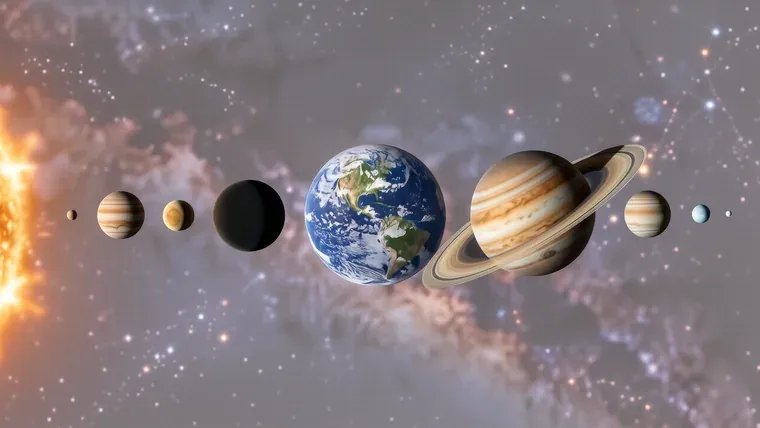
There are eight officially recognized planets orbiting the Sun: Mercury, Venus, Earth, Mars, Jupiter, Saturn, Uranus, and Neptune. While many people still remember Pluto as the ninth planet, the International Astronomical Union reclassified it as a dwarf planet in 2006 because its mass is insufficient to clear its orbital path of other debris. These eight worlds follow specific trajectories called orbits around our central star.
The Central Star and Solar System Formation
The Sun provides everything. It sits at the center of our system. This massive sphere of hydrogen and helium contains approximately 99.8% of the total mass in the solar system, so its gravity holds every planet, moon, and asteroid in a stable orbit. The Sun is huge. Its equatorial diameter measures 1,392,000 km, which makes it about 109 times larger than the diameter of Earth.
The system is old. It formed roughly 4.5 to 4.6 billion years ago. A massive cloud of gas and dust collapsed toward a central point because gravitational forces caused the particles to coalesce into a spinning disk. This process created the Sun and the planets. Most scientists believe the planets grew from these leftover materials after the Sun ignited.
The Sun is hot. Its surface temperature stays around 5,500 degrees Celsius. The core is much hotter, reaching 15 million degrees Celsius, so the intense pressure maintains the nuclear fusion that powers the star. It radiates energy constantly. This light travels to Earth in about 8 minutes.
The Terrestrial Planets
The inner planets are rocky. Mercury, Venus, Earth, and Mars make up this group. These four worlds have solid surfaces because they formed closer to the Sun where temperatures were too high for volatile gases to condense easily. They are small. Compared to the gas giants, these terrestrial planets have relatively low masses and densities.
Mercury is first. It is the smallest planet. This world orbits the Sun in only 87.97 days, although its rotation is very slow at 58 Earth days. Temperatures vary wildly. During the day, Mercury reaches 350 degrees Celsius, while the night side drops to -170 degrees Celsius. It has no moons.
Venus is second. It is often called Earth’s twin. The planet has a diameter of 12,104 km, but its atmosphere consists of 95% carbon dioxide so that it creates an intense greenhouse effect. This makes Venus the hottest planet. Average temperatures reach 480 degrees Celsius.
Earth is third. It is our home. Water covers 70% of the surface, which allows for the complex biological processes required to sustain life. We have one moon. The Moon reflects sunlight and influences our tides because its gravitational pull affects Earth’s oceans.
Mars is fourth. It is the Red Planet. The surface looks red due to iron oxide, which is essentially rust, coating the dusty landscape. It has two moons named Phobos and Deimos. These small satellites have irregular shapes, so they look more like asteroids than spherical worlds.
- Mercury: 0 satellites.
- Venus: 0 satellites.
- Earth: 1 satellite (the Moon).
- Mars: 2 satellites (Phobos, Deimos).
The Gas and Ice Giants
The outer planets are massive. Jupiter, Saturn, Uranus, and Neptune form this second group. These worlds lack solid surfaces because they consist mostly of hydrogen, helium, and other gases. They are far away. Their orbits take much longer to complete than the inner planets do.
Jupiter is fifth. It is the largest planet. Its mass is more than twice that of all the other planets combined, so it exerts a massive gravitational influence on the entire solar system. A day lasts 9 hours and 55 minutes. It has many moons, including Ganymede, which is larger than the planet Mercury.
Saturn is sixth. It has famous rings. These rings consist of ice, rock, and dust particles that orbit the planet at speeds of 10 km/s. Saturn is huge. Its diameter is 120,536 km, although its density is so low that it would float in a giant bathtub of water.
Uranus is seventh. It is an ice giant. The planet rotates on its side because its axial tilt is approximately 97 degrees. This causes extreme seasons. A single season can last 42 years on Uranus, while the temperature can drop to -224 degrees Celsius.
Neptune is eighth. It is the farthest planet. Winds on Neptune can reach speeds of 700 kilometers per hour, which makes it one of the most violent environments in the solar system. It is blue. This color comes from methane in its atmosphere, which absorbs red light and reflects blue.
Dwarf Planets and the Kuiper Belt
Pluto is a dwarf planet. It was once the ninth planet. The IAU changed its status in 2006 because Pluto has not cleared its orbit of other objects in the Kuiper Belt. It is small. Its diameter is only about 2,377 kilometers.
Other dwarf planets exist. Ceres, Makemake, Eris, and Haumea are also recognized. These bodies reside in different parts of the solar system, so they each have unique compositions and orbital paths. They are icy. Most of them stay far beyond the orbit of Neptune.
The Kuiper Belt is vast. It contains many frozen objects. Scientists use telescopes to track these bodies because they provide clues about how the solar system formed billions of years ago. Some are large. Others are just small chunks of ice and rock.
- Ceres: Located in the asteroid belt.
- Pluto: Located in the Kuiper Belt.
- Eris: Located in the scattered disc.
- Haumea: Known for its elongated shape.
Comparing Planetary Characteristics
Size varies greatly. Jupiter is 11 times larger than Earth. This massive difference shows how much material gathered in the outer solar system while the inner planets remained small and rocky. Mass also differs. Jupiter’s mass is 318 times that of Earth.
Orbits differ too. Mercury moves fast. It completes a circuit in 88 days, whereas Neptune takes about 164 years to finish one trip around the Sun. Distance matters. The further a planet is from the Sun, the colder and slower its orbit becomes.
Satellites are common. Most outer planets have dozens of moons. For example, Jupiter has over 70 known satellites, although new ones are frequently discovered by advanced telescopes like those used in the Juno mission. Earth has only one. The Moon remains our only natural satellite.
Temperatures fluctuate. Mercury is hot. Venus is even hotter due to its atmosphere, while Neptune stays at a constant -220 degrees Celsius because it receives very little solar energy. Space is extreme. There are no moderate temperatures in the vacuum of the solar system.
The Sun’s mass is 332,950 times that of Earth. This enormous weight keeps everything in place. If the Sun were to disappear, the planets would fly off into space along straight lines because there would be no gravity to hold them.
Light takes time. It travels at 299,792 kilometers per second. While this seems fast, it still takes several hours for light to reach Neptune from the Sun, so astronomers must account for these delays when observing distant objects.
The solar system continues to change. New moons are found. Spacecraft like Voyager 2 have provided data that changes our understanding of these worlds every few years, so we are always learning something new about our cosmic neighborhood.
Frequently asked questions
How many planets are in our solar system?
There are eight officially recognized planets orbiting the Sun: Mercury, Venus, Earth, Mars, Jupiter, Saturn, Uranus, and Neptune.
Why is Pluto no longer considered a planet?
In 2006, the International Astronomical Union reclassified Pluto as a dwarf planet because its mass is insufficient to clear its orbital path of other debris.
What are the differences between terrestrial and gas giant planets?
Terrestrial planets like Earth and Mars are small, rocky worlds with solid surfaces, while gas giants like Jupiter and Saturn are massive and lack solid surfaces.
Which planet is the hottest in the solar system?
Venus is the hottest planet, with average temperatures reaching 480 degrees Celsius due to an intense greenhouse effect caused by its carbon dioxide atmosphere.
More in Solar System
Calculating the Earth's mass: A complex task
Learn how scientists use the gravitational constant and orbital mechanics to determine Earth's mass of approximately 5.9722 x 10^24 kg.
Discovering the current location of Voyager in interstellar space
Learn about the current location of Voyager 1 and 2, their distances from Earth, and how they navigate the harsh environment of interstellar space.
How many natural satellites does the earth possess?
Explore Earth's celestial companions, from the permanent Moon to transient quasi-satellites and cosmic dust clouds located at Lagrange points.
Finding the location of the Chelyabinsk meteorite impact
Discover where the Chelyabinsk meteorite landed, including details on the Lake Chebarkul fragment and the primary debris field in Russia.