Finding the location of the Chelyabinsk meteorite impact
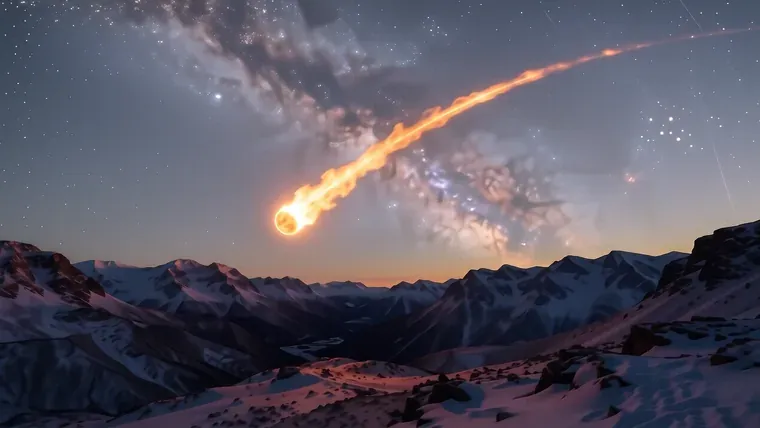
The Chelyabinsk meteorite entered the atmosphere over the South Ural region of Russia at 9:20 am local time on 15 February 2013. It exploded at an altitude of 23.3 km because the intense pressure of atmospheric deceleration caused the structure to fragment violently. The largest piece, a 654 kg mass, landed in Lake Chebarkul.
The Descent and Atmospheric Explosion
The sky brightened suddenly. A massive superbolide streaked across the morning horizon while residents were beginning their daily routines in the Chelyabinsk region. NASA data indicates the object had an initial mass between 7,000 and 13,000 tons. It was large. The diameter measured approximately 19.8 meters at the start of its descent.
The velocity was high. It traveled at roughly 17 to 19 km/s through the upper atmosphere so that the kinetic energy could be converted into a massive thermal and pressure wave. This energy release totaled between 440 and 570 kilotons of TNT. It was powerful. This yield exceeds the energy of the Hiroshima atomic bomb by more than 20 times, although it remains significantly smaller than the 1908 Tunguska event.
The explosion occurred rapidly. After 32.5 seconds of flight, the asteroid disintegrated into numerous fragments because the mechanical stress exceeded the internal strength of the stony material. A bright flash lasted for five seconds. This light preceded a destructive shockwave that reached the ground about one minute later.
Windows shattered everywhere. The pressure wave caused 1,613 injuries, mostly from flying glass shards, although no fatalities were recorded during the event. Damage was widespread. Material losses in the region reached an estimated 1 billion rubles after the initial chaos subsided.
The sound was strange. Witnesses reported hearing a hissing noise or electromagnetic discharges, which characterizes the event as an electrophonic bolide. It sounded loud. People mistook the atmospheric boom for a rocket malfunction or an airplane crash because the sound arrived shortly after the visual flash.
Fragment Distribution and Recovery
Fragments fell in several locations. The primary debris field spanned approximately 100 km across the Chelyabinsk and Zlatoust districts. Most pieces were small. Investigators located about 100 pieces of debris in the Emangelinsk and Travniki areas after extensive ground searches.
Lake Chebarkul holds a large piece. Fishermen observed a column of water and ice reaching 3 to 4 meters in height when the main fragment struck the surface. It was deep. A massive 654 kg specimen was recovered from the lake bed so that scientists could perform detailed geochemical analysis.
The search was difficult. Teams organized expeditions to the Deputatsky, Emangelinsk, and Pervomaysky districts because the fragmentation pattern was so irregular. Some pieces were tiny. Only about 0.05% of the original mass reached the ground, which results in a total recovered weight of roughly 4 to 6 tons.
Recovery efforts continued for months. Small specimens were found near the village of Etkul, which is located 20 km south of the city. Collectors often seek these pieces. Many small shards have entered the private market, although researchers advise against buying unverified stones from non-specialized stores.
The largest fragment remains protected. The State Historical Museum of the Southern Urals houses the primary specimen under a controlled microclimate. It is stable. The museum maintains a temperature no higher than 18 °C and humidity levels between 50% and 55% so that the mineral structure does not degrade.
Composition and Geochemical Profile
The meteorite is stony. It belongs to the LL5 class of ordinary chondrites, which is a very common subgroup among known meteorites. It contains chondrons. These small, spherical melted formations measure approximately 1 mm in diameter.
Minerals are diverse. The composition includes olivine, pyroxene, and kamasite, while unexpected copper nuggets were also identified within the structure. This was unusual. Such large copper inclusions have not been commonly observed in other LL chondrite samples before this discovery.
The fusion crust is complex. It contains pentlandite, magnetite, and iridium because the intense heat of entry melted the outer layers of the asteroid. The surface is dark. Analysis using the Rietveld method on a fragment from Deputatsky showed 37% forsterite ferruginous and 35% glass.
Internal fractures exist. These cracks are filled with feldspathic glass because a major collision occurred approximately 290 million years ago. The object is old. Uranium and lead isotope analysis suggests the primary material formed about 4.45 billion years ago.
The history is violent. Dark streaks inside the structure indicate that the asteroid experienced high-temperature events during its long journey through the solar system. It survived much. Some researchers believe the presence of partially melted iron nuclei proves the object was once in close proximity to the Sun.
Orbital Dynamics and Origins
The object came from space. It originated in the primary asteroid belt located between the orbits of Mars and Jupiter. It followed a specific path. Astronomers used satellite imagery and video footage to reconstruct its trajectory after it entered the atmosphere.
The orbit was elliptical. The major semi-major axis measured approximately 1.76 a.u. while the perihelion sat at 0.74 a.u. and the aphelion reached 2.6 a.u. It moved fast. These orbital parameters allowed scientists to search astronomical catalogs for potential parent bodies.
Potential parents exist. Researchers Raul and Carlos de la Fluente Marcos suggested asteroid 2011 EO40 as a possible predecessor because its orbit shows significant similarities. The connection is likely. Another team led by Jiří Borovicka identified asteroid 86039 (1999 NC43) as a candidate due to its 2.2 km diameter and similar orbital path.
The asteroid was lost. Many small celestial bodies are cataloged and then disappear from observation before being rediscovered by modern surveys. It returned suddenly. The Chelyabinsk object represents a typical encounter with a near-Earth asteroid that had been traveling undetected for thousands of years.
Impact Sites and Memorials
The epicenter was remote. While the flash was visible over Chelyabinsk, the actual impact occurred in the neighboring areas of Emangelinsk and Yuzhnouralsk. It was quiet there. The most significant physical damage happened due to the atmospheric shockwave rather than a direct ground hit.
A memorial exists now. A marble stele stands near Lake Chebarkul to commemorate the event. It is shaped like a lake. A metal beam runs through the structure so that visitors can see the exact coordinates where the fragment landed.
The site is accessible. Visitors can look through a designated aperture in the stele to view the impact spot. There is a buoy. A red-and-white buoy floats on the water at the precise location of the Chebarkul impact.
Museums offer more context. The Natural Science Museum of the Ilmensky Reserve in Miass contains 30,000 items for comparison. It is educational. Visitors can compare the Chelyabinsk fragments to local minerals like ilmenite, which was originally found in the nearby Ilmen Mountains.
The event changed science. This fall provided the most well-documented data on a modern meteor impact because of the widespread video coverage. We learned much. The transition from visual observation to digital recording allowed for a level of scrutiny that previous events like Tunguska lacked.
The sky returned to normal. Even though the 2013 event caused significant local disruption, it served as a reminder of the constant flux within our solar system. Small objects enter the atmosphere roughly five times every century. Most of these fall over oceans or uninhabited deserts without being noticed by anyone.
Frequently asked questions
Where did the largest piece of the Chelyabinsk meteorite land?
The largest fragment, weighing 654 kg, landed in Lake Chebarkul. Fishermen observed a water and ice column reaching 3 to 4 meters in height upon impact.
At what altitude did the Chelyabinsk meteorite explode?
The meteorite exploded at an altitude of 23.3 km due to intense pressure from atmospheric deceleration.
What was the extent of the debris field after the impact?
The primary debris field spanned approximately 100 km across the Chelyabinsk and Zlatoust districts, with pieces found in areas like Emangelinsk and Travniki.
How much energy was released during the Chelyabinsk event?
The energy release totaled between 440 and 570 kilotons of TNT, which is more than 20 times the energy of the Hiroshima atomic bomb.
More in Solar System

Calculating the Earth's mass: A complex task
Learn how scientists use the gravitational constant and orbital mechanics to determine Earth's mass of approximately 5.9722 x 10^24 kg.
Discovering the current location of Voyager in interstellar space
Learn about the current location of Voyager 1 and 2, their distances from Earth, and how they navigate the harsh environment of interstellar space.

How many natural satellites does the earth possess?
Explore Earth's celestial companions, from the permanent Moon to transient quasi-satellites and cosmic dust clouds located at Lagrange points.
How many planets orbit the sun in second grade lessons
Learn how many planets orbit the sun and discover key facts about the eight official planets, from Mercury to Neptune, for students and educators.