How many natural satellites does the earth possess?
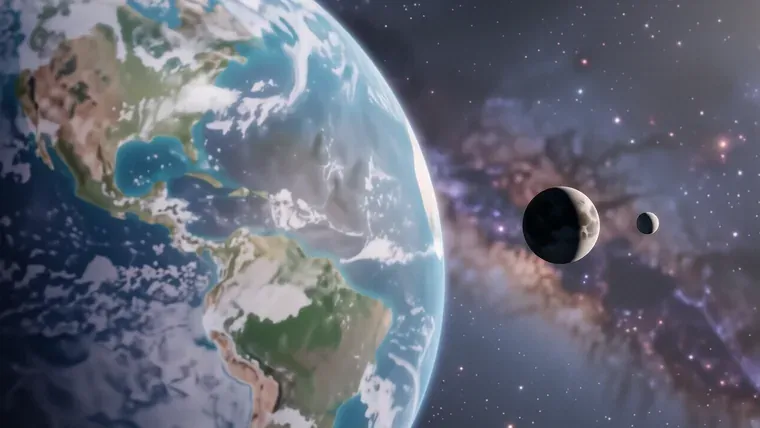
Earth possesses one permanent, natural satellite: the Moon. While the Moon remains the only solid, long-term celestial companion, our planet also interacts with various transient objects, quasi-satellites, and dust accumulations that mimic satellite behavior. These include temporary asteroids captured by gravity, horseshoe-orbiting bodies like 3753 Cruithne, and the Kordylewski clouds located at the Earth-Moon Lagrange points.
The Primary Satellite
The Moon is our only true companion. It orbits the Earth every 27.3 days. This satellite maintains a stable, circular path because the gravitational pull of our planet prevents it from drifting into deep space. The Moon is old. Data from 2020 suggests an estimated age of 4.25 billion years, although there remains a margin of error of 25 million years.
Scientists once debated its origin. George Howard Darwin proposed in 1878 that the Earth’s rotation ejected igneous rock into orbit. This theory failed. Analysis of lunar soil samples collected during the Apollo missions discredited his hypothesis because no iron was found within the lunar regolith. The collision theory gained traction after a 1984 conference in Hawaii.
Theia likely caused the impact. A massive protoplanet named Theia struck the Earth approximately 4.4 billion years ago so that the resulting debris could coalesce into the Moon. This event explains the chemical composition of the lunar surface. It also accounts for the slight tilt in our planet’s orbit.
The system is actually a double planet. Both bodies revolve around a single center of mass located about 5,000 kilometers from the Earth’s center. The Moon is large. Because of this significant mass ratio, the two objects function as a shared gravitational unit. This relationship mirrors the interaction between Pluto and its moon Charon.
The surface is rugged. Mountains, valleys, and lunar seas dominate the landscape. These “seas” are actually lowlands formed by solidified lava. The Moon has no thick atmosphere. It possesses only an extremely thin exosphere, which means the sky remains perpetually black even during the daylight hours.
Transient and Quasi-Satellites
Earth captures temporary visitors. These objects enter our orbit for short periods before they eventually break free. One such asteroid is 2006 RH120. It has a diameter of approximately 6 meters. This object enters Earth’s orbit roughly every twenty years because its trajectory brings it into our gravitational influence periodically.
It was here recently. The asteroid was present from September 2006 to June 2007. It will return in 2028. Astronomers also track objects like 2020 CD3, which appeared to be a natural satellite until researchers identified it as a 1960s rocket booster remnant.
Quasi-satellites follow different paths. They do not orbit the Earth directly. Instead, they revolve around the Sun in a 1:1 orbital resonance with our planet. This creates a horseshoe-shaped path that makes them appear to be near Earth. They are deceptive.
Cruithne is the most famous example. Discovered in 1986, this object belongs to the rare spectral class Q. It has a diameter of 5 kilometers. Cruithne traverses the orbits of Earth, Venus, and Mars because its highly elongated path crosses multiple planetary lanes.
Other quasi-satellites exist. There are seven known bodies: Cruithni, Kamoaleva, Duende, 2003 YN107, 2004 GU9, 2010 SO16, and the Trojan satellite 2010 TK7. Kamoaleva is particularly stable. It assumed its current status about a century ago so that it might continue accompanying Earth for the next million years.
Duende is very small. This object measures only 30 meters in diameter. It was discovered in 2012. Because of its tiny size, it remains one of the smallest detected quasi-satellites in our immediate vicinity.
The Kordylewski Clouds
Dust gathers in specific spots. These locations are known as Lagrange points L4 and L5. They form an equilateral triangle with the Earth and the Moon. Gravity holds these particles in place.
These clouds are called Kordylewski clouds. They were named after Kazimierz Kordylewski, who first observed them in 1956. For decades, their existence remained controversial. A group of Hungarian astronomers finally confirmed the detection of one at L5 in 2018 because previous observations lacked sufficient clarity.
The clouds are not solid. They consist of accumulations of cosmic dust. Each cloud has an estimated mass of 10,000 tons. The diameter of these clusters ranges from 10,000 to 40,000 km.
Dust particles move constantly. Some particles escape into space while new ones are pulled into the cluster. They act as “ghost moons.” Although they are permanent features of our orbital environment, they will never coalesce into a single rocky body.
Artificial Satellites
Humans have crowded the orbit. We use machines to stay connected. The USSR launched Sputnik-1 in 1957, which began the era of human-made satellites. Since then, the number of objects has grown exponentially.
The count is high. As of April 2022, the United Nations reported approximately 12,500 artificial objects in orbit. Many are active. By the end of 2021, more than 8,000 of these devices remained operational for their intended purposes.
Satellites serve many roles. They handle meteorology, navigation, and communication. Military satellites are also common. Because much of this technology remains classified, the exact number of active human-made objects is difficult to verify.
Space stations are also present. The International Space Station (ISS) and China’s Tiangong both orbit the planet. These are manned environments. They allow humans to live in microgravity while conducting long-term scientific research.
Debris remains a problem. Old satellites eventually die. We move them to “graveyard orbits” at altitudes of 35,986 kilometers or between 600 and 1,000 kilometers above the surface. This prevents dead hardware from colliding with active missions.
Historical Misidentifications
Astronomers have been mistaken. In the 19th century, several scientists claimed to find new moons. These claims never held up under scrutiny.
Frederick Petit was one such person. He served as the director of the Toulouse Observatory. In 1846, he identified a bolide as a satellite. It had a rotational period of 2 hours and 45 minutes. His theory failed because subsequent observations could not confirm the object’s orbit.
Georg Waltemath also made claims. In 1898, he announced a system of small satellites. He predicted one would pass across the solar disk in February of that year. Amateur astronomers in Germany saw something, but professional observers reported nothing but sunspots.
The search continued into the 20th century. William Pickering and Clyde Tombaugh both looked for Earth’s companions. They found nothing. Tombaugh, famous for discovering Pluto, concluded in 1959 that no objects with a brightness exceeding magnitude 12-14 were orbiting the Earth.
Some even turned to mysticism. In 1918, Walter Gornold named a hypothetical satellite “Lilith.” He believed it had a mass similar to the Moon. This idea was dismissed by the scientific community because such a massive body would have visibly disturbed the Moon’s orbit.
The Moon remains our primary focus. We study its regolith and its thin atmosphere. Its presence dictates our tides and stabilizes our axial tilt. While we look for other companions, the Moon stays as the central figure of our local space environment.
Frequently asked questions
What is Earth's only permanent natural satellite?
The Moon is Earth's only true, long-term natural companion. It orbits the planet every 27.3 days and is estimated to be approximately 4.25 billion years old.
What are quasi-satellites?
Quasi-satellites are objects like Cruithne that revolve around the Sun in a 1:1 orbital resonance with Earth. They appear to be near our planet due to a horseshoe-shaped path rather than orbiting Earth directly.
What are the Kordylewski clouds?
These are accumulations of cosmic dust located at the Earth-Moon Lagrange points L4 and L5. Each cloud has an estimated mass of 10,000 tons and a diameter ranging from 10,000 to 40,000 km.
How many artificial satellites are in orbit?
As of April 2022, the United Nations reported approximately 12,500 artificial objects in orbit, with more than 8,000 of those being operational devices.
More in Solar System
Calculating the Earth's mass: A complex task
Learn how scientists use the gravitational constant and orbital mechanics to determine Earth's mass of approximately 5.9722 x 10^24 kg.
Discovering the current location of Voyager in interstellar space
Learn about the current location of Voyager 1 and 2, their distances from Earth, and how they navigate the harsh environment of interstellar space.
How many planets orbit the sun in second grade lessons
Learn how many planets orbit the sun and discover key facts about the eight official planets, from Mercury to Neptune, for students and educators.
Finding the location of the Chelyabinsk meteorite impact
Discover where the Chelyabinsk meteorite landed, including details on the Lake Chebarkul fragment and the primary debris field in Russia.