Biography of Russian cosmonaut Maxim Viktorovich Suraev

Maxim Viktorovich Suraev is a Russian Colonel and test cosmonaut who completed two long-duration expeditions to the International Space Station (ISS). He flew as the commander of Soyuz TMA-16 from 30 September 2009 to 18 March 2010, and again as commander of Soyuz TMA-13M from 28 May 2014 to 10 November 2014. His total time in orbit across these two missions reached 334 days, 12 hours, 10 minutes, and 46 seconds.
Early Military Career and Training
Suraev was born on 24 May 1972, He grew up in Chelyabinsk within a military family. This background influenced his early academic and professional choices. He attended secondary school No. 5 in Noginsk, located in the Moscow Region, until he finished his studies in 1989.
He pursued aviation. In 1994, he graduated with distinction from the Kachinsk Higher Military Aviation School of Pilots, which is named after A.F. Myasnikov. He later earned honors from the Air Force Engineering Academy, named after N.E. Zhukovsky, in 1997.
He flew combat aircraft. Between 1994 and 1997, Suraev served in Air Force combat units where he gained experience flying L-39 and Su-27 jets. He accumulated approximately 700 hours of flight time during this period. He also completed over 100 parachute jumps to satisfy military requirements.
His path changed in 1997. He was accepted as a candidate test cosmonaut at the Gagarin Cosmonaut Training Research Test Center in June of that year. He underwent comprehensive space training from 1998 through 1999 so that he could meet the rigorous standards for orbital flight. By December 1999, he was officially certified as a test cosmonaut.
The First Expedition: Soyuz TMA-16
The first mission began in 2009. Suraev served as the commander of the Soyuz TMA-16 spacecraft and as a flight engineer for the 21st and 22nd main expeditions to the ISS. He launched on 30 September 2009 alongside American astronaut Jeffrey Williams and Canadian space tourist Guy Laliberté.
The docking was successful. On 2 October 2009, the Soyuz TMA-16 spacecraft connected with the International Space Station. This mission lasted for 169 days, 4 hours, 9 minutes, and 37 seconds. During this time, Suraev performed an extravehicular activity (EVA) that lasted 5 hours and 44 minutes.
He was a digital pioneer. Suraev became the first Russian cosmonaut to document his journey through an online journal on the Roscosmos website. He wrote 98 entries about daily life in microgravity. He described specific activities such as:
- The biological experiments involving wheat growth.
- The breeding of butterflies in zero gravity.
Also worth noting: The logistics of sleeping in specialized bags, and The consumption of space food.
The return was precise. On 18 March 2010, the descent vehicle detached from the station and landed in Kazakhstan. The landing occurred approximately 57 km away from the city of Arkalyk. He received the title of Hero of the Russian Federation by a Presidential Decree on 30 October 2010.
Second Flight and Command of TMA-13M
Suraev returned to space in 2014. He commanded the Soyuz TMA-13M spacecraft during the 40th and 41st main expeditions to the ISS. His crew included Gregory Wiseman from the United States and Alexander Gerst from Germany.
The mission was long, It lasted 165 days, 8 hours, 1 minute, and 9 seconds. On 29 May 2014, the Soyuz TMA-13M successfully docked with the station. He performed a second spacewalk during this mission which lasted for 3 hours and 41 minutes.
The landing site was similar. On 10 November 2014, the spacecraft undocked and the descent vehicle landed in Kazakhstan just north of Arkalyk. This flight solidified his experience as a high-level mission commander.
His cumulative orbital stats are significant.
- Total spaceflight duration: 334 days, 12 hours, 10 minutes, 46 seconds.
- Total EVA time: 9 hours and 25 minutes.
- Total missions: 2.
Post-Cosmonaut Career and Public Service
Suraev moved into politics, in 2013, he led the election campaign for A.Yu. Vorobyev in the Moscow region leadership elections. He later became a member of the General Council of “United Russia” in 2016.
He entered the legislature. Suraev served as a member of the State Duma of the VII convocation. Because he took on these political responsibilities, he was relieved of his duties as a test cosmonaut and removed from the cosmonaut team.
His honors are numerous. He holds several decorations including:
- Hero of the Russian Federation (2010).
- Order of Merit to the Fatherland, 4th degree (2016).
Also worth noting: “For Merit in Space Exploration” medal (2011), and Honorary Citizen of Noginskiy District.
He remains a local figure, in 2011, Secondary School No. 5 in Noginsk was named after him. A memorial sign also exists on Victory Square in Noginsk to commemorate his service.
Technical Qualifications and Personal Life
Suraev holds several professional certifications. He is qualified as a “Military pilot 3rd class” and a “Parachute and airborne training instructor.” He also maintains credentials as a “Diving officer,” “Cosmonaut 3rd class,” and “Test cosmonaut 2nd class.”
His family life is private, He is married to Anna. They have two daughters.
He transitioned to the reserve in 2012, This followed his active military service which began in 1989. His career moved from the cockpit of a Su-27 to the command module of a Soyuz spacecraft, although his later years have been defined by legislative work in the Moscow region.
Frequently asked questions
How much total time did Maxim Viktorovich Suraev spend in space?
He spent a total of 334 days, 12 hours, 10 minutes, and 46 seconds in orbit across two missions.
What spacecraft did Suraev command during his expeditions?
He served as the commander of the Soyuz TMA-16 mission in 2009 and the Soyuz TMA-13M mission in 2014.
What honors has Maxim Viktorovich Suraev received?
He was awarded the title of Hero of the Russian Federation in 2010 and the Order of Merit to the Fatherland, 4th degree, in 2016.
How many spacewalks did Suraev perform during his career?
He performed two extravehicular activities (EVAs) totaling 9 hours and 25 minutes of spacewalk time.
More in Solar System
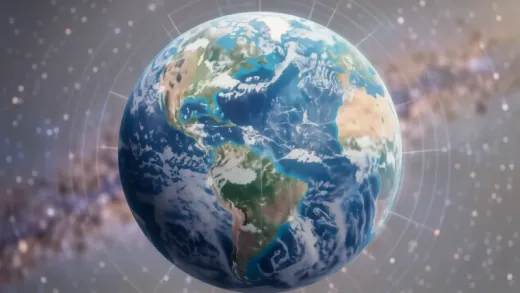
Calculating the Earth's mass: A complex task
Learn how scientists use the gravitational constant and orbital mechanics to determine Earth's mass of approximately 5.9722 x 10^24 kg.
Discovering the current location of Voyager in interstellar space
Learn about the current location of Voyager 1 and 2, their distances from Earth, and how they navigate the harsh environment of interstellar space.
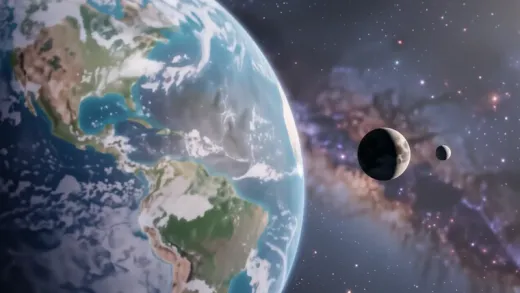
How many natural satellites does the earth possess?
Explore Earth's celestial companions, from the permanent Moon to transient quasi-satellites and cosmic dust clouds located at Lagrange points.
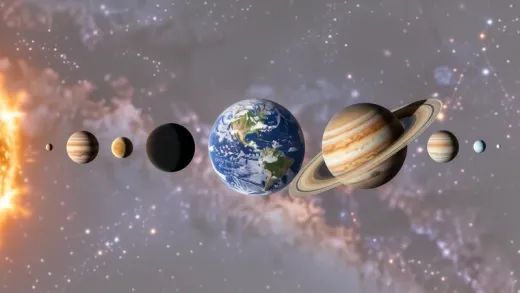
How many planets orbit the sun in second grade lessons
Learn how many planets orbit the sun and discover key facts about the eight official planets, from Mercury to Neptune, for students and educators.