The Moon's perigee: What does it mean for Earth?
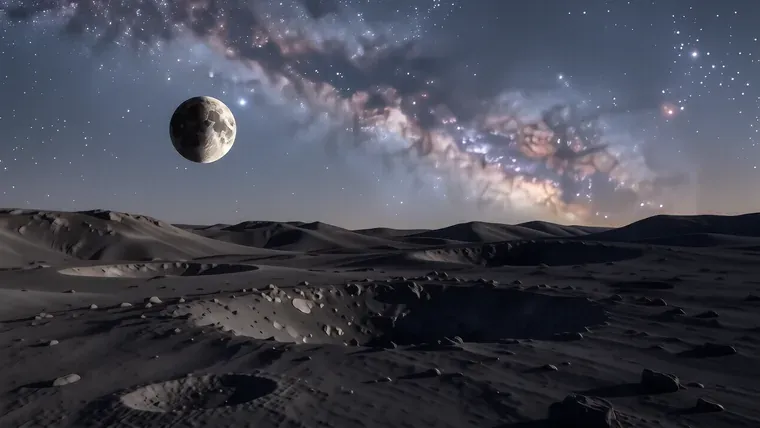
Perigee occurs when the Moon reaches its closest point to Earth in its elliptical orbit, typically measuring between 356,410 and 370,400 kilometers from the planet’s center. This proximity increases the Moon’s apparent size and brightness because the distance between the two bodies is at its minimum. Apogee describes the opposite state, where the Moon reaches a maximum distance of approximately 406,700 kilometers.
Orbital Mechanics and Distances
The Moon follows an ellipse. It is not a circle. Because the lunar orbit lacks perfect circularity, the distance between the Earth and the Moon fluctuates throughout every synodic month. This cycle takes roughly 29.5 days to complete.
The distance varies significantly. Perigee can reach as low as 356,410 kilometers. While the average distance sits at 384,400 kilometers, the gap widens during apogee so that the Moon appears much smaller in the night sky.
Specific measurements change often. On 21 January 2023 at 23:59 MSK, the Moon reached perigee at a distance of 356,569 kilometers. These shifts happen because the eccentricity of the orbit dictates how much the Moon speeds up or slows down during its revolution.
The apsidal line shifts. This line connects perigee and apogee. As the position of this line changes over time, the timing of these closest and farthest approaches also moves.
The Supermoon Phenomenon
Supermoons are not official IAU terms. Journalists use them. Although astronomers prefer technical descriptions, the public recognizes a supermoon when a full moon coincides with perigee within a three-day window.
The Moon looks larger. It is bright. A supermoon can appear 14% larger and 30% brighter than a full moon occurring at apogee because the proximity to Earth increases the angular diameter of the lunar disk.
Observers cannot see this easily. The naked eye struggles with the difference. You must use a camera or a telescope to confirm the increased scale, although the brightness remains detectable during clear nights.
The distance matters here. For a supermoon to qualify by common definition, the perigee distance should be less than 362,000 kilometers. This specific threshold separates a standard full moon from one that qualifies as a supermoon in popular media.
Gravitational and Biological Effects
Tides respond to gravity. The Moon pulls. When the Moon reaches perigee, its gravitational pull on Earth’s oceans increases because the distance between the two masses has decreased significantly.
Plants react to light. Some researchers note changes in growth. During perigee, certain seeds may absorb more moisture, although some traditional agricultural practices suggest avoiding planting or transplanting during these windows to prevent pest infestation.
Human biology remains a subject of study. The Moon affects tides. While many people claim lunar cycles influence mood, scientific data from NASA and other agencies focus primarily on the physical tidal forces rather than psychological shifts.
The 1962 Cuban Missile Crisis reached its peak while the Moon was near Earth. This historical coincidence shows how celestial positions align with human events. We cannot prove causation, but the timing remains a point of interest for historians.
Psychological and Observational Perspectives
Apogee brings distance. People feel calm. Some observers suggest that during apogee, individuals may experience a sense of optimism because the Moon’s influence feels less intense from its farthest orbital point.
Perigee brings tension. It is heavy. Because the Moon is closer, some people report increased irritability or nervousness during these periods of maximum proximity.
Avoid big decisions. Stay calm. If you feel overwhelmed by sudden emotions, it may help to listen to calming music so that you can regain your composure before acting impulsively.
- Monitor tidal changes.
- Track lunar phases.
- Observe the Moon’s diameter.
- Note the brightness levels.
Orbital Variations in Artificial Satellites
Perigee applies to satellites too. Earth is not a sphere. Because the Earth’s shape is an oblate spheroid, the trajectory of an artificial satellite’s perigee changes based on its inclination to the equatorial plane.
The orbit shifts constantly. Gravity is complex. A satellite might experience a different perigee height depending on whether it orbits over the poles or the equator, although the Earth’s mass distribution remains the primary driver of these perturbations.
Satellites use perigee for maneuvers. They change speed. Engineers often adjust a spacecraft’s velocity at perigee so that they can raise the apogee to reach a higher orbit.
The shape matters. Gravity is uneven. The bulge at the Earth’s equator creates a non-uniform gravitational field, which means that an artificial satellite’s path will drift over time if left uncorrected.
Summary of Lunar Distances
The Moon moves. It orbits. We see the results in the sky every month as the distance between Earth and the Moon fluctuates between 356,410 and 406,700 kilometers.
Perigee is close. Apogee is far. While perigee brings a larger and brighter Moon, apogee provides a smaller view that allows for a different perspective on the lunar surface.
The cycle continues. It never stops. After the Moon passes through its closest point, it begins its long trek back toward the farthest reaches of its elliptical path.
Frequently asked questions
What is the Moon's perigee?
Perigee is the point in the Moon's elliptical orbit where it is closest to Earth, typically measuring between 356,410 and 370,400 kilometers from the planet's center.
What causes a supermoon?
A supermoon occurs when a full moon coincides with perigee within a three-day window, making the Moon appear up to 14% larger and 30% brighter.
How does perigee affect Earth's tides?
Because the distance between the two masses decreases during perigee, the Moon's gravitational pull on Earth's oceans increases, resulting in stronger tidal responses.
What is the difference between perigee and apogee?
Perigee is the closest point in the lunar orbit, while apogee is the farthest point, reaching a maximum distance of approximately 406,700 kilometers.
More in Moon
The path of the Moon's orbit around Earth
Explore the mechanics of lunar motion, including elliptical orbits, tidal locking, and how the Moon's distance fluctuates between perigee and apogee.
What is the color of the moon and why does it look gray?
Discover why the Moon appears gray due to regolith while its underlying geological composition contains hidden shades of brown, red, and blue.
When is the full moon in June 2021?
Discover the exact timing of the June 2021 Strawberry Moon and learn about its astronomical significance, seasonal names, and zodiacal alignment.
Which occurs more frequently, a lunar or solar eclipse?
Learn why solar eclipses occur more often than lunar eclipses and explore the mechanics, types, and safety requirements for observing these celestial events.