The path of the Moon's orbit around Earth
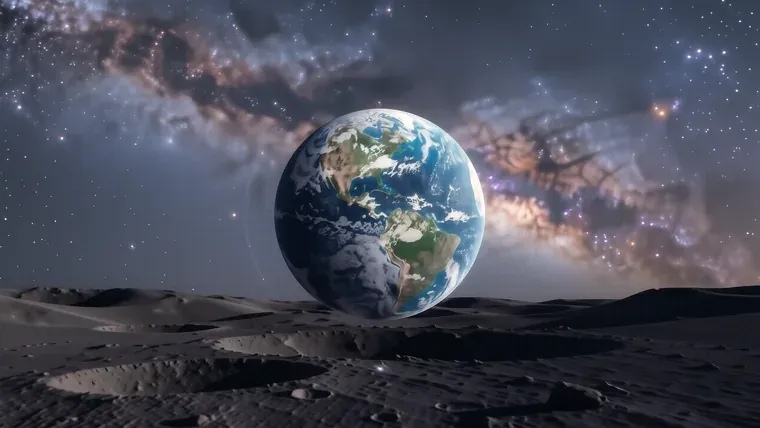
The Moon maintains synchronous rotation with Earth. This means it completes one axial rotation in approximately 27.32 days, which is the same duration required to complete a single orbit around our planet. Because these two periods align so precisely, observers on Earth always see the same lunar hemisphere. The far side remains hidden from terrestrial view without spacecraft intervention.
Orbital Mechanics and the Barycenter
The Moon follows an elliptical path. It is not a perfect circle. The eccentricity of this orbit measures 0.0549, although the shape appears nearly circular to the naked eye. This deviation causes the distance between the Earth and the Moon to fluctuate significantly during a single revolution.
Perigee is the closest approach. At this point, the Moon reaches a distance of approximately 363,104 kilometers from Earth. The satellite moves faster here because the gravitational pull of the Earth is at its maximum intensity. This increased velocity follows Kepler’s second law regarding orbital motion.
Apogee represents the farthest point. The distance reaches 405,696 kilometers during this phase of the orbit. The Moon travels more slowly through space while it sits at this distant extremity. This variation in speed creates a predictable but uneven rhythm in the lunar month.
The system has a center. This point is called the barycenter. It does not sit at the center of the Earth, but rather resides approximately 4,624 kilometers from the Earth’s center. Because this point lies within the Earth’s mantle, the Earth wobbles slightly as the Moon orbits.
The Earth-Moon system moves together. They orbit a shared center of mass while traveling around the Sun. This combined motion follows a convex path through the solar system because the gravitational influence of the Sun on the Moon exceeds twice that of the Earth.
The Synchronous Rotation Phenomenon
The Moon rotates. It does not stay stationary. Many people believe the Moon lacks an axis, but it actually possesses one that is inclined 1.5° to the ecliptic plane. This rotation is perfectly timed with its orbital period so that the same face always points toward our planet.
Tidal locking caused this. Earth’s gravity exerted a constant pull on the lunar mass for billions of years. This force acted as a brake on the Moon’s original, faster rotation until the speeds synchronized. The process reached a stable state after eons of gravitational interaction between the two bodies.
We see one side. The visible hemisphere remains constant. We can use a simple analogy involving a weight on a string to understand this motion. As you swing the weight, you only see one side because the rotation matches the orbital sweep around your hand.
Libration allows more views. We actually see about 59% of the lunar surface over time. This happens through longitudinal and latitudinal libration because the elliptical orbit causes the Moon’s orbital speed to vary against its constant rotational speed.
Types of Lunar Months
The sidereal month lasts 27.32 days. This measures one full revolution relative to the distant, fixed stars. It is the most fundamental measurement of the Moon’s actual orbital period.
The synodic month lasts 29.53 days. This is the time between two consecutive full moons. The extra 2.21 days occur because the Earth moves along its own orbit around the Sun while the Moon is revolving.
Measuring the Path
- Sidereal month: 27.321662 days.
- Synodic month: 29.530589 days.
- Anomalistic month: 27.554550 days.
- Draconic month: 27.212221 days.
Orbital Perturbations and Precession
The Moon’s path shifts. It is not a static loop. The major axis of the elliptical orbit undergoes apsidal precession every 8.85 years. This rotation occurs in the same direction as the Moon’s forward motion through space.
Nodal regression also happens. The line where the lunar orbit intersects the ecliptic plane moves backward. This movement completes a full cycle every 18.6 years because of the complex gravitational tugging from the Sun and other planets.
The inclination varies. The angle between the Moon’s orbit and the ecliptic is roughly 5.09°. This tilt changes periodically so that the Moon’s path moves north and south of the ecliptic plane over long cycles.
Gravity dictates these shifts. The Sun exerts a massive influence on the lunar trajectory. While the Earth provides the primary centripetal force, the Sun’s pull causes the orbital plane to wobble significantly over decades.
The nodes are critical. They are the two points where the Moon crosses the ecliptic. Solar and lunar eclipses can only occur when the Moon is near one of these nodes because the alignment must be three-dimensional.
Lunar Phases and Illumination
Phases depend on geometry. The Sun illuminates half of the Moon at all times. We only see different amounts of that light depending on the angle between the Earth, Moon, and Sun.
The New Moon is dark. The Moon sits between the Earth and the Sun. We cannot see it because the unilluminated side faces our planet during this phase.
The First Quarter shows half. The Sun illuminates the right side of the lunar disk. This occurs when the Moon reaches a 90-degree angular distance from the Sun.
The Full Moon is bright. The Moon is in opposition to the Sun. We see the entire illuminated hemisphere because the Earth sits directly between the two bodies.
The Last Quarter returns. The left side of the Moon is now lit. This phase occurs as the Moon moves toward its next new moon position.
Observing the Crescent
A waxing crescent appears after the new moon. It grows in brightness each night. You can use the “P” mnemonic in the northern hemisphere to identify it because the shape resembles a letter with a stick.
A waning crescent appears before the new moon. It shrinks as the cycle progresses. The shape looks like a “C” so that observers can easily distinguish it from the waxing phase.
The Lunar Terminator
The terminator is the line. It divides light from shadow. This boundary moves across the lunar surface as the Moon orbits, creating the illusion of changing shapes.
Tides and Earth’s Rotation
Tides are powerful. They move entire oceans. The Moon’s gravity pulls on Earth’s water, creating a tidal bulge that follows the Moon’s position in the sky.
The Earth rotates faster. This rotation carries the tidal bulges ahead of the Moon. Because this movement creates friction against the ocean floors, the Earth’s rotation gradually slows down over time.
A day grows longer. The length of an Earth day increases by about 23 microseconds every year. This deceleration transfers angular momentum to the Moon, causing its orbit to expand.
The Moon is receding. It moves away from Earth at a rate of approximately 38 millimeters per year. This gradual spiral continues because the tidal forces act as a continuous engine for orbital migration.
Historical Observations
- Babylonians (c. 1000 BC): Recorded moonrises and moonsets on clay tablets.
- Ptolemy: Developed geometric models using epicycles to explain motion.
- Isaac Newton: Used lunar motion to test his laws of mechanics.
Physical Characteristics and Composition
The Moon is small. It has 1/81 the mass of Earth. Its density is 3.3464 grams per cubic centimeter, which is much lower than Earth’s composition.
The surface is rugged. It lacks a significant atmosphere. Without wind or water, the regolith—a layer of fine dust—remains undisturbed for millions of years.
Temperature extremes exist. The surface reaches 127°C during the day. At night, it drops to -173°C because there is no atmosphere to trap the heat from the Sun.
The gravity is weak. It is only 0.165 times the gravity found on Earth. An object that weighs 100 kilograms on Earth would weigh only 16.5 kilograms on the Moon.
Comparison Table
| Property | Earth | Moon |
|---|---|---|
| Mass (kg) | $5.97 \times 10^{24}$ | $7.3477 \times 10^{22}$ |
| Radius (km) | 6,371 | 1,737.1 |
| Gravity ($m/s^2$) | 9.8 | 1.62 |
The Moon’s age is vast. The oldest soil samples are 4.1 billion years old. These samples suggest the Moon formed through a massive collision between Earth and another protoplanet.
This collision theory explains the chemistry. The Moon lacks much iron compared to Earth. This happened because the impact likely stripped the outer rocky layers of the colliding bodies to form the satellite.
Space missions changed our view. The USSR launched Luna 2 in 1959, which was the first spacecraft to reach the lunar surface. Later, the Apollo 11 mission in 1969 placed humans on the Moon for the first time.
These landings provided data. We now know the far side is heavily cratered. This contrasts with the near side, which contains large basaltic plains called maria.
The Moon’s orbit will change. In about 50 billion years, the Earth and Moon might reach a state of mutual tidal locking. At that point, the Moon’s orbital period would increase to roughly 47 days so that both bodies always face each other.
Frequently asked questions
Why do we always see the same side of the Moon?
The Moon is tidally locked to Earth, meaning it completes one axial rotation in approximately 27.32 days, which matches its orbital period.
What is the difference between perigee and apogee?
Perigee is the Moon's closest approach to Earth at about 363,104 kilometers, while apogee is the farthest point at approximately 405,696 kilometers.
How long is a synodic month?
A synodic month lasts 29.53 days, which is the time between two consecutive full moons caused by Earth's movement around the Sun.
Is the Moon moving away from Earth?
Yes, the Moon is receding from Earth at a rate of approximately 38 millimeters per year due to tidal forces.
More in Moon
The Moon's perigee: What does it mean for Earth?
Learn how the Moon's perigee affects tidal forces, lunar brightness, and the phenomenon known as a supermoon during its closest approach to Earth.
What is the color of the moon and why does it look gray?
Discover why the Moon appears gray due to regolith while its underlying geological composition contains hidden shades of brown, red, and blue.
When is the full moon in June 2021?
Discover the exact timing of the June 2021 Strawberry Moon and learn about its astronomical significance, seasonal names, and zodiacal alignment.
Which occurs more frequently, a lunar or solar eclipse?
Learn why solar eclipses occur more often than lunar eclipses and explore the mechanics, types, and safety requirements for observing these celestial events.