What is the color of the moon and why does it look gray?
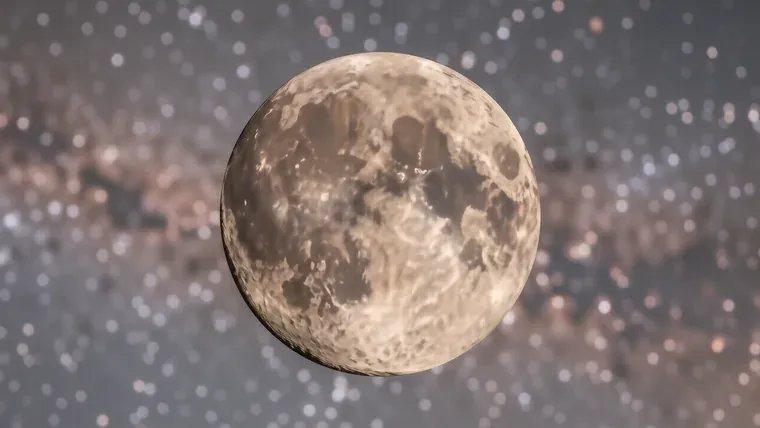
The Moon is primarily gray. This appearance results from a pervasive layer of fine, pulverized dust known as regolith that covers the lunar surface. While the naked eye and standard telescopes perceive shades of white, yellow, or gray, the actual geological composition includes significant brown, reddish, and even blue hues. These colors remain hidden under the dust because the regolith acts as a uniform coating across most of the lunar landscape.
The Regolith Veil
The surface is dusty. Most observers see a monochromatic sphere when looking through an eyepiece. This happens because a thin layer of regolith blankets the diverse geological features of the Moon.
The regolith forms from billions of years of meteorite impacts. When small rocks strike the surface, they shatter into microscopic fragments that settle across the terrain. Because the Moon lacks a substantial atmosphere to sweep these particles away, the dust remains in place for eons. This process creates a relatively uniform gray appearance that masks the true colors of the underlying basalt and anorthosite.
The dust is not static. It behaves differently depending on the local gravity and impact frequency.
On Mars, atmospheric storms transport red dust across entire hemispheres, but the Moon relies on kinetic energy from impacts to redistribute its material. This dust can travel hundreds of kilometers from a single impact site. While the layer is thin in some regions, it is sufficient to neutralize the visual impact of the colorful rocks beneath.
The composition of this dust is highly varied.
- Impact-generated glass beads.
- Pulverized basaltic rock.
- Anorthositic fragments.
- Microscopic mineral grains.
Hidden Geological Colors
Beneath the gray lies color. The Moon was once geologically active. It featured massive volcanic eruptions that created large, dark plains known as maria.
The Apollo 11 mission utilized a specific tool to verify these colors on-site. Astronauts used a device called a gnomon, which is a standardized color indicator, so that they could objectively compare lunar samples to Earth-based color standards. When the gnomon was placed against the lunar surface, the contrast appeared muted compared to its appearance in a laboratory setting. This discrepancy occurs because the lack of a dense atmosphere changes how light scatters and reaches the eye.
The rocks are not just gray.
During the Apollo 17 mission in 1972, astronauts observed that clearing away the dust revealed distinct reddish regions. These areas stand out because they lack the fine-grained gray coating that covers the rest of the lunar highlands. While many people assume the Moon is a uniform stone, the samples brought back by both the Soviet Luna-16 probe and American Apollo missions prove a much wider spectrum exists.
Lunar samples show diversity.
The collected rocks include shades of brown, gray, and even subtle blue tones. These variations exist because the Moon’s crust is composed of different mineral suites. If you were to strip away the top few centimeters of regolith, the lunar landscape would look more like a mottled desert than a silver coin.
The Physics of Reflection
The Moon does not glow. It reflects sunlight. This process is governed by the albedo of the lunar surface.
Albedo is a measurement of how much light a celestial body reflects back into space. The Moon has a remarkably low albedo, reflecting only about 12% of the solar radiation that hits it. It appears bright to us because the surrounding night sky is exceptionally dark. This low reflectivity is caused by the roughness of the regolith and the presence of porous soil.
Glass helps with brightness.
The lunar soil contains approximately 50% glass, often in the form of tiny, smooth spheres created by the intense heat of meteorite impacts. These glass beads act as miniature reflectors. Because these spheres are scattered throughout the regolith, they contribute to the way sunlight bounces off the surface and reaches Earth.
Light travels fast.
It takes approximately 1.26 seconds for moonlight to reach the surface of the Earth. This delay is negligible for human perception, but it is a concrete physical constant in lunar observation. The brightness we perceive also changes based on the observer’s angle.
The Zeliger effect influences visibility.
This phenomenon occurs when a light source is positioned directly behind the observer, making a rough surface appear significantly brighter. If you stand under a streetlamp at night, the ground appears more luminous than it would from a side angle. The Moon undergoes a similar optical shift depending on the geometry of the Sun, the Moon, and the Earth.
Optical Illusions and Perception
Human eyes are imperfect. We see colors differently based on light levels.
The Purkinje effect explains why the Moon may appear blueish during certain phases or under specific lighting conditions. As light intensity decreases, the human eye shifts its sensitivity toward the blue end of the spectrum. This means that a full moon might look pale yellow or light blue depending on how your pupils are reacting to the surrounding darkness.
The Moon changes shape.
It moves through eight distinct phases during its synodic month, which lasts approximately 29.6 days. These phases include the new moon, waxing crescent, first quarter, waxing gibbous, full moon, waning gibbous, third quarter, and waning crescent. Each phase alters the angle of sunlight hitting the surface, which changes both the perceived brightness and the visible color.
Eclipses change everything.
During a lunar eclipse, the Moon takes on a deep reddish hue. This happens because Earth’s atmosphere bends sunlight, filtering out shorter blue wavelengths and allowing only the longer red wavelengths to pass through to the lunar surface. This is not a change in the rock itself, but a change in the light reaching it.
A supermoon increases brightness.
When the Moon reaches perigee, its closest point to Earth, it can appear 14% larger than usual. During these events, the perceived brightness can intensify by 30%. This makes the subtle color variations in the regolith even harder to distinguish with the naked eye because the sheer volume of reflected light tends to wash out fine details.
Debunking the Color Conspiracy
Skeptics often use color to claim fraud. Some conspiracy theories suggest the Moon landings were filmed on a gray set.
These claims often point to photographs where the reflection in an astronaut’s visor appears more colorful than the ground. They argue that if the Moon were truly brown or red, the astronauts would have seen those colors in their helmets. This argument ignores basic physics and the way light interacts with different surfaces.
The visor is a mirror.
An astronaut’s helmet visor is highly reflective and curved. It captures a wide-angle view of the surroundings, including the sky and the horizon, which can create different optical effects than looking directly at the ground. The perceived color in a reflection is heavily influenced by the angle of incidence and the specific properties of the gold-coated or polycarbonate shielding.
The Moon is diverse.
The idea that the Moon is a uniform gray is a simplification. While the regolith provides a consistent mask, the underlying geology is complex and colorful. The transition between the dark maria and the bright highlands is a matter of mineralogy, not just light and shadow.
Astronomy requires precision.
Observing the Moon is a lesson in both geology and optics. Whether you are looking at the subtle shifts of a waxing crescent or the intense glare of a supermoon, you are seeing a complex interaction of reflected light, mineral composition, and atmospheric filtering. The gray we see is simply the surface layer of a much more colorful world.
Frequently asked questions
Why does the Moon look gray to the naked eye?
The Moon appears gray because a layer of fine, pulverized dust called regolith covers most of its surface. This uniform coating masks the diverse brown, red, and blue hues of the underlying rocks.
What is the albedo of the Moon?
The Moon has a low albedo, reflecting only about 12% of the solar radiation that hits it. This low reflectivity is caused by the porous nature of the soil and the roughness of the regolith.
Why does the Moon turn red during an eclipse?
During a lunar eclipse, Earth's atmosphere bends sunlight and filters out shorter blue wavelengths. This allows only longer red wavelengths to pass through and reach the lunar surface.
How long does it take for moonlight to reach Earth?
It takes approximately 1.26 seconds for moonlight to travel from the Moon's surface to the Earth's surface.
More in Moon
The Moon's perigee: What does it mean for Earth?
Learn how the Moon's perigee affects tidal forces, lunar brightness, and the phenomenon known as a supermoon during its closest approach to Earth.
The path of the Moon's orbit around Earth
Explore the mechanics of lunar motion, including elliptical orbits, tidal locking, and how the Moon's distance fluctuates between perigee and apogee.
When is the full moon in June 2021?
Discover the exact timing of the June 2021 Strawberry Moon and learn about its astronomical significance, seasonal names, and zodiacal alignment.
Which occurs more frequently, a lunar or solar eclipse?
Learn why solar eclipses occur more often than lunar eclipses and explore the mechanics, types, and safety requirements for observing these celestial events.