Which occurs more frequently, a lunar or solar eclipse?
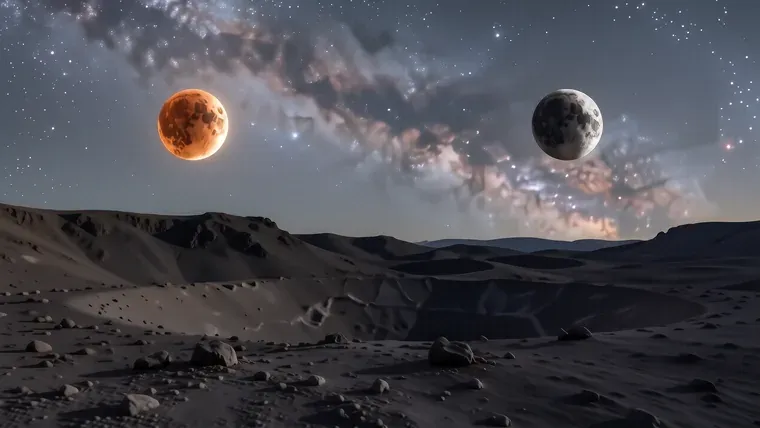
Solar eclipses occur more frequently than lunar eclipses. Earth experiences between 2 and 5 solar eclipses per year, while there may be no lunar eclipses at all in a given year. This frequency exists because the Moon’s orbital plane is tilted approximately 5 degrees relative to the ecliptic, so the alignment required for an eclipse only happens when the Moon reaches one of its two nodes.
The Mechanics of Solar Eclipses
The Moon blocks the Sun. This happens during the new moon phase. A solar eclipse occurs when the Moon passes directly between the Earth and the Sun, because this specific geometry allows the lunar shadow to cast onto our planet’s surface. The diameter of this shadow remains limited to approximately 270 km. It is quite narrow.
Observers see different types of eclipses depending on their location. A total solar eclipse occurs when the Moon completely covers the solar disk, although the observer must be positioned within the narrow path of totality to witness it. During this phase, the sky darkens significantly. The solar corona becomes visible. This happens because the bright light of the photosphere is suddenly obscured.
Partial eclipses are common. The Moon only covers a portion of the Sun. You can see these from a much larger area than a total eclipse, while the sky merely dims without reaching true darkness. These events do not reveal the corona or bright stars. They feel like twilight.
Annular eclipses provide another variation. The Moon appears smaller than the Sun during these events. An annular eclipse occurs when the Moon is near aphelion, so its apparent diameter is insufficient to cover the entire solar disk. A bright ring of sunlight remains visible around the lunar silhouette. This ring is called an annulus.
The shadow moves fast. It travels across the Earth at a minimum speed of slightly over 1 km/s. An observer in the path of totality experiences a rapid transition into darkness, because the lunar umbra sweeps across the landscape with immense velocity. The duration of totality is brief. It usually lasts only a few minutes.
Lunar Eclipse Characteristics
The Earth casts a shadow. This shadow falls on the Moon. A lunar eclipse occurs when the Moon enters the Earth’s shadow during the full moon phase, although the Moon does not disappear entirely from view. Instead, it often takes on a deep reddish hue. The color changes.
This redness results from Rayleigh scattering. Sunlight passes through the Earth’s atmosphere before reaching the lunar surface. The atmosphere filters out shorter blue wavelengths while allowing longer red wavelengths to pass through toward the Moon. This process creates the “blood Moon” effect. It is quite striking.
There are three distinct types of lunar eclipses. A total lunar eclipse occurs when the entire Moon enters the umbra. A partial lunar eclipse happens when only a segment of the Moon enters this dark inner shadow, so the rest of the lunar disk remains illuminated by sunlight. Penumbral eclipses are the most subtle. They occur when the Moon passes through the Earth’s outer penumbra.
Lunar eclipses are easier to see. They are visible from any part of the night side of Earth. While a solar eclipse requires traveling to a specific coordinate, a lunar eclipse can be watched by millions of people simultaneously across entire continents. You do not need special glasses. The Moon is safe to view.
The Moon stays visible. It does not vanish. Even during a total eclipse, the silhouette remains detectable because the Earth’s atmosphere refracts light onto the lunar surface. This refraction provides the necessary illumination for the red glow. It is a slow process.
Comparing Frequency and Visibility
Solar eclipses happen more often. The ratio is roughly four solar eclipses for every three lunar eclipses. This statistical reality seems counterintuitive, although it follows from the physical size of the shadows involved. The Earth’s shadow is much larger than the Moon’s shadow.
The visibility window is small. A total solar eclipse is only visible along a narrow strip of land. Because the lunar shadow is so compact, a specific location on Earth might wait 300 years to see totality again. This makes them geographically rare. They are locally infrequent.
Lunar eclipses have a wide reach. The entire night side of the planet can witness the event. If you live in a region where the Moon is above the horizon, you will see it, so travel is rarely necessary for these events. They occur more frequently for a stationary observer.
The following table summarizes the typical annual occurrences:
- Solar eclipses: 2 to 5 per year.
- Total or annular solar eclipses: No more than 2 per year.
- Lunar eclipses: 0 to 3 per year.
Total solar eclipses are rare in specific spots. For example, Moscow saw only three total solar eclipses between the 11th and 18th centuries. These occurred on August 11, 1124, March 20, 1140, and June 7, 1415. The next one will not arrive until October 16, 2126.
Historical Observations and Discoveries
Ancient people watched the sky. They recorded eclipses in many cultures. Maximin of Trier documented a solar eclipse on February 16, 538, which lasted from the first to the third hour. This record provides a concrete timestamp for medieval astronomical study. History is written in shadows.
Eclipses have aided science. They allow us to see the Sun’s atmosphere. During a total solar eclipse in India on August 18, 1868, Pierre Jansen studied the chromosphere. He identified a spectrum that led to the discovery of helium, although Norman Lockyer demonstrated the same result two months later using different methods.
Comets have also been found. Astronomers use eclipses to spot objects near the Sun. On May 17, 1882, observers in Egypt saw a comet passing near the solar disk during an eclipse. This object was named the Teufik Comet because it was named after the ruler of Egypt at that time. It belonged to the Kreutz family.
Shadow bands are visible too. These are thin, wavy lines of light and dark. They appear on the ground just before and after totality, because the turbulent atmosphere acts like a series of moving lenses. They move very quickly. You must watch closely.
The Moon is moving away. Tidal deceleration pushes it further from Earth. In approximately 600 million years, the Moon will be too distant to cover the Sun entirely, so total solar eclipses will cease to exist. The Moon is retreating. This process is slow.
Safety and Observation Methods
Never look at the Sun. You must use solar filters. Looking directly at the Sun during a partial eclipse can cause permanent retinal damage, because the eye’s lens focuses the intense light onto a tiny spot on the retina. Sunglasses are insufficient. They do not work.
Use certified equipment. Solar filters should be purchased from specialized photo or video suppliers. These filters block the harmful infrared and ultraviolet radiation so that you can observe the solar disk safely. Binoculars require dedicated solar covers. Do not use standard lenses.
Total eclipses allow brief viewing. You may look without protection only during the few minutes of absolute totality. Once the first bead of sunlight reappears, you must put your filters back on immediately, because even a tiny amount of direct light can cause injury. The transition is sudden.
Lunar eclipses are safe. No special eyewear is required for these events. Since the Moon is only reflecting sunlight rather than emitting it, the intensity is low enough for naked-eye observation, which makes them accessible to everyone. They are easy to watch.
Planning is essential for solar events. You must know the exact time and path of totality. Because the window of opportunity is so small, missing the timing by even a few minutes means you will only see a partial eclipse. Check your local ephemeris. Precision matters.
The shadow moves east. It races across the landscape. On August 11, 1999, an eclipse passed over Europe with great speed. In Bucharest, residents witnessed the full event, while other areas saw only a partial phase because they were outside the path of totality. The sky turned indigo.
Frequently asked questions
How many solar eclipses happen every year?
Earth experiences between 2 and 5 solar eclipses per year. In contrast, there may be no lunar eclipses at all in a given year.
Why do lunar eclipses turn the moon red?
This occurs due to Rayleigh scattering, where Earth's atmosphere filters out blue wavelengths and allows longer red wavelengths to reach the Moon. This creates the 'blood Moon' effect.
Is it safe to look at a solar eclipse with the naked eye?
No, you must use certified solar filters to avoid permanent retinal damage. The only exception is during the few minutes of absolute totality when the Sun is completely obscured.
What are the different types of solar eclipses?
There are three main types: total solar eclipses, where the Moon completely covers the Sun; partial eclipses, where only a portion is covered; and annular eclipses, where a bright ring of sunlight remains visible.
More in Moon
The Moon's perigee: What does it mean for Earth?
Learn how the Moon's perigee affects tidal forces, lunar brightness, and the phenomenon known as a supermoon during its closest approach to Earth.
The path of the Moon's orbit around Earth
Explore the mechanics of lunar motion, including elliptical orbits, tidal locking, and how the Moon's distance fluctuates between perigee and apogee.
What is the color of the moon and why does it look gray?
Discover why the Moon appears gray due to regolith while its underlying geological composition contains hidden shades of brown, red, and blue.
When is the full moon in June 2021?
Discover the exact timing of the June 2021 Strawberry Moon and learn about its astronomical significance, seasonal names, and zodiacal alignment.