The movement of the Sun across the sky
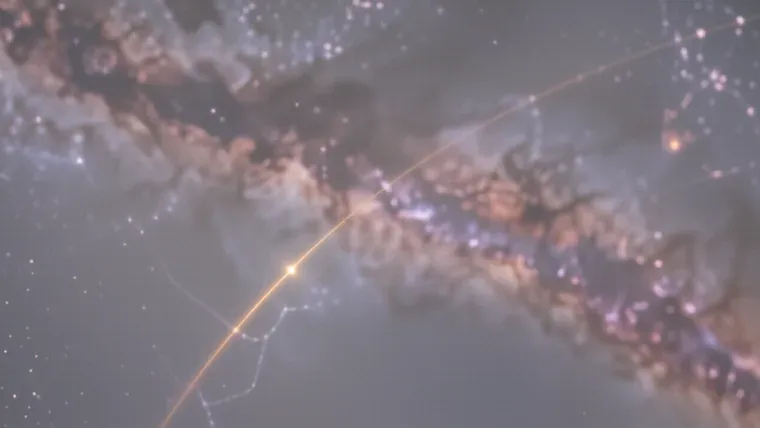
The Sun appears to move from east to west because the Earth rotates on its axis in a counterclockwise direction. This rotation completes one full cycle approximately every 24 hours. While the star remains relatively stationary at the center of our solar system, an observer on the surface perceives a daily transit across the celestial sphere. The apparent motion follows an elliptical arc. It changes based on your latitude and the time of year.
The Mechanics of Daily Motion
The Earth rotates. It is fast. Because the planet spins from west to east at an angular velocity of approximately 15 degrees per hour, the Sun seems to climb from the eastern horizon and descend toward the west. This motion creates the cycle of day and night. We see it every day. Although the sun appears to move across the sky, the actual change in position results from our own planetary rotation rather than any lateral movement of the star itself.
The Sun rises in the east. It sets in the west. Most people assume this happens everywhere at the same time, but sunrise times vary significantly depending on your longitudinal position. For example, observers on the eastern coast of the United States see the sun rise approximately 3 hours earlier than those on the western coast. Time zones help manage this. They organize our lives.
The Sun reaches its highest point at noon. This is called culmination. The Sun follows a specific trajectory along the southern projection of the horizon for observers in the northern hemisphere because the Earth’s tilt directs the solar rays toward that specific part of the sky during the midday hours. It hits a peak. We call this the zenith.
The path changes with latitude. It is not constant. If you move to the Southern Hemisphere, such as Australia, the Sun moves from right to left across the sky because your orientation to the Earth’s axis has flipped relative to the celestial poles. The direction reverses. You see a different arc.
The rotation speed is steady. It is 15 degrees per hour. This constant rate ensures that the solar transit remains predictable for navigation and timekeeping. We use this daily. Ancient civilizations relied on shadows to track these movements. They built monuments to align with the sun.
Axial Tilt and Seasonal Shifts
The Earth is tilted. It is 23.44 degrees. Because this axial inclination exists in relation to the plane of Earth’s orbit, different parts of the planet receive varying intensities of sunlight throughout the year. This causes the seasons. We experience them annually.
Summer arrives when the tilt favors a hemisphere. The Sun sits high. When the Sun is higher above the horizon, its rays hit the surface at a greater angle so that more concentrated energy reaches a specific area to increase temperatures. This creates summer. Winter is the opposite. In the Northern Hemisphere, winter occurs when the tilt points away from the star.
The seasons are opposite. They flip globally. While the Northern Hemisphere experiences winter, the Southern Hemisphere experiences summer because the two halves of the planet are tilted in opposite directions relative to the Sun’s position. The weather differs. It is a global cycle.
The Sun does not always rise due east. It shifts. On the spring equinox and the fall equinox, the Sun rises precisely in the east and sets precisely in the west. These dates occur around March 20 and September 22. The days are equal. Light and dark balance.
The solstice defines extremes. It is a turning point. On June 21, the summer solstice occurs in the Northern Hemisphere when the Sun reaches its maximum northern declination, resulting in the longest period of daylight for that year. Days grow long. Nights become short.
The poles experience extremes. They are unique. In regions above the Arctic Circle, the Sun may not set at all during the summer because the Earth’s tilt keeps the pole facing the star continuously. This is the polar day. It lasts months.
The Ecliptic and Zodiacal Paths
The Sun follows a path. It is the ecliptic. This imaginary line represents the annual movement of the Sun relative to the stars, although it is actually just the projection of Earth’s orbit onto the celestial sphere. Astronomers use it. It is a coordinate.
The ecliptic is a circle. It stays near the planets. Nearly all planets in our solar system orbit near this same plane because they formed from the same rotating disk of gas and dust that created the Sun. They follow the line. The path is narrow.
The zodiac follows the ecliptic. It is a belt. This celestial belt encompasses approximately 9 degrees on each side of the ecliptic, so it creates a wide track where the Sun, Moon, and planets appear to travel. There are twelve signs. They cover 360 degrees.
The constellations change. They move slowly. In March and early April, the constellation Pisces can be seen behind the Sun, but as the Earth moves in its orbit, different constellations like Aries or Taurus become visible. The stars shift. We track them.
The intersection matters. It defines equinoxes. The points where the ecliptic intersects the celestial equator are known as the equinoxes, which serve as the transition points between the seasons. These points move. Precession changes them.
Earth undergoes precession. It is a wobble. Because the Earth’s axis rotates in a slow circle, the position of the equinoxes shifts by about 1 degree every 70 years, meaning the stars behind the Sun change over millennia. The cycle is long. It takes 25,776 years.
Solar Characteristics and Composition
The Sun is a star. It is yellow. While it appears yellow to us due to atmospheric scattering, its true color is white because the spectrum of light it emits contains all visible wavelengths in roughly equal proportions. It is bright. It is massive.
The Sun is huge. It is 1.391 million kilometers in diameter. You could fit 1.3 million Earths inside the Sun because its volume is so much greater than our planet’s mass and scale. It dominates us. Gravity holds it.
Composition is mostly hydrogen. It is 74.9%. Helium makes up 23.8% of the mass, while trace amounts of oxygen, carbon, neon, and iron exist within the solar plasma. The core is hot. Fusion happens there.
The core is a furnace. It reaches 15.7 million degrees Kelvin. This extreme temperature allows for nuclear fusion, which converts hydrogen into helium and provides the energy that radiates outward to reach the Earth. Energy travels fast. It arrives daily.
Light takes time. It is 8 minutes. Even though the Sun is 150 million kilometers away, its light reaches us in approximately 8 minutes and 20 seconds after leaving the solar surface. We see the past. The delay is constant.
The Sun has a wind. It is plasma. A constant flow of charged particles originates from the corona and spreads throughout the solar system because high temperatures create pressure imbalances that push material outward. This affects Earth. It impacts satellites.
The Future of our Star
The Sun is middle-aged. It is 4.57 billion years old. Scientists estimate its current stage based on stellar evolution models, which suggest it will remain stable for several more billion years before changing. It burns steadily. Time passes.
The brightness increases. It gets hotter. In approximately 2 billion years, the Sun’s luminosity will increase to a point where Earth’s oceans evaporate because the intense heat will trigger a runaway greenhouse effect. Life will struggle. The planet will dry.
A red giant forms. It is huge. After exhausting its hydrogen, the Sun will expand into a red giant and likely engulf Mercury and Venus, although the fate of Earth remains a subject of debate among researchers. It grows large. It turns red.
The nebula follows. It is beautiful. When the Sun sheds its outer layers, it will create a planetary nebula before the remaining core collapses into a white dwarf. This is the end. The star fades.
A white dwarf stays. It is small. This dense remnant will endure for trillions of years, providing a faint glow in the dark of the galaxy after the more active stages of stellar life have ended. It is quiet. The light dims.
The Sun provides life. It is vital. Without the constant stream of photons and heat from our star, the Earth would be a frozen rock drifting through the void of space. We depend on it. It is our source.
Frequently asked questions
Why does the Sun appear to move from east to west?
The Sun appears to move this way because the Earth rotates on its axis in a counterclockwise direction from west to east. This rotation completes one full cycle approximately every 24 hours.
How does Earth's tilt affect the Sun's position?
The Earth is tilted at an angle of 23.44 degrees, which causes different parts of the planet to receive varying intensities of sunlight. This inclination is responsible for the changing seasons throughout the year.
How long does it take for sunlight to reach Earth?
Even though the Sun is 150 million kilometers away, its light takes approximately 8 minutes and 20 seconds to reach us after leaving the solar surface.
What is the ecliptic in relation to the Sun?
The ecliptic is an imaginary line representing the annual movement of the Sun relative to the stars. It is actually the projection of Earth's orbit onto the celestial sphere.
More in Solar System
Calculating the Earth's mass: A complex task
Learn how scientists use the gravitational constant and orbital mechanics to determine Earth's mass of approximately 5.9722 x 10^24 kg.
Discovering the current location of Voyager in interstellar space
Learn about the current location of Voyager 1 and 2, their distances from Earth, and how they navigate the harsh environment of interstellar space.
How many natural satellites does the earth possess?
Explore Earth's celestial companions, from the permanent Moon to transient quasi-satellites and cosmic dust clouds located at Lagrange points.
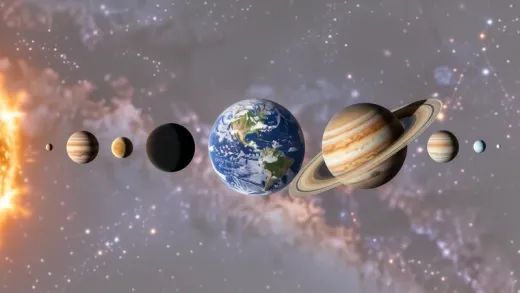
How many planets orbit the sun in second grade lessons
Learn how many planets orbit the sun and discover key facts about the eight official planets, from Mercury to Neptune, for students and educators.