How stars die: the process explained
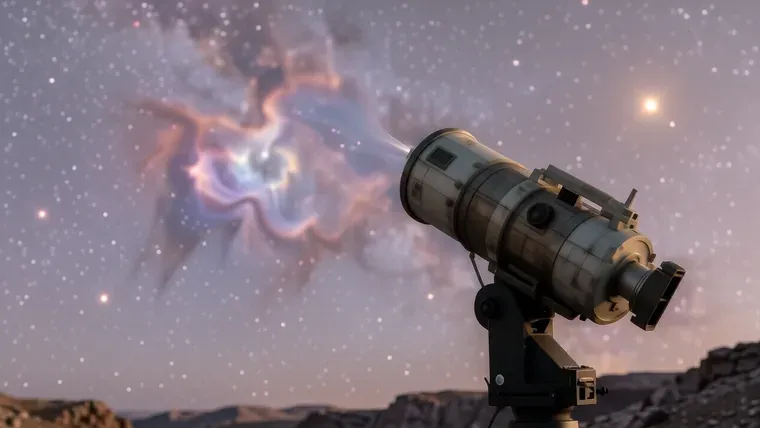
A star’s death depends entirely on its initial mass. Low-mass stars like the Sun eventually shed their outer layers to become white dwarfs, while massive stars exceeding roughly eight solar masses undergo cataclysmic supernova explosions that leave behind neutron stars or black holes.
The Mechanics of Stellar Equilibrium
Stars exist in a state of tension. Gravity pulls inward. This force attempts to crush the stellar matter toward a single point, although the outward radiation pressure from thermonuclear fusion provides a counteracting force that maintains stability. This balance defines the main sequence phase. Most stars spend 90% of their lives here.
The Sun is currently stable. It is 4.5 billion years old. Hydrogen nuclei fuse into helium within the core, so the star maintains its size and temperature through this continuous energy release. The process is slow. It lasts for billions of years because the density and temperature requirements for fusion are strictly regulated by the star’s mass.
Mass dictates the timeline. Large stars burn fast. A blue supergiant might exhaust its hydrogen supply in only a few million years, while a small red dwarf can persist for trillions of years because its lower mass results in much slower fusion rates. High mass means high pressure. This pressure accelerates the consumption of fuel.
The equilibrium eventually fails. Fuel runs out. Once the hydrogen in the core is depleted, the outward radiation pressure drops, so gravity begins to compress the core while the outer layers expand. This expansion creates a red giant. The star grows significantly larger.
The Fate of Medium-Mass Stars
Medium stars expand. They become red giants. When the Sun exhausts its hydrogen, its radius will increase by a factor of approximately 250 so that it can engulf Mercury and potentially Venus. This phase is unstable. The star undergoes cycles of inflation and contraction.
The core changes composition. Helium begins to fuse. After the hydrogen is gone, the core contracts and heats up until helium fusion ignites, producing carbon and oxygen through new thermonuclear reactions. This creates a helium flash. The star’s structure shifts completely.
Planetary nebulae form. The outer layers drift. As the red giant reaches its limit, it ejects its gaseous envelope into space, leaving behind a hot, dense core that we observe as a planetary nebula like NGC 2818. These shells are beautiful. They consist of ionized gas.
White dwarfs remain. They are small. If the remaining core mass stays below the Chandrasekhar limit of 1.44 solar masses, it will become a white dwarf with a radius comparable to Earth’s 6371 kilometers. They do not fuse. They simply cool down.
The cooling takes time. It is very slow. Because white dwarfs lack new energy production, they emit a diminishing number of photons from their surfaces over billions of years until they eventually become dark, cold black dwarfs. We haven’t seen one yet. The universe is too young.
Supernovae and High-Mass Evolution
Massive stars die violently. They explode. When a star with more than eight solar masses develops an iron core, the fusion process stops because fusing iron consumes energy rather than releasing it. This causes a sudden, total collapse.
The collapse is rapid. Gravity wins instantly. The core shrinks from thousands of kilometers to a radius of only 10 to 20 kilometers in a fraction of a second, so the resulting shockwave tears the rest of the star apart in a supernova. These events are bright. They outshine entire galaxies.
Type 1a supernovae are special. They act as candles. Astronomers use these specific explosions to measure distances between galaxies because their peak luminosity remains consistent due to the predictable mass of the white dwarf that explodes. We use them for cosmology. They provide a standard scale.
Heavy elements appear. The explosion scatters matter. During the supernova, the intense heat synthesizes elements like silicon and magnesium, which are then propelled into the interstellar medium by powerful shockwaves so that they can form new stars. This recycles the cosmos. Life requires these metals.
Neutron Stars and Magnetars
Neutron stars are dense. They are tiny. After a supernova, if the remaining core is between approximately 1.4 and 3 solar masses, it collapses into a neutron star with a radius of about 11 kilometers. This object is incredibly heavy. It contains more mass than the Sun.
The physics is complex. Newtonian gravity fails. Because the gravitational radius of a neutron star is roughly 4 kilometers while its actual radius is 11 kilometers, physicists must use Einstein’s general theory of relativity to describe its behavior accurately. The density is extreme. It exceeds atomic nuclei.
Magnetic fields are intense. Magnetars are extreme. While a standard neutron star has a strong field, a magnetar can possess a magnetic field strength of $10^{16}$ Gauss, which is many orders of magnitude stronger than anything we can produce on Earth. These fields influence particles. They warp the local environment.
Neutron stars may cool. The process is long. It could take between $10^{16}$ and $10^{22}$ years for a neutron star to dissipate its thermal energy, although we currently lack the technology to observe such ancient, cold remnants in our young universe. They might become black holes. This remains a theory.
The Formation of Black Holes
Gravity overcomes everything. A black hole forms. If the collapsing stellar core is massive enough to surpass the limit where even neutron degeneracy pressure can halt the collapse, the matter falls into a singularity. Light cannot escape. It is trapped forever.
The event horizon exists. This is the boundary. Once matter passes this specific radius, the gravitational pull becomes so strong that the escape velocity exceeds the speed of light, so no information can ever return to the outside universe. We see them indirectly. We watch orbiting stars.
Supermassive black holes reside in centers. They are huge. These entities weigh millions or billions of solar masses and sit at the hearts of galaxies like our own Milky Way, although the exact mechanism that grows them from stellar seeds remains uncertain. Quasars were once thought to be different. They are actually active nuclei.
Black holes evaporate. Hawking radiation exists. According to the Hawking mechanism, particles and antiparticles can be created near the event horizon, so one particle escapes while the other falls in, which effectively reduces the black hole’s mass over time. Small black holes vanish fast. Large ones last forever.
The Cycle of Cosmic Matter
Death feeds life. Dust becomes stars. When a star dies, it releases gas and dust back into the interstellar medium, so that gravity can eventually pull this material together to form new protostars in molecular clouds. This is a continuous loop.
The Orion Nebula shows this. It is active. We see gas and dust condensing under gravity right now, which demonstrates how the remnants of old stars provide the raw materials for the next generation of celestial bodies. Stars are born from ruins. The cycle repeats endlessly.
Brown dwarfs are different. They are failed stars. These objects have masses between 13 and 80 times that of Jupiter, so they can fuse deuterium but lack the gravitational pressure required to sustain the hydrogen fusion that defines a true star. They stay dim. They eventually cool down.
The universe will change. It grows old. As all stars eventually exhaust their fuel and fade into black dwarfs or black holes, the cosmos will transition from a period of bright light to an era of darkness. We live in a young age. The light is still abundant.
Frequently asked questions
What determines how a star will die?
A star's death depends entirely on its initial mass. Low-mass stars like the Sun become white dwarfs, while stars exceeding eight solar masses undergo supernovae.
What happens when a massive star develops an iron core?
Fusing iron consumes energy rather than releasing it, causing a sudden, total collapse. This results in a supernova explosion that can outshine entire galaxies.
How large can a white dwarf become before it is no longer stable?
A white dwarf must stay below the Chandrasekhar limit of 1.44 solar masses to remain a stable, cooling remnant.
What is the difference between a neutron star and a black hole?
A neutron star forms if the core is between 1.4 and 3 solar masses, whereas a black hole forms if the mass is so great that even neutron degeneracy pressure cannot halt the collapse.
More in Stars
How far away is the nearest star in light years?
Discover how far Proxima Centauri is from Earth and learn about its physical characteristics, planetary system, and distance measurements.
Methods used by scientists to calculate the distance to stars
Explore how astronomers use the cosmic distance ladder, from trigonometric parallax to standard candles and redshift, to measure stellar distances.
Reasons for the descent of stars from the heavens and their final
Learn why meteoroids appear as falling stars, how friction creates light during atmospheric entry, and where these cosmic fragments ultimately end up.
Shooting stars: An enigmatic phenomenon explained
Discover the science behind shooting stars, from the mechanics of atmospheric entry to the chemical composition of meteorites and predictable meteor showers.