Effective ways to identify the location of the North Star
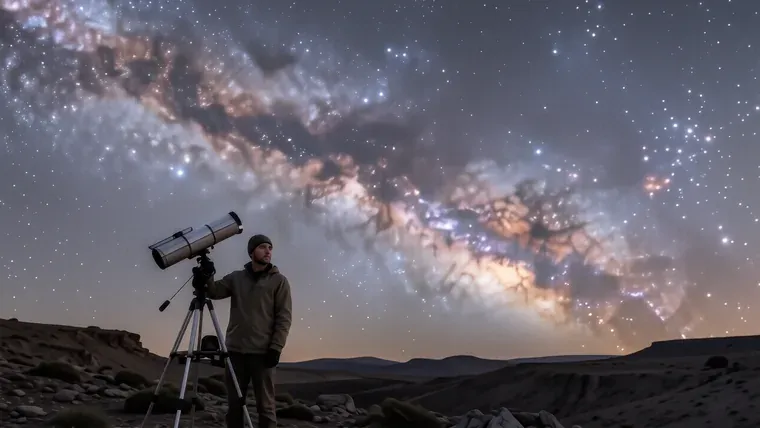
Polaris sits near the North Celestial Pole. It provides a fixed point because the Earth rotates on an axis that points almost directly toward this star. You can find it by following the “pointer stars” in the Big Dipper or by using the constellation Cassiopeia. While many people assume it is the brightest star in the sky, its magnitude is actually +1.97, which ranks it 48th or 50th depending on the catalog used.
Navigating with Ursa Major
The Big Dipper is your best tool. It is a large, seven-star asterism within the constellation Ursa Major. Most observers find this group easily because its shape resembles a ladle or a bucket. You must first locate the two stars that form the outer edge of the “bucket” bowl. These are Merak and Dubhe.
Follow the line carefully. Mentally extend a straight line from Merak through Dubhe so that you can project it into the darker part of the sky. This imaginary path should continue for about five times the distance between those two stars. You will eventually hit Polaris, which sits at the end of the handle of the Little Dipper.
The Little Dipper is harder to see. It contains Ursa Minor. The stars in this constellation are much dimmer than those in the Big Dipper, although Polaris remains the most prominent member of the group. If you face Polaris and extend your arms, you will face north. South lies behind you. East is to your right. West is to your left.
The position changes slightly. You might see the stars in different spots if you move from Novosibirsk to Moscow. This happens because the change in latitude alters the altitude of the star above your horizon. The Big Dipper also shifts its orientation throughout the year. It sits low near the horizon in winter, while it reaches a higher point in late spring.
Alternative Constellation Methods
Cassiopeia offers another path. This constellation looks like a jagged “W” or an “M” in the sky. It sits on the opposite side of Polaris from the Big Dipper. You can use it when the Big Dipper is obscured by trees or clouds.
Draw two lines through the outer points of Cassiopeia. These lines should intersect at a central point. From that intersection, draw a third line through the middle star of the constellation so that you can track the direction toward the pole. Polaris will appear along this trajectory. It is often easier to find in summer because the Big Dipper may be below the horizon for observers near the equator.
Cygnus provides a third option. This constellation is known as the Swan. You must identify the star Deneb, which is one of its brightest points. Draw a line from Alpha Cygni through Deneb and extend it twice the length of that segment. This method works well if you are an experienced observer, although the Swan can be difficult to recognize in heavy light pollution.
Orion is also useful. It appears during the winter months in the Northern Hemisphere. Locate the three stars of the Orion Belt. Draw a line from the midpoint of the belt through the star Meissa so that you can follow the path toward the northern sky. This technique requires specific timing because Orion is not visible year-round.
Using Technology and Photography
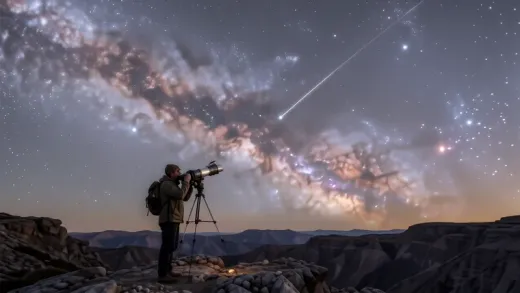
Cameras reveal hidden patterns. A long exposure photograph shows how all stars move in circles. You will see many curved trails of light. One star will remain at the center of these circles because it sits directly above the rotational axis. This stationary point is Polaris.
Configure your settings correctly. Set your aperture to the maximum setting to let in as much light as possible. Use an ISO between 400 and 600 so that the image does not become overexposed. Set the shutter speed to approximately thirty minutes. This long duration allows the star trails to form clear, visible arcs.
Condensation can ruin a shot. Moisture often forms on lenses when you move from a warm house to the cold night air. Let your camera rest on a dry, cool surface for several minutes before you begin shooting. Secure the device on a tripod. Even small vibrations will blur the image and destroy the circular pattern of the trails.
Mobile apps help beginners. Stellarium is a reliable choice for Android users. iOS users often prefer Sky Guide to identify celestial objects in real time. These tools use your phone’s internal sensors to map the sky. However, smartphone cameras often lack the sensitivity required to capture the distinct circular trail of Polaris.
Calculating Latitude and Direction
Polaris acts as a natural level. Its altitude above the horizon matches your geographic latitude. If you are at the North Pole, the star is at your zenith. At the equator, it sits on the horizon. This relationship allows travelers to estimate their position without a GPS.
Use a ruler for estimation. Hold a ruler vertically at a distance of 57 cm from your eyes. Mark a point on the ruler that corresponds to the calculated altitude in centimeters. For example, if you are in Odessa where the latitude is 40°29’10”, you would look for the star at approximately 40.5 cm above the horizon line. This method is an approximation, although it works in a pinch.
A magnetic compass requires correction. The needle points to magnetic north, which is not the same as true geographic north. You must account for magnetic declination to find Polaris accurately. If the declination is 15° west, subtract that value from your reading. Always avoid using a compass near vehicles or power lines because electromagnetic interference will distort the needle.
Maps provide context. Align the map with a physical landmark like a road or a river. Rotate the paper until the representation of the landscape matches what you see on the ground. If a factory appears on the left side of your map, it should also be on the left in reality. The top of the map will then point toward Polaris.
Physical Properties of the Star
Polaris is not one star. It is a triple star system. The central component, Polaris Aa, is a supergiant. It is roughly 2,000 times more luminous than our Sun. This massive star undergoes periodic pulsations. These oscillations occur every 3.97 days.
The system includes smaller companions. William Herschel identified the companion Polaris B in 1780. A much smaller third star, Polaris Ab, exists very close to the primary giant. Only the Hubble Space Telescope has captured clear images of this component because it is so tightly bound to the central star. The orbital period for this small component is approximately 30 years.
The star’s color is yellow. Many people think it looks white, but a telescope reveals a distinct yellowish hue. Its distance from Earth is estimated at 447 light-years, or 137.14 parsecs. While it seems constant, its brightness has actually increased by about 15% over the last century. This change is due to the star’s internal evolution as a Cepheid variable.
The sky will change. The Earth undergoes axial precession, which causes the pole to wobble in a large circle. This cycle takes about 26,000 years to complete. In 13,000 years, the star Vega will replace Polaris as our primary pole star. Currently, we are in an era where Polaris provides a reliable reference point.
The North Star remains a vital tool. It provides a way to find direction when electronics fail. You can use it to find north, south, east, and west by creating a cross on the ground. Once you find the star, you have found your bearing.
Frequently asked questions
How can I use the Big Dipper to find the North Star?
Locate the two pointer stars, Merak and Dubhe, at the edge of the Big Dipper's bowl. Extend an imaginary line through them for about five times the distance between those stars to find Polaris.
Is Polaris the brightest star in the sky?
No, Polaris has a magnitude of +1.97, which makes it the 48th or 50th brightest star depending on the catalog used.
How does the altitude of Polaris relate to my location?
The altitude of Polaris above the horizon matches your geographic latitude. For example, if you are at the North Pole, the star will be at your zenith.
What is the composition of the Polaris star system?
Polaris is a triple star system consisting of a central supergiant known as Polaris Aa and two smaller companions, Polaris B and Polaris Ab.
More in Stars
How far away is the nearest star in light years?
Discover how far Proxima Centauri is from Earth and learn about its physical characteristics, planetary system, and distance measurements.
Methods used by scientists to calculate the distance to stars
Explore how astronomers use the cosmic distance ladder, from trigonometric parallax to standard candles and redshift, to measure stellar distances.
Reasons for the descent of stars from the heavens and their final
Learn why meteoroids appear as falling stars, how friction creates light during atmospheric entry, and where these cosmic fragments ultimately end up.
Shooting stars: An enigmatic phenomenon explained
Discover the science behind shooting stars, from the mechanics of atmospheric entry to the chemical composition of meteorites and predictable meteor showers.