What are the different surfaces of Earth?
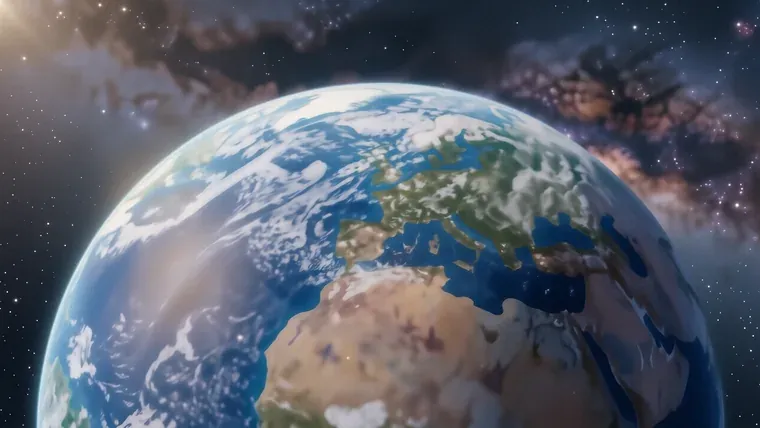
The Earth’s surface consists of a thin, chemically diverse crust that sits atop a viscous mantle and a metallic core. This outermost layer divides into oceanic and continental sections because the density and composition of the underlying rock vary significantly across the planet. While the crust reaches depths of 150 kilometers beneath mountain ranges, it thins to only 5 kilometers under much of the ocean floor.
The Internal Architecture of Earth
Earth formed approximately 4.5 billion years ago. It began as a molten mass of debris and gas that coalesced under gravity so that heavy metals could sink toward the center. This process of differentiation created the distinct layers we observe through seismic data today. Heavier elements like iron and nickel migrated downward. Lighter silicates rose to form the mantle and crust.
The core occupies the center. It reaches temperatures near 10,000 degrees Celsius at its deepest point. Scientists cannot visit this region directly because the extreme heat and pressure would destroy any known probe. The core consists of two parts: a liquid outer core and a solid inner core. The outer core measures about 2,200 kilometers in thickness. It contains iron, nickel, sulfur, and oxygen. Its movement generates the planetary magnetic field.
The mantle follows. This layer occupies 83% of Earth’s total volume. It behaves like a viscous fluid over geological timescales because the high temperatures allow for slow, convective movement. The upper mantle meets the crust at the Mohorovicich boundary. This boundary shows a sharp increase in seismic wave velocity. The mantle extends to a depth of approximately 2,900 kilometers.
The lithosphere is the rigid shell. It includes the crust and the uppermost portion of the mantle. This layer varies in thickness from 30 kilometers in flat areas to 70 kilometers in mountainous regions. Tectonic plates reside within the lithosphere. They move at rates of 20 to 100 mm per year.
The core is deep. It sits 2,900 kilometers below the surface. The inner core has a radius of approximately 1,200 kilometers, which is roughly 70% of the Moon’s radius. This solid center remains stable despite the heat because the immense pressure prevents the iron from melting.
Composition of the Crust and Lithosphere
The crust differs by location. Oceanic crust is relatively young and thin. It consists mostly of basaltic rocks that form between 5 and 12 kilometers in thickness. Most of this crust lies beneath the oceans, which cover 70% of the planet’s surface. The ocean floor slopes gently away from the continental margins.
Continental crust is much thicker. It averages 40 to 45 kilometers in depth. This layer contains three distinct sub-layers: a base of metamorphic granulites, a middle layer of granites and gneisses, and an upper layer of sedimentary rocks. The continental crust contains 18 different elements, including silicon, aluminum, and oxygen. It makes up only 30% of the surface area.
The lithosphere is solid. It consists primarily of crystalline rocks formed from ancient magma flows. This shell houses both stable platforms and mobile folded regions where volcanoes frequently erupt. While some parts of the lithosphere remain quiet, other areas experience constant tectonic shifts. These movements create the mountains we see today.
The crust is not a single piece. It breaks into several tectonic plates. These plates interact at boundaries to create “hot spots” or deep trenches. Some plates collide to push up mountain ranges. Other plates pull apart so that new crust can form from rising magma.
Oceanic vs. Continental Structures
Oceanic crust is basalt-heavy. This rock is denser than the granite found on land. Because of this density difference, the oceanic crust sits lower in the mantle. This creates the deep basins that hold the world’s oceans.
Continental crust is complex. It relies on a mix of sedimentary and metamorphic layers to maintain its structure. The distribution of continents is uneven. Approximately 67% of the total continental area lies in the Northern Hemisphere.
Primary Landforms and Surface Relief
Relief describes the irregularities of the surface. We categorize these features by their scale and shape. Some landforms are positive, meaning they rise above the surrounding area, while others are negative, creating depressions. The arrangement of these features is constantly changing.
Mountains exceed 500 meters in height. They often form where tectonic plates collide or where volcanic activity occurs. Asia contains the most mountain systems on Earth. The Andes-Cordilleras represents the longest system, stretching 18,000 kilometers along the western coast of the Americas. Mount Everest reaches an altitude of 8,850 meters above sea level. However, Mauna Kea is taller when measured from its base on the ocean floor.
Plains cover most of the land. They make up approximately 65% of the Earth’s surface. These regions have gentle slopes and minimal elevation changes. The Amazon lowland in Brazil is the largest plain, spanning 5 million square kilometers. Plains form through various processes, such as the accumulation of sediment or the cooling of lava.
The surface has many scales.
- Planetary configurations: Continents and oceanic basins.
- Mega-configurations: Mountains and plateaus.
- Macro-configurations: Ridges and troughs.
- Microforms: Caves and sinkholes.
- Nanoforms: Small sand dune ripples.
Water shapes the land. Rivers erode rock in some areas while depositing sediment in others. This creates denudational relief, like canyons, and accumulative relief, like deltas. The Grand Canyon in Colorado reaches depths of approximately 1,600 meters. It demonstrates how water can carve through hard rock over millions of years.
Wind also moves material. Aeolian processes create landforms like sand dunes or barkhans. These dunes can reach heights of 100 meters in desert environments. Wind can also erode rock to create stone pillars. The Demerdzhi massif in Crimea shows this type of erosion clearly.
Karst topography occurs in specific rocks. Limestone, gypsum, and salt dissolve easily in water. This dissolution creates caves, tunnels, and sinkholes. The Karst plateau in Slovenia gave this landscape its name. These features are common in the Caucasus and Crimea regions.
Human Impact and Technogenic Landscapes
Humans change the surface. We extract minerals and move massive amounts of earth. This activity creates “technogenic” landscapes that did not exist naturally. Mining often leaves behind large quarries or artificial embankments.
Bingham Canyon in Utah is a massive example. This copper mine is 4 kilometers wide and reaches a depth of 1.2 kilometers. It produces over 400 tons of extracted rock every year. Such sites alter the local topography permanently.
The Earth’s mass changes slightly. It gains about 40,000 tons of space dust and meteorites annually. However, it loses roughly 100,000 tons of gas into space each year. This net loss means the planet is technically losing mass over time. The mass is $5.97 \times 10^{24}$ kilograms.
Extreme Points and Measurements
The Mariana Trench is the deepest point. It sits 10,994 meters below sea level near the Mariana Islands. American explorers first reached this depth in 1960. A second major descent was documented in 2012. The average ocean depth is much shallower, at about 3,800 meters.
The highest point is Everest. It sits in the Himalayas on the border of Nepal and China. Winds at the summit reach speeds of 60 meters per second. In 2013, Yuichiro Miura climbed the peak at age 80. He holds the record for the oldest successful ascent.
Earth is a geoid. This means it is an ellipsoid of rotation rather than a perfect sphere. The diameter at the equator measures 12,756 kilometers. The total surface area reaches 510,072,000 square kilometers. These measurements help scientists understand gravity and orbital mechanics.
The hemispheres differ in composition. The Southern Hemisphere is mostly water, with about 80% coverage. The Northern Hemisphere has more land, consisting of 40% terrestrial surface. Temperature swings are more extreme in the north because of these large landmasses.
The Interconnected Spheres
The geographical envelope connects everything. It includes the atmosphere, hydrosphere, lithosphere, and biosphere. These systems exchange energy and matter constantly. For example, water evaporates from the ocean to enter the atmosphere.
The biosphere is active. It includes all living organisms on the planet. Life helps maintain the atmosphere because plants consume carbon dioxide and release oxygen. This biological process facilitates the chemical cycles that keep the surface habitable. The biosphere occupies the lower atmosphere and the upper lithosphere.
The atmosphere protects us. It extends from 8 km to over 1,000 km in height. The troposphere handles weather and precipitation. Below this, the stratosphere contains the ozone layer. This layer blocks ultraviolet radiation so that life on the surface can survive.
The hydrosphere is vast. It contains all water, including glaciers and groundwater. Most of this water is saltwater. Freshwater exists in much smaller quantities but is essential for terrestrial life. The water cycle ensures that this resource remains renewable through evaporation and condensation.
The lithosphere provides a foundation. It is the solid shell that supports both oceans and continents. While it seems static, it is actually part of a dynamic system. Tectonic plates move, mountains rise, and ocean basins widen over millions of years.
The Earth continues to change. New crust forms at mid-ocean ridges while old crust sinks into trenches. This cycle maintains the planet’s surface even as individual features erode away. The interaction between the hot interior and the cold exterior drives this entire process.
Frequently asked questions
What is the difference between oceanic and continental crust?
Oceanic crust is thinner (5-12 km) and composed mostly of basaltic rocks, while continental crust is thicker (averaging 40-45 km) and contains granites and sedimentary rocks.
How deep is the Earth's core?
The core sits approximately 2,900 kilometers below the surface and consists of a liquid outer core and a solid inner core with a radius of about 1,200 kilometers.
What are the main layers of the Earth?
The Earth is composed of a thin crust, a viscous mantle that occupies 83% of the volume, and a metallic core divided into liquid and solid sections.
What is the lithosphere?
The lithosphere is a rigid shell consisting of the crust and the uppermost portion of the mantle, which houses the planet's tectonic plates.
More in Solar System
Calculating the Earth's mass: A complex task
Learn how scientists use the gravitational constant and orbital mechanics to determine Earth's mass of approximately 5.9722 x 10^24 kg.

Discovering the current location of Voyager in interstellar space
Learn about the current location of Voyager 1 and 2, their distances from Earth, and how they navigate the harsh environment of interstellar space.
How many natural satellites does the earth possess?
Explore Earth's celestial companions, from the permanent Moon to transient quasi-satellites and cosmic dust clouds located at Lagrange points.
How many planets orbit the sun in second grade lessons
Learn how many planets orbit the sun and discover key facts about the eight official planets, from Mercury to Neptune, for students and educators.