What are the distinguishing features of asteroids?
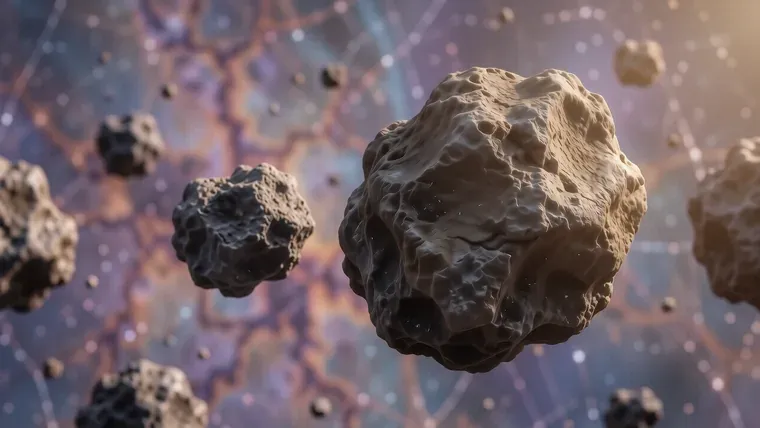
Asteroids are rocky, undifferentiated bodies that lack the layered internal structure of planets like Earth. They exist primarily in the Main Belt between Mars and Jupiter, though Near-Earth Objects (NEOs) with a perihelion distance under 1.3 astronomical units pose significant orbital intersection risks. Unlike terrestrial planets, most asteroids have not undergone geological stratification into a core, mantle, and crust because they lacked the sufficient mass to generate the internal heat required for such differentiation.
Compositional and Structural Divergence
Asteroids differ fundamentally from planets in their chemical distribution. Earth is stratified. Gravity pulled heavy iron to the center while lighter silicates rose to form the crust. Most asteroids remain homogeneous. This lack of tectonic mixing means that metals like platinum, rhenium, or iridium are distributed evenly throughout the body rather than being concentrated in specific geological veins.
Mining these bodies presents a unique logistical challenge. You cannot find a single rich vein of ore. Instead, extraction requires processing massive volumes of rock to isolate desired elements because the minerals are spread thin across the entire volume. While this makes traditional drilling less efficient, it ensures that a miner will not run out of material once a deposit is located.
The physical structure of an asteroid depends heavily on its diameter. Small asteroids often behave like solid blocks. They lack internal pressure. However, as a body grows between 1 and 100 kilometers in diameter, it develops enough gravitational pull to retain regolith and loose rocks on its surface. These larger objects are often porous conglomerates of loosely compacted stones rather than single solid masses.
- Small bodies rely on magnetic bonds or internal cohesion to resist centrifugal forces during rotation.
- Large bodies exhibit significant porosity.
- Larger diameters allow for the accumulation of a primitive regolith layer.
Classification by Spectral Type
Astronomers categorize asteroids using spectral classes based on their albedo and chemical signatures. These classes provide a roadmap for potential resource extraction. C-type asteroids are carbonaceous. They are the most common type and often contain high amounts of water and organic compounds.
S-type asteroids are stony. They consist primarily of silicate rocks and metals like iron and magnesium. The asteroid Itokawa, which was studied by the NEAR Shoemaker spacecraft in 2000, is a classic S-type example. It measures approximately 535 by 294 by 209 meters.
M-type asteroids are metallic. These bodies are of particular interest for heavy metal mining. Because they have not undergone differentiation, they may contain high concentrations of nickel and iron alongside precious metals.
The C-Class Profile
C-type asteroids like Ryugu provide a window into the early solar system. The Hayabusa-2 mission investigated this body to understand how its composition has remained virtually unchanged for billions of years. These objects are vital for studying the prebiotic chemistry that may have led to life on Earth.
The S-Class Profile
S-type bodies are more common in the inner part of the asteroid belt. They provide silicate-rich material. The asteroid Itokawa contains minerals from the olivine, pyroxene, and plagioclase groups. Japan’s Hayabusa probe successfully returned dust from Itokawa to Earth in 2010.
The M-Class Profile
M-type asteroids are dense. They are often considered the remnants of the metallic cores of larger protoplanets that were shattered by collisions during the solar system’s violent formation period.
Distribution and Orbital Dynamics
The Main Belt holds the majority of the solar system’s small-body mass. This region lies between Mars and Jupiter. It contains a diverse assortment of objects, including the dwarf planet Ceres. Ceres is massive. It has a diameter of approximately 900 kilometers and contains much of the total mass found in the asteroid belt.
Ceres is different from other asteroids. It is a protoplanet that has undergone significant differentiation. Vesta is another such object. The Dawn mission extensively examined Vesta to study its complex structure of core, mantle, and crust. It belongs to the V spectral class, which is enriched with magnesium-rich pyroxene.
Other populations exist outside the Main Belt. The Kuiper Belt lies past Neptune. It is much larger than the Main Belt. Objects here are rich in volatiles like frozen nitrogen, methane, and water ice. Centaurs inhabit the unstable space between Jupiter and Neptune. Their orbits are transitory.
| Location | Primary Composition | Key Object |
|---|---|---|
| Main Belt | Silicates, Metals, Carbon | Ceres |
| Kuiper Belt | Volatiles, Ices, Organics | Various |
| Near-Earth | Variable (NEOs) | Bennu |
Near-Earth Objects and Planetary Defense
Near-Earth Objects (NEOs) represent a specific subset of asteroids. These bodies have orbits that bring them close to Earth’s path. A collision would be catastrophic. Consequently, monitoring these objects is a high priority for agencies like NASA and the ESA.
There are approximately 1,000,000 known NEOs with a diameter exceeding 100 meters. We do not have a complete catalog yet. Tracking them requires constant telescopic observation. The goal is to identify potential impactors decades before they reach Earth.
Deflection technology is no longer purely theoretical. In 2022, the DART mission successfully altered the trajectory of the asteroid Dimorphos. This kinetic impactor test proved that we can manipulate the orbital path of a small celestial body. Such capabilities are essential for protecting the planet from future threats.
The study of Bennu is also critical. The OSIRIS-REx mission has been investigating this B-type carbonaceous asteroid. Scientists expect to gain deep insights into the solar system’s history through its composition. This mission demonstrates our growing ability to intercept and sample these distant rocks.
Resource Potential and Space Habitation
Asteroids are more than just hazards. They are potential fuel depots and construction sites. The high chemical purity of metals in asteroids makes them attractive for future space-based manufacturing. Earth’s crust is depleted of many heavy elements due to gravitational differentiation. Asteroids offer a way to bypass this scarcity.
The concept of using an asteroid as a spacecraft is gaining traction. A large, hollowed-out asteroid could provide radiation shielding and mass for artificial gravity. Project RAMA, proposed by the startup Made in Space in 2017, explored the idea of converting an asteroid into a massive space station. This would require an S-class asteroid with dimensions around 34 by 11 by 11 kilometers.
Living on an asteroid requires mastering several technologies:
- Extraction of water and fusion fuel from regolith.
- Creation of artificial gravity through rotation.
- Autonomous life support in high-radiation environments.
Phobos is a candidate for such a role near Mars. It may be a captured asteroid that wandered into the Martian system. Using Phobos as a base would allow for long-term exploration of the Red Planet. Such projects require us to develop skills for living in rocky, resource-limited environments.
The transition from Earth-based mining to asteroid-based mining will change the economy of space. We will move from bringing everything from Earth to utilizing what is already there. This shift is necessary if we are to establish permanent settlements on Mars or beyond.
Small-scale operations might begin with harvesting volatiles from C-type asteroids. These can be converted into propellant. Once we have reliable fuel in orbit, the logistics of deep space travel change completely. We will no longer be tethered to the heavy lift capacity of Earth’s gravity well.
The asteroid belt remains a vast, largely unexplored frontier. Every mission, from Hayabusa to OSIRIS-REx, adds a new piece to the puzzle. We are learning that these rocks are not just dead debris. They are the building blocks of the solar system and the potential foundation for our future in space.
Frequently asked questions
How do asteroids differ from planets in structure?
Unlike planets, most asteroids are undifferentiated and lack a layered core, mantle, and crust because they lacked the mass to generate sufficient internal heat.
What are the different spectral classes of asteroids?
Asteroids are categorized into C-type (carbonaceous), S-type (stony silicates), and M-type (metallic) based on their chemical signatures and albedo.
Where are most asteroids located in the solar system?
The majority of asteroid mass is found in the Main Belt, which is located in the region between the orbits of Mars and Jupiter.
What makes Near-Earth Objects (NEOs) significant?
NEOs have orbits that bring them close to Earth's path, posing potential collision risks that require constant monitoring by agencies like NASA and the ESA.
More in Solar System
Calculating the Earth's mass: A complex task
Learn how scientists use the gravitational constant and orbital mechanics to determine Earth's mass of approximately 5.9722 x 10^24 kg.
Discovering the current location of Voyager in interstellar space
Learn about the current location of Voyager 1 and 2, their distances from Earth, and how they navigate the harsh environment of interstellar space.
How many natural satellites does the earth possess?
Explore Earth's celestial companions, from the permanent Moon to transient quasi-satellites and cosmic dust clouds located at Lagrange points.
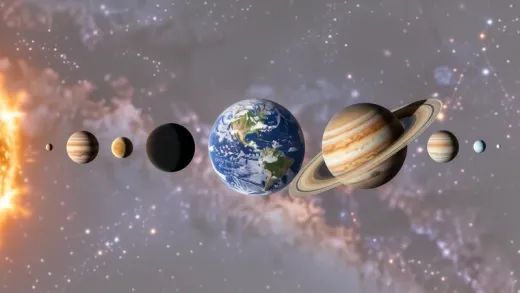
How many planets orbit the sun in second grade lessons
Learn how many planets orbit the sun and discover key facts about the eight official planets, from Mercury to Neptune, for students and educators.