What characteristics does Saturn's internal composition possess?
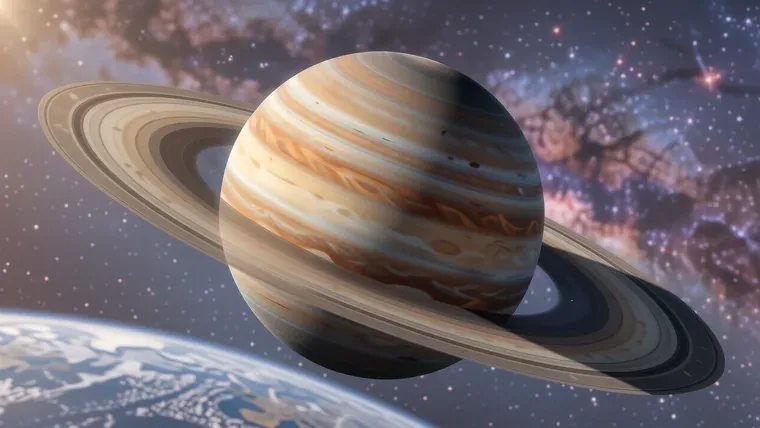
Saturn lacks a solid surface. It consists of a massive hydrogen and helium envelope that transitions into liquid layers under extreme pressure. Deep within the planet, metallic hydrogen forms a thick shell around a central core composed of iron, nickel, and ice.
Atmospheric Composition and Dynamics
The atmosphere is mostly hydrogen. Specifically, 96.5% of the upper layers consist of hydrogen while 3.5% consists of helium. Trace amounts of phosphine, ammonia, ethane, and methane exist within these gaseous layers because they are carried upward by internal convection.
Winds move very fast. Voyager missions recorded wind speeds reaching 500 m/s, although these currents can accelerate to 1800 km/h near the equator. These winds blow predominantly in an easterly direction so that they maintain consistent patterns across much of the planet’s latitudes.
Storms occur periodically. Large formations like the “Great White Oval” appear roughly every 30 years, although their specific timing remains difficult to predict with absolute certainty. In 2010, the Cassini spacecraft captured a storm that looked like cigarette smoke because the turbulent gases swirled in a tight, localized column.
The north pole is strange. A permanent hexagonal cloud pattern exists at 78 degrees latitude, which rotates with a period of 10 hours and 40 minutes. This shape remains stable because the atmospheric vortices are driven by deep-seated jet streams that resist breaking into smaller, irregular cells.
Polar auroras glow blue. These lights appear as rings or spirals above the poles after solar winds interact with the planet’s magnetic field.
Internal Structure and Density
Saturn is very light. Its average density measures 0.69 g/cm³, which makes it the only planet in the solar system with a density lower than that of water. This low density occurs because the planet’s massive volume, which is 800 times that of Earth, consists mostly of light gases rather than heavy rock.
Pressure increases with depth. As one descends through the atmosphere, the gas transitions into a liquid state after the pressure reaches levels that prevent simple evaporation. The transition from gas to liquid happens gradually so that there is no distinct boundary like an ocean on Earth.
Metallic hydrogen dominates the interior. This state of matter exists because the immense gravitational compression forces hydrogen atoms to behave like a conductor. Deep below this layer, a solid nucleus resides at the center.
The core contains heavy elements. It likely consists of iron, nickel, and silicates while it remains buried under thousands of kilometers of compressed hydrogen.
Magnetosphere and Magnetic Field
Pioneer 11 discovered the field in 1979. Saturn possesses the second-largest magnetosphere in the solar system, although Jupiter’s magnetic environment is significantly more powerful. The magnetosphere extends to a distance of approximately 20 planetary radii because the interaction with solar wind creates a vast protective bubble.
Plasma fills this region. Much of this plasma comes from the moon Enceladus after its geysers eject water vapor into space. The magnetic field ionizes this vapor so that it becomes part of the planet’s complex electromagnetic environment.
The field is asymmetrical. It follows a dipole structure similar to Earth, yet the magnetic axis is slightly displaced toward the north pole.
Magnetic storms trigger lightning. These discharges impact the planet’s electromagnetic stability while they occur during periods of intense solar activity.
Planetary Rotation and Orbit
Saturn orbits the Sun slowly. It completes one full revolution every 30 Earth years, which equals approximately 10,957.5 days. The planet travels at an average orbital speed of 9.8 km/s.
Rotation is rapid. A single day on Saturn lasts only 10 hours and 34 minutes because the planet spins extremely fast around its axis. This rotation rate varies by latitude, so the equator moves faster than the polar regions.
The distance from the Sun is vast. Saturn sits approximately 1,430 million kilometers away from the Sun, which means it receives about 90 times less solar heat than Earth.
Rotation speed fluctuates. Researcher Williams noted that the equatorial rotation period varies over 200-year cycles because of semi-annual and annual influences.
The Ring System
Rings surround the planet. They consist of 93% water ice with various impurities while they span a diameter of roughly 250,000 kilometers. These rings are incredibly thin, often measuring less than 1 kilometer in thickness.
The B ring is brightest. It serves as the largest and most luminous component of the system although it is separated from the A ring by the Cassini division. Within the A ring, a narrow feature called the Enke separation band exists.
Particles vary in size. Most ring matter consists of fragments ranging from 1 cm to 10 meters because smaller dust particles are swept up or pushed by gravity. Shepherd satellites like Mimas help maintain these structures through gravitational resonance.
The rings can disappear. When the planet’s tilt causes the rings to face edge-on toward Earth, they become nearly invisible to telescopes. This phenomenon caused a widespread rumor in 1921 that the rings had actually vanished into space.
Satellite Systems and Exploration
Saturn has many moons. There are currently 63 known satellites, including Titan, which is the second largest moon in the solar system after Jupiter’s Ganymede. Titan possesses a thick nitrogen-rich atmosphere although it lacks a solid surface like the terrestrial planets.
Enceladus is geologically active. It shoots plumes of water vapor into space so that the Cassini spacecraft could detect the potential for life within its subsurface ocean. NASA declared Enceladus one of the most promising targets for biological study in 2011.
Exploration has been extensive. The Cassini-Huygens mission arrived in 2004 and studied the system until 2017, providing data on everything from ring oscillations to Titan’s hydrocarbon lakes.
Voyager 1 provided high-resolution images in 1980. It captured details of the moons Mimas, Rhea, and Dione before it left the Saturnian system.
The history of observation is long. Galileo Galilei first saw Saturn through a telescope in the early 17th century, although he initially mistook the rings for two separate satellites.
Huygens landed on Titan. The probe descended via parachute for 2.5 hours before it collected samples of methane-derived ice and liquid nitrogen.
Recent studies continue. Researchers use the Subaru telescope in Hawaii to track irregular satellites that move in retrograde orbits.
Frequently asked questions
What is the average density of Saturn?
Saturn has an average density of 0.69 g/cm³, making it the only planet in our solar system with a density lower than that of water.
What materials make up Saturn's core?
The central core is composed of heavy elements including iron, nickel, and silicates, buried under thousands of kilometers of compressed hydrogen.
How much hydrogen and helium is in Saturn's atmosphere?
The upper atmospheric layers consist of 96.5% hydrogen and 3.5% helium, with trace amounts of methane, ammonia, and phosphine.
What is metallic hydrogen in Saturn?
Metallic hydrogen is a state of matter found deep within the planet where immense gravitational compression forces hydrogen atoms to behave like a conductor.
More in Solar System
Calculating the Earth's mass: A complex task
Learn how scientists use the gravitational constant and orbital mechanics to determine Earth's mass of approximately 5.9722 x 10^24 kg.
Discovering the current location of Voyager in interstellar space
Learn about the current location of Voyager 1 and 2, their distances from Earth, and how they navigate the harsh environment of interstellar space.
How many natural satellites does the earth possess?
Explore Earth's celestial companions, from the permanent Moon to transient quasi-satellites and cosmic dust clouds located at Lagrange points.
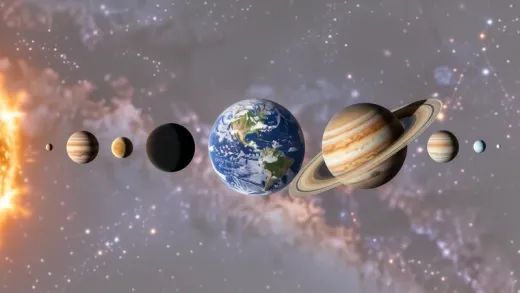
How many planets orbit the sun in second grade lessons
Learn how many planets orbit the sun and discover key facts about the eight official planets, from Mercury to Neptune, for students and educators.