What do the planets orbit around?
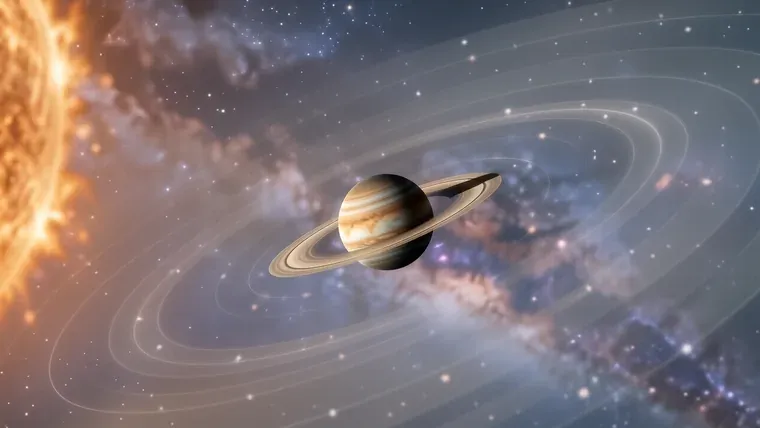
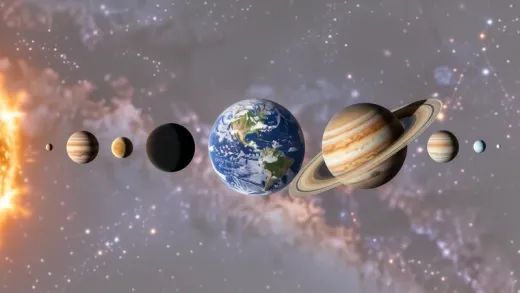
The eight planets in our solar system revolve around the Sun because its mass accounts for approximately 99% of the total system mass. Gravity dictates these paths. While the planets follow elliptical orbits rather than perfect circles, they all move within the same approximate plane known as the ecliptic. This orbital arrangement emerged from a single protoplanetary disk that formed after the collapse of a molecular cloud roughly 4.57 billion years ago.
The Mechanics of Orbital Motion
Orbits are not circles. They are ellipses. Because the Sun sits at one of the two focal points of these elliptical paths, the distance between a planet and its star changes throughout its year. This variation creates the perihelion, the closest approach, and the aphelion, the farthest point. Johannes Kepler formalized these movements through his three laws after he analyzed Tycho Brahe’s observational data from the late 16th century.
The speed of a planet varies. It changes constantly. A planet moves faster at perihelion because the gravitational pull of the Sun is stronger when the distance is shorter. Conversely, orbital velocity decreases at aphelion so that the object maintains its stable path through the outer reaches of the system. This relationship between distance and velocity ensures that the planets do not drift into deep space or crash into the central star.
The inclination of these orbits matters. Most stay flat. Although most planets orbit in the same plane, they exhibit slight deviations from the ecliptic. The degree of this deviation determines how much a planet’s path tilts relative to Earth’s orbital plane.
- Eccentricity: The measure of how much an orbit deviates from a perfect circle.
- Semi-major axis: Half of the longest diameter of an elliptical orbit.
- Sidereal period: The time required for one complete revolution around the Sun.
The Terrestrial Inner Planets
The inner solar system contains four rocky worlds. They are small. Mercury, Venus, Earth, and Mars consist primarily of silicates and metals because the intense heat from the young Sun prevented lighter volatile gases from condensing near the center. These planets possess high densities ranging from 5420 kg/m³ on Mercury to 3950 kg/m³ on Mars.
Mercury is tiny. It is scorched. The planet has an orbital eccentricity of 0.206, which is the highest in the solar system. Because its atmosphere is extremely thin and lacks significant mass, temperatures fluctuate wildly between the sunlit side and the dark side. In 1991, astronomers identified water ice within deep, shadowed craters at the poles where sunlight never reaches the surface.
Venus is a furnace. It is dense. The atmosphere contains 96% carbon dioxide, which creates a runaway greenhouse effect that maintains surface temperatures near 480 °C. This thick shroud prevents heat from escaping into space so that the planet remains the hottest in the system despite being further from the Sun than Mercury.
Earth is our home. It is wet. We possess a vast hydrosphere and an atmosphere rich in free oxygen, which distinguishes us from all other known planets in this solar system. Our orbit follows an elliptical path with an average velocity of 29.765 kilometers per second.
Mars is red. It is cold. The surface contains iron oxide, and the planet features Olympus Mons, a volcano that reaches a height of 21.2 km. Because the atmosphere is thin and mostly carbon dioxide, the planet cannot retain heat effectively during the night.
The Gas and Ice Giants
The outer planets are massive. They are gaseous. Jupiter, Saturn, Uranus, and Neptune lack solid surfaces because they consist mostly of hydrogen and helium. These giants occupy the region beyond the main asteroid belt.
Jupiter is a titan. It is fast. With a mass 318 times greater than Earth, it dominates the outer solar system through sheer gravitational influence. The planet rotates so rapidly that its equatorial velocity reaches 45,000 kilometers per hour. This rotation causes the planet to bulge at the equator, resulting in a compression ratio exceeding 6%.
Saturn has rings. They are wide. These rings consist of countless pieces of ice and rock that range from centimeters to tens of meters in size. While the rings appear solid from a distance, they are actually quite thin, measuring no more than two kilometers in thickness. Saturn’s moon Titan possesses a dense nitrogen atmosphere, which allows for liquid methane lakes to exist on its surface.
Uranus rotates sideways. It is blue. The planet has an axial tilt of approximately 98 degrees, meaning it essentially rolls along its orbital path. This orientation causes extreme seasonal variations because the poles receive direct sunlight for long periods while the equator remains in darkness.
Neptune is the farthest. It is windy. Mathematical calculations predicted Neptune’s existence in 1846 before any telescope actually observed the planet. Its vibrant blue color comes from methane in the atmosphere, which absorbs red light while reflecting the blue spectrum back to observers.
- Jupiter: 67 known satellites.
- Saturn: 62 known satellites.
- Uranus: 27 known satellites.
- Neptune: 14 known satellites.
Small Bodies and Reclassified Worlds
The solar system contains many smaller objects. They are diverse. Beyond the eight major planets, we find dwarf planets, asteroids, comets, and Kuiper belt objects. These bodies follow their own orbital paths, though they often reside in more eccentric or inclined orbits than the major planets.
Pluto is a dwarf planet. It is small. The International Astronomical Union reclassified Pluto in 2006 because it has not cleared its orbital neighborhood of other debris. It resides in the Kuiper belt alongside other objects like Quavar and Ixion. Pluto and its largest moon, Charon, are tidally locked so that they always face one another during their orbits.
Asteroids occupy a belt. They are rocky. This region sits between Mars and Jupiter, acting as a divider between the terrestrial planets and the gas giants. Most of these objects are composed of silicate rock or metals.
Comets are icy travelers. They have tails. When a comet approaches the Sun, solar radiation causes its ices to sublimate, creating a visible coma and tail. These objects often originate from the distant Oort cloud or the Kuiper belt.
Origins and Evolution
A cloud collapsed. It was old. The nebular theory explains that the solar system formed from a rotating disk of gas and dust approximately 4.6 billion years ago. As the central mass grew into the Sun, the remaining material clumped together through accretion to form planets.
The process was chaotic. Gravity helped. Particles in the protoplanetary disk moved in irregular patterns until the rotation of the Sun helped establish a unified plane of motion. This shared plane is why most planets orbit in the same direction and within a similar inclination.
We see this elsewhere. Stars form. A team of scientists identified a young star called HL Taurus, which is located 450 light-years from Earth. This star possesses its own protoplanetary disk, providing a real-time look at how planetary systems begin their long evolutionary cycles.
The solar system remains active. It changes. While the major orbits appear stable, the gravitational tugging between planets and moons causes subtle shifts in their positions over millions of years. We continue to refine our models as new data arrives from instruments like the James Webb Space Telescope.
Frequently asked questions
What do the planets in our solar system revolve around?
The eight planets revolve around the Sun, which accounts for approximately 99% of the total mass of the solar system.
Are planetary orbits perfect circles?
No, orbits are ellipses rather than perfect circles. This causes the distance between a planet and the Sun to change between perihelion and aphelion.
Why do most planets orbit in the same plane?
The orbital arrangement emerged from a single protoplanetary disk that formed after a molecular cloud collapsed roughly 4.57 billion years ago.
How does orbital speed change during a planet's year?
A planet moves faster at perihelion due to stronger gravitational pull and decreases in velocity at aphelion to maintain a stable path.
More in Solar System
Calculating the Earth's mass: A complex task
Learn how scientists use the gravitational constant and orbital mechanics to determine Earth's mass of approximately 5.9722 x 10^24 kg.
Discovering the current location of Voyager in interstellar space
Learn about the current location of Voyager 1 and 2, their distances from Earth, and how they navigate the harsh environment of interstellar space.
How many natural satellites does the earth possess?
Explore Earth's celestial companions, from the permanent Moon to transient quasi-satellites and cosmic dust clouds located at Lagrange points.
How many planets orbit the sun in second grade lessons
Learn how many planets orbit the sun and discover key facts about the eight official planets, from Mercury to Neptune, for students and educators.