What is currently taking place in the online space?
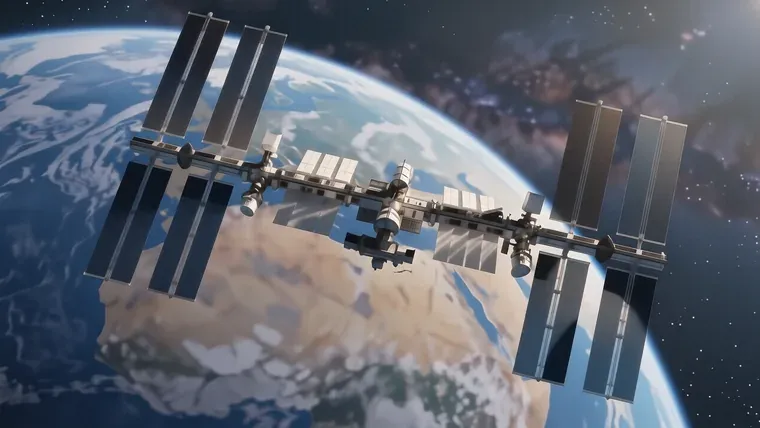
The International Space Station (ISS) provides a continuous stream of high-definition video and telemetry to the public through various NASA and Roscosmos channels. These digital feeds allow anyone with an internet connection to observe Earth from an altitude of 413 to 429 kilometers while watching astronauts perform complex maintenance tasks in microgravity.
Orbital Mechanics and Visibility
The station moves fast. It travels at 27,700 km/h. Because the ISS orbits the Earth every 92 minutes, the crew experiences 16 sunrises and 16 sunsets during a single 24-hour period. This rapid transit means that observers on the ground must use tracking tools to locate it.
You can track it. Use Google Maps or ESA tracking data. While many people attempt to spot the station with the naked eye, its visibility depends heavily on your specific latitude and the local time of day. If you live far north of the 51-degree orbital inclination, you may never see it pass overhead.
The ISS is massive. It measures 109 meters in width. Although the station weighs approximately 417.3 tons, this mass fluctuates depending on whether a Soyuz or Progress spacecraft is currently docked to a module.
Live Feeds and Technical Constraints
Digital streams exist. They are everywhere. NASA maintains a media channel that provides live coverage of astronaut missions, docking procedures, and press conferences so that the public can follow mission progress in real-time. These feeds often include audio from the crew during their active duty hours.
The signal varies. Sometimes it cuts out. You might see a blue screen or a static NASA logo because the station enters the Earth’s shadow every 45 minutes or so. When the solar panels cannot catch sunlight, the power levels drop and the transmission must pause until the next sunlit period begins.
Observers should be patient. Technical glitches happen. While high-speed internet makes these streams accessible, channel congestion often occurs during major events like a spacewalk or a Crew Dragon docking.
- NASA TV provides mission updates.
- Roscosmos broadcasts Russian segment activities.
- YouTube hosts SpaceX launch replays.
- Webcams offer 24/7 Earth views.
Extravehicular Activities and Maintenance
Spacewalks are difficult. They require precision. On 18 April 2022, cosmonauts Oleg Artemyev and Denis Matveev exited the Poisk module to begin a series of tasks that lasted several hours. They had to install a protective ring on the hatch trim because the integrity of the seal is vital for station pressure.
The suits are complex. They use Orlan-MKS technology. During training sessions, astronauts must verify the medical systems and the structural integrity of their suits so that they remain safe during long periods of exposure to the vacuum.
Maintenance happens constantly. It is never finished. On 17 November 2022, Sergey Prokopyev and Dmitry Petelin performed an EVA to prepare for a radiator transfer using the European Robotic Arm (ERA) manipulator. This task required them to work outside the Search module after the exit hatch opened at 17:20 Moscow time.
The Evolution of Space Tourism
Space travel is changing. It used to be rare. In the early years of the ISS, only a few individuals visited the station, but Roscosmos and Space Adventures eventually facilitated the first journeys for private citizens. These early tourists paid between 20 and 30 million dollars per seat.
Costs remain high. Suborbital flights are cheaper. While companies now offer trips to altitudes of 100–140 km, these do not provide the full orbital experience that a dedicated mission to the ISS offers. Most people will likely rely on live streams for the foreseeable future because true orbital flight remains prohibitively expensive.
The number of travelers grows. It is increasing. Although health requirements limit who can fly, the industry is developing more cost-effective methods for transporting non-professional astronauts into orbit.
Scientific Research in Microgravity
Science happens here. The station is a lab. Because the ISS sits above the thickest parts of the atmosphere, it provides a near-perfect vacuum environment that researchers cannot replicate in terrestrial laboratories. This setting allows for studies in biology, physics, and cosmology.
Researchers collect data. They use many tools. On 10 March 2022, Oleg Artemyev collected physical samples from external panels to assist with long-term technology research. These samples help engineers understand how the harsh environment of space affects station materials over time.
The modules vary. Each has a purpose. The station currently consists of 14 primary modules, including the American Unity modules and the Russian Zvezda module, which work together to support a permanent crew of six or seven people.
Solar Observation and Deep Space Data
The Sun is active. We watch it closely. The SOHO (Solar and Heliospheric Observatory) station sits at the first Lagrangian point of the Earth-Sun system so that its telescopes can provide constant, unobstructed views of the solar atmosphere. This data includes ultraviolet snapshots from the EIT instrument.
Prominences appear bright. They are loops of plasma. While these structures look beautiful in time-lapse videos, they represent massive magnetic events that can impact satellite communications on Earth. The observatory updates its images every hour to track these changes.
We also hear space. Meteorites make noise. In Canada, specialized transmitters capture the radio waves emitted by ionized particles in a meteor trail and broadcast them online so that listeners can hear the “whistle” of a falling rock in real-time.
The view is vast. It covers everything. From the high-definition cameras on a SpaceX Dragon to the deep-space telemetry from SOHO, the digital space is currently filled with more data than ever before.
Frequently asked questions
How can I watch the International Space Station online?
You can access high-definition video and telemetry through NASA and Roscosmos digital channels, including YouTube for SpaceX replays and various webcams for 24/7 Earth views.
Why do live space streams sometimes cut out?
Signals may pause because the station enters Earth's shadow approximately every 45 minutes, causing power levels to drop when solar panels cannot catch sunlight.
How fast does the ISS travel in orbit?
The International Space Station travels at a speed of 27,700 km/h, completing a full orbit around the Earth every 92 minutes.
What is the cost of space tourism to the ISS?
Early journeys for private citizens facilitated by Roscosmos and Space Adventures cost between 20 and 30 million dollars per seat.
More in Solar System
Calculating the Earth's mass: A complex task
Learn how scientists use the gravitational constant and orbital mechanics to determine Earth's mass of approximately 5.9722 x 10^24 kg.
Discovering the current location of Voyager in interstellar space
Learn about the current location of Voyager 1 and 2, their distances from Earth, and how they navigate the harsh environment of interstellar space.
How many natural satellites does the earth possess?
Explore Earth's celestial companions, from the permanent Moon to transient quasi-satellites and cosmic dust clouds located at Lagrange points.
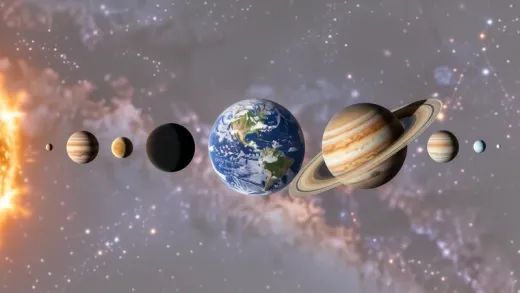
How many planets orbit the sun in second grade lessons
Learn how many planets orbit the sun and discover key facts about the eight official planets, from Mercury to Neptune, for students and educators.