What is solar time?
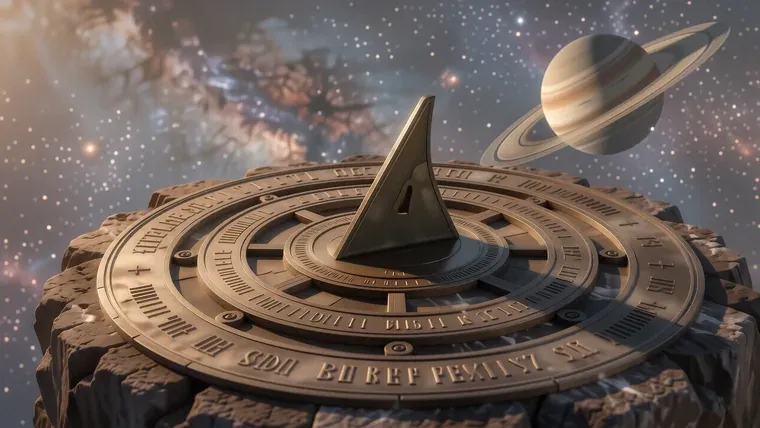
Solar time measures the Sun’s position relative to its culmination point at a specific meridian. It uses fractions of true solar days, including hours, minutes, and seconds, to track the Sun’s apparent movement across the sky. Because the Earth orbits the Sun in an elliptical path and maintains an axial tilt, the length of a true solar day fluctuates throughout the year. This variation means that “noon” on a sundial does not occur at a constant interval of 24 hours.
The Mechanics of True Solar Time
True solar time depends on the Sun’s hour angle. To calculate it, one adds 12 hours to the Sun’s center hour angle. It is inconsistent. While a clock might tick steadily, the actual position of the Sun shifts because the Earth’s orbital velocity changes as it moves from perihelion to aphelion.
The length of a true solar day varies significantly. On 22 December, a true solar day lasts roughly 50 seconds longer than the day on 23 September. This occurs because the Earth’s orbit is an ellipse rather than a perfect circle. The Sun does not move along the celestial equator. Instead, it follows the ecliptic, which is inclined to the equator.
The tilt matters. Near the solstices, the change in the Sun’s direct ascent is greater than it is near the equinoxes. This inclination causes the time intervals between lower culminations to fluctuate throughout the seasons. Astronomers track these shifts with extreme precision so that they can predict exactly when the Sun will cross a specific meridian.
The Sun moves. It follows the ecliptic.
Mean Solar Time and the Equation of Time
True solar time is impractical for daily schedules. We use mean solar time instead. This system relies on two fictional points: an average ecliptic Sun and an average equatorial Sun. The average equatorial Sun moves at a constant speed along the equator. It reaches the vernal equinox at the same time as the average ecliptic Sun.
A mean solar day is the interval between two consecutive lower culminations of this average equatorial Sun. We define the start of the day when this fictional Sun crosses a geographic meridian. Astronomers cannot measure mean solar time directly with a telescope. They must calculate it using mathematical models because the physical Sun never moves at a perfectly uniform rate.
The relationship between true and mean solar time is called the equation of time. This value fluctuates throughout the year. It ranges from +14 minutes on approximately 11 February to -16 minutes on approximately 3 November. We calculate this difference so that we can synchronize artificial clocks with the actual solar cycle.
The values shift. They follow a curve.
The Mathematical Offset
The equation of time acts as a bridge. It accounts for the discrepancies caused by orbital eccentricity and axial tilt. While some sources define it as the difference between mean and true time, others reverse the order. We follow the convention of Vorontsov-Vel’yaminov, which defines the equation of time as the difference between mean solar time and true solar time.
The offset is visible. You can see it on a sundial. If you compare a mechanical watch to a shadow cast by a pole, the two will drift apart throughout the months because the Earth’s speed in its orbit is not constant.
Ephemeris Time and Atomic Precision
Ephemeris time (ET) provides a more stable scale for celestial mechanics. It ignores the erratic rotation of the Earth. The International Astronomical Union (IAU) defines ET based on the motion of celestial bodies rather than the solar day. This scale ensures that calculations for planetary trajectories remain accurate over centuries.
The definition is specific. ET is the time it takes for the mean solar day to increase by 1.00273790935 seconds. This constant value allows scientists to predict the positions of planets without being misled by Earth’s wobbles. Spacecraft navigation relies on this stability because even a tiny error in timing would result in a massive miss at a distant destination.
Atomic time offers even higher precision. In 1964, the International Committee of Weights and Measures sanctioned the caesium atomic clock as the global standard. It counts vibrations. A single second is defined by the time it takes for a caesium atom to undergo 9,192,631,771 vibrations during an energy transition.
Atomic clocks are fast. They are incredibly stable. Although these clocks are much more precise than astronomical observations, they must be periodically adjusted. The difference between atomic time and ephemeral time accumulates to about 0.9 seconds over a year. Consequently, the atomic clock is reset by approximately 1 second almost every year to maintain synchronization with the Earth’s actual motion.
Global Timekeeping and Time Zones
Humanity uses many systems. Local time measures the time at a specific geographic meridian. The difference between two local times depends on their longitude. If you move east, you move forward in time. This is because the Earth rotates toward the east, bringing the Sun to your location sooner.
Universal Time (UT) is the local mean solar time at the Greenwich meridian. It serves as the global reference point. In 1884, the belt system was introduced to organize this chaos. This system divides the world into 24 main geographical meridians. Each meridian sits exactly 15 degrees apart from the prime meridian.
Zone time is standard. It uses a specific number for each region. A territory follows the solar time of its main meridian, which we call zone time. While these zones are intended to be 15 degrees wide, they are often irregular. Political boundaries frequently override geographic ones so that entire countries can stay on the same schedule.
The system is helpful. It organizes trade.
The Discrepancy of the Clock
Clocks do not always match the Sun. In some regions, the difference between clock time and true solar time exceeds one hour. This happens because the Sun only reaches its zenith at exactly 12:00 noon on the central meridian of a time zone. If you live on the edge of a zone, your sundial will show a different hour.
The discrepancy is real. It affects local life.
Sidereal Time and Stellar Observations
Astronomers use sidereal time for mapping the stars. Sidereal time measures the rotation of the Earth relative to the fixed stars rather than the Sun. A sidereal day is shorter than a solar day. Specifically, it is shorter by 3 minutes and 56 seconds.
The Earth rotates once. It also orbits the Sun. Because the Earth moves along its orbit while it spins, it must rotate slightly more than 360 degrees to bring the Sun back to the same meridian. This extra rotation is why a solar day is longer than a sidereal day. One year contains one additional sidereal day compared to the average solar year.
Star clocks are essential. They help observers find targets. An observatory clock operates on star time, which gains about four minutes every day relative to a solar clock. If an astronomer wants to observe Sirius, they use the right ascension from a star chart to set their equipment. This ensures that the telescope points at the correct coordinates when the star reaches its highest point.
The stars move. They follow a pattern.
Historical Methods and Mechanical Evolution
Ancient people used shadows. They planted poles in the ground to track the Sun. This was local apparent solar time. It worked well for small communities. However, it failed at night because shadows disappear when the light source is gone.
Water clocks provided an alternative. Known as klepsydras, these devices measured time by the flow of water through a vessel. They were more consistent than shadows during the day. Still, they were difficult to calibrate because changes in temperature or water viscosity would alter the flow rate.
Mechanical precision grew. In the 17th century, Thomas Tompion built clocks for the first Royal Astronomer, John Flamsteed, at the Greenwich Observatory. These instruments measured time in degrees, minutes, and seconds of arc. They were highly advanced for their era. For example, one hour equaled exactly 15 degrees of arc on the celestial sphere.
Pendulums improved accuracy. Fedchenko’s clock, developed in 1954, reached a precision of $3 \cdot 10^{-4}$ seconds. Although this was an achievement, mechanical pendulums were largely replaced by quartz oscillators by 1939. Quartz clocks use a vibrating crystal to regulate time. They are much more stable than any pendulum, although the crystals can age and cause the clock to slow down by $10^{-6}$ seconds per day.
The evolution is constant. Technology drives precision.
The Lunar Cycle and Biological Rhythms
The Moon influences Earth. It governs the tides through gravitational pull. Because of this, many cultures developed lunar calendars for agriculture and fishing. A lunar cycle lasts roughly 29 days and consists of four distinct phases.
The phases change. They follow a predictable sequence. First, there is the new moon. Then comes the first quarter, followed by the full moon and the third quarter. Some systems count lunar days as 24-hour intervals from the new moon. Other systems measure a lunar day from one moonrise to the next. These lunar days are longer than solar days, typically ranging from 24.5 to 25 hours.
Humanity feels these cycles. Many people believe that lunar phases impact emotional well-being or physical health. While scientific evidence for direct biological control is debated, the rhythm of light and dark clearly affects sleep patterns. Chronic sleep deprivation is a modern problem because our artificial lights disrupt the natural solar cycle.
The Moon stays constant. It pulls the tides.
Calendars and the Leap Year
Calendars organize history. They link human events to the seasons. If we used a strict 365-day year, the New Year would drift through the seasons every few centuries. This is because the true solar year is slightly longer than 365 days.
Julius Caesar introduced leap years. The Roman calendar added an extra day every four years to correct this drift. The Gregorian calendar, which we use now, refined this method. It adds a leap year every four years except for century years, unless that century year is divisible by 400. This keeps the calendar accurate within 22 seconds of the true solar year.
The Persians were different. In the eleventh century, they used a system where they had four leap years followed by a skip on the eighth year. Their method was actually more precise than the Gregorian system. We use the Gregorian version because it simplifies the math for global administration and long-term historical tracking.
Time flows forward. It cannot be reversed.
The Earth continues to spin. The Sun continues to rise. Whether we use an atomic clock or a simple sundial, our measurements are all attempts to capture a single, moving reality. We build these complex systems so that we can navigate the stars and coordinate our lives on a spinning planet.
Frequently asked questions
What is the difference between true solar time and mean solar time?
True solar time tracks the Sun's actual position, which fluctuates due to Earth's orbital eccentricity, while mean solar time uses a fictional average equatorial Sun moving at a constant speed.
What is the equation of time?
The equation of time is the mathematical difference between mean solar time and true solar time, ranging from approximately +14 minutes in February to -16 minutes in November.
How much shorter is a sidereal day than a solar day?
A sidereal day is shorter than a solar day by approximately 3 minutes and 56 seconds because it measures Earth's rotation relative to fixed stars rather than the Sun.
Why do we use leap years in our calendars?
Leap years are used because the true solar year is slightly longer than 365 days; the Gregorian calendar adds an extra day every four years to prevent seasonal drift.
More in Solar System

Calculating the Earth's mass: A complex task
Learn how scientists use the gravitational constant and orbital mechanics to determine Earth's mass of approximately 5.9722 x 10^24 kg.
Discovering the current location of Voyager in interstellar space
Learn about the current location of Voyager 1 and 2, their distances from Earth, and how they navigate the harsh environment of interstellar space.
How many natural satellites does the earth possess?
Explore Earth's celestial companions, from the permanent Moon to transient quasi-satellites and cosmic dust clouds located at Lagrange points.
How many planets orbit the sun in second grade lessons
Learn how many planets orbit the sun and discover key facts about the eight official planets, from Mercury to Neptune, for students and educators.