Determining what is the age of the planet Earth
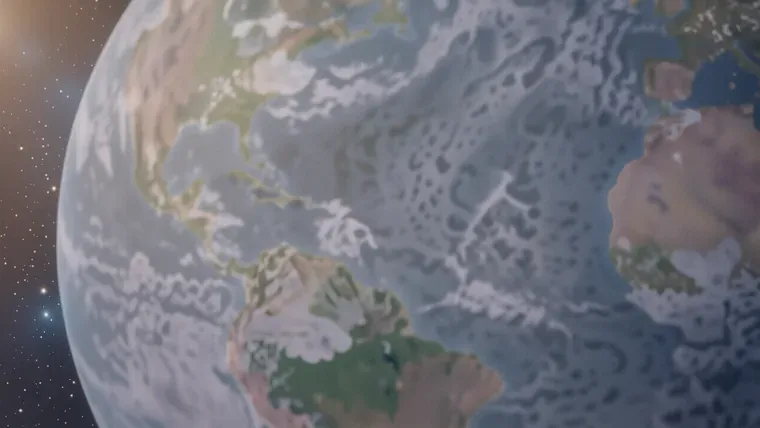
The Earth is approximately 4.54 billion years old. Scientists reached this conclusion by measuring the decay of radioactive isotopes within meteorites and lunar samples, because these celestial objects provide a more consistent record of the early solar system than the highly recycled crust of our own planet.
Radiometric Dating and the Lead Ratio
The method relies on physics. It is precise. Geochemists calculate age by examining the ratio between lead-207 and lead-206, although they must account for the specific decay rates of uranium-235 and uranium-238 to ensure accuracy. This process uses isotopes. They act as clocks.
Bertrand Boltwood changed everything in the early 20th century. He demonstrated that uranium decays into lead within crystalline structures, so researchers could finally move past speculative theological timelines. His work provided a foundation. It was solid. Before this, the scientific community struggled to define any meaningful geological timescale because they lacked a way to measure time through chemical changes.
The math is complex. It requires precision. In 1953, American geochemist Claire Patterson used uranium-lead and lead-lead techniques to provide a definitive age for the planet, while his colleague George Tilton assisted in refining the measurements of igneous rocks. Patterson worked hard. He was meticulous. He eventually realized that finding the oldest Earth rocks was unnecessary because the uranium-to-lead ratios in meteorites offered a more direct window into the solar system’s formation.
The results were clear. The age is 4.54 billion years. This number carries a margin of error of less than 1%, so it remains the standard in modern planetary science.
Evidence from Space and the Moon
Meteorites offer the best data. They are old. Most analyzed meteorites date between 4.53 and 4.58 billion years, which allows scientists to bracket the formation of the Earth within a very narrow window of time. These rocks fall often. We collect them.
The Moon provides another record. It is stable. Unlike Earth, the Moon lacks active plate tectonics, so it preserves ancient lunar basalt that has remained largely untouched for billions of years. The Apollo missions helped. They brought samples. Some of these lunar rocks date between 4.4 and 4.5 billion years, which establishes a minimum age for the Moon’s origin after the Giant Impact hypothesis.
A specific rock tells a story. It came from Earth. A piece of lunar material once thought to be extraterrestrial actually originated from our planet, because a massive collision between Earth and an asteroid expelled terrestrial soil into space 4 billion years ago. The impact was violent. It changed everything. This explains why certain lunar samples appear chemically similar to Earth’s mantle despite being found on the Moon.
- Oldest lunar basalt: 4.4–4.5 billion years.
- Meteorite age range: 4.53–4.58 billion years.
- Moon distance increase: 2 to 4 cm per year.
The Search for Ancient Earth Rocks
Earth destroys its own history. It is recycled. Tectonic activity constantly pushes old crust into the mantle, so finding rocks from the very beginning of the planet’s life is extremely difficult. We look for zircons. They are tough.
Zircon minerals in west-central Australia provide a vital clue. These grains date back 4.4 billion years, although the original host rocks that contained them have not yet been discovered by geologists. They survive heat. They endure pressure. These tiny crystals act as time capsules because their structure resists chemical alteration even during intense metamorphic events.
Other sites offer different ages. Canada holds secrets. Gneisses found near Great Slave Lake in Canada date back at least 4.03 billion years, which suggests that the Earth’s crust began stabilizing much earlier than previously thought. These rocks are old. They are sturdy. They did not break off from an original crust but formed from ancient lava flows and sediments after the planet cooled sufficiently.
Greenland also has history. It is cold. Supracrustal rocks in western Greenland date to between 3.7 and 3.8 billion years, while the Minnesota River Valley contains rocks aged 3.5 to 3.7 billion years.
Historical Attempts at Dating
Scientists used to guess. They were wrong. In 1868, Lord Kelvin estimated the Earth was between 20 and 400 million years old, although his model based on thermal cooling ignored the heat generated by radioactive decay. His math was flawed. He lacked data.
John Phillips had a different view. He studied sediment. He proposed an age of 96 million years, which was roughly similar to the estimated age of the Sun at that time. This estimate was low. It was incorrect. The debate between Kelvin and others like John Perry, who suggested 4 billion years, continued for decades because no one had discovered radioisotope dating yet.
Benoit de Maye made early observations. He was a diplomat. In the 18th century, he concluded the planet was approximately 2.4 billion years old after gathering various geological data points. This was surprisingly close. It showed promise. Even though his methods were not modern, he moved the conversation away from purely biblical interpretations of the Earth’s age.
Continental Erosion and Geological Time
The landscape changes fast. Water moves soil. Rivers carry sediment into the oceans, so the continents are constantly being reshaped by the force of precipitation and runoff. This process is relentless. It never stops.
Calculations suggest a timeline for erosion. The volume of continents above water is 128,636,000 km3. If we use the observed rates from the 22 largest rivers, the total destruction of continental plates could occur in approximately 20,150,000 years, although this model assumes current ocean levels and erosion rates remain constant. The math is specific. It uses density.
Different continents erode at different speeds. Africa is large. With a volume of 22,425,000 km3 and an average erosion rate of 0.369 km3/year, Africa might face complete destruction in about 60,772,000 years. Australia is smaller. It will vanish faster. Australia and Oceania have a volume of 3,026,000 km3, so they may be completely eroded in roughly 31,412,000 years.
- Asia volume: 42,180,000 km3.
- America volume: 27,365,000 km3.
- Antarctica volume: 30,580,000 km3.
The Evolution of Life and Atmosphere
Life changed the air. It was slow. During the Archean eon, the atmosphere contained mostly carbon dioxide and had very little oxygen, so the early oceans reached temperatures as high as 90°C. The planet was hot. It was dark.
Prokaryotes appeared first. They were simple. These microscopic organisms emerged around 3.5 to 4 billion years ago, and they began to transform the planet through photosynthesis. Oxygen grew. Life thrived. As oxygen levels increased during the Neoarchean era, anaerobic organisms died out while aerobic organisms began to dominate the biosphere.
The Paleozoic era brought diversity. It was long. This period began 541 million years ago and saw the rise of invertebrates, fish, and eventually land-dwelling plants. Forests grew thick. The climate shifted. During the Carboniferous period, massive swamps covered the land, so huge amounts of organic matter were buried to eventually become the coal deposits we mine today.
The Mesozoic era followed. Reptiles ruled. This era began 252.17 million years ago and featured the rise of dinosaurs, although the climate shifted from hot and dry to wetter as the era progressed. Flowering plants appeared. Birds evolved. The extinction event 66 million years ago ended the reign of large reptiles, so mammals were able to occupy new ecological niches.
The Cenozoic era is now. It is our time. This ongoing era has seen the rise of primates and humans, while the climate continues to fluctuate between glacial and interglacial periods. We live here. The history continues.
Frequently asked questions
How old is the Earth?
The Earth is approximately 4.54 billion years old. This age is determined by measuring radioactive isotope decay in meteorites and lunar samples.
Why are meteorites used to date the planet?
Meteorites provide a more consistent record of the early solar system than Earth's crust, which is constantly recycled by plate tectonics. Most analyzed meteorites date between 4.53 and 4.58 billion years.
What are the oldest rocks found on Earth?
Zircon minerals in west-central Australia date back 4.4 billion years, while gneisses near Great Slave Lake in Canada date to at least 4.03 billion years.
How does radiometric dating work?
Geochemists calculate age by examining the ratio between lead-207 and lead-206, accounting for the specific decay rates of uranium-235 and uranium-238.
More in Solar System
Calculating the Earth's mass: A complex task
Learn how scientists use the gravitational constant and orbital mechanics to determine Earth's mass of approximately 5.9722 x 10^24 kg.
Discovering the current location of Voyager in interstellar space
Learn about the current location of Voyager 1 and 2, their distances from Earth, and how they navigate the harsh environment of interstellar space.
How many natural satellites does the earth possess?
Explore Earth's celestial companions, from the permanent Moon to transient quasi-satellites and cosmic dust clouds located at Lagrange points.
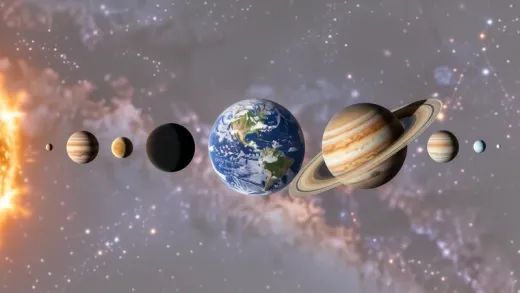
How many planets orbit the sun in second grade lessons
Learn how many planets orbit the sun and discover key facts about the eight official planets, from Mercury to Neptune, for students and educators.