What is the appearance of a Cepheus star?
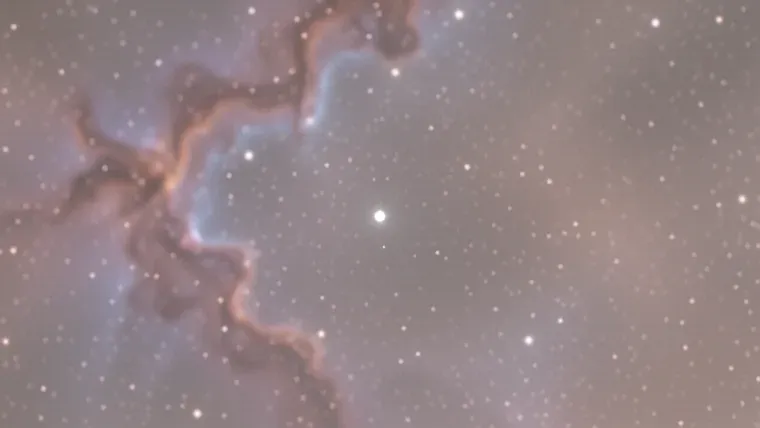
Determining the appearance of a Cepheus star requires distinguishing between its visual magnitude and its physical dimensions. While many stars in this constellation appear as faint points of light to the naked eye, several red hypergiants within the region possess radii that exceed 1,000 solar diameters. Because these stars are often located thousands of light-years away, we cannot see their surfaces directly. We rely on indirect measurements like parallax and luminosity to estimate their size.
The Physics of Stellar Measurement
Measuring a star is difficult. Most stars appear as infinitesimal dots because our current telescopes cannot resolve the actual disk of a distant sun. We only observe the physical surface of a few nearby supergiants. For most of the millions of stars in the Milky Way, we must calculate diameter using light curves and temperature data.
The margin for error is huge. A calculation might vary by millions of kilometers because the boundary between a star’s photosphere and its extended atmosphere is often blurred. Many of these giants pulsate. They expand and contract over time.
Size is not constant. On 9 October 2009, the LCROSS impactor struck the lunar surface, which demonstrated how precision matters in celestial mechanics, yet stellar diameters remain much harder to pin down than lunar topography. Stars like VV Cepheus change their diameter significantly during their cycles. This makes a single “appearance” description technically inaccurate for variable stars.
The Giants of Cepheus
VV Cepheus is a massive system. It functions as an eclipsing variable star, so we know it contains at least two distinct components. Component A is a red hypergiant. Its size fluctuates between 1,050 and 1,900 solar diameters because the star undergoes regular pulsations every 150 days.
It shines brightly. At its maximum expansion, VV Cepheus reaches a luminosity 575,000 times greater than our Sun. Despite being 5,000 light-years away, it maintains a visual magnitude of 5.18 m. You can see it with binoculars on a clear night.
The second star is smaller. Component B is a blue star that measures approximately 8 times the size of our Sun. The two bodies orbit each other in a complex dance that lasts roughly 20 years per revolution.
Mu Cepheus is another giant. Astronomers call it Herschel’s garnet star. It sits at a distance of about 5,200 light-years from Earth. Its radius reaches up to 1,420 solar radii while its surface temperature stays around 2,000 °C.
It is a triple system. Mu Cepheus consists of a primary star and two much fainter components, B and C, which have magnitudes of 12.3m and 12.7m respectively. The primary star is currently burning helium so that it will eventually transition into carbon. This process signals the beginning of its end.
V354 Cepheus also occupies this region. It is a red supergiant located roughly 9,000 light-years away. Its diameter reaches approximately 1 billion kilometers. If we placed it in our solar system, it would reach the orbit of Jupiter.
Comparing Scale and Magnitude
Size can be deceptive. UY Shield is often cited as a candidate for the largest star because its diameter is estimated at 2.4 billion kilometers. This equates to 15.9 astronomical units. If placed at our Sun’s position, it would engulf the inner planets.
It is quite dim. The star has a magnitude of 11.2 m, so you cannot see it without a telescope. Dust clouds sit between us and UY Shield, although these clouds do not prevent us from measuring its scale through infrared observations. It shines 340,000 times brighter than the Sun despite its distance of 9,500 light-years.
VY Canis Majoris is different. It is located in the constellation Canis Major, but it provides a useful comparison for Cepheus giants. This star has a density lower than the air we breathe. It is currently losing mass to create a visible nebula around itself.
Light takes time to travel. For VY Canis Majoris, light would take 8.5 hours to orbit the star’s circumference. A jet flying at 4,500 km/h would take 220 years to complete that same journey.
Stevenson 2-18 holds a different title. It is currently recognized as the largest known star in the Milky Way. Located 18,900 light-years away in the Stevenson cluster, it has an estimated radius of 2,150 solar radii. This distance means we see the star as it existed nearly 19,000 years ago.
The Constellation’s Structure and Sky Position
Cepheus looks like a pentagon. It is an irregular shape that covers 587.8 square degrees of the sky. It sits in the Northern Hemisphere near Cassiopeia and Ursa Minor.
The constellation moves. Earth’s axis undergoes precession, so the North Pole will not stay at Polaris forever. By the year 3100, the star Gamma Cepheus will be near the celestial pole. Eventually, Alpha Cepheus will become the new pole star around 8300 AD.
Finding it is easy. Look between the “W” of Cassiopeia and the “Little Bear.” It is visible from Russia all year long because of its high northern declination.
The stars are mostly faint. Only eight stars in Cepheus have a magnitude brighter than 4.0. However, a person with good eyes can see 60 stars on a moonless night.
Deep Sky Objects in the Region
NGC 6951 is a spiral galaxy. It resides within the constellation and appears as an active stellar system. It possesses a modest size but remains visually interesting for observers.
Clusters exist here too. NGC 188 is one of the oldest scattered clusters in our Galaxy, with an estimated age of 5 billion years. NGC 7160 contains eight bright stars that form a shape similar to a bucket or a dolphin.
Nebulae provide color. IC 1396 is an emission nebula known as the Elephant Trunk. It shows active star formation while gas clouds stretch across the field of view.
NGC 7380 is also present. Some people call it the “Harry Potter Nebula” because its shape resembles a golden snitch. It requires a decent telescope to resolve the fine details of the gas.
The Iris Nebula (NGC 7023) is a reflection nebula. It houses a dispersed group of stars that scatter light through dust. This object is highly regarded by professional astronomers.
Myth and Legend
Greek myths define the shape. Cepheus was a king in Ethiopia. He was married to Cassiopeia, who was famously vain.
Poseidon sent a monster. The sea god punished the queen because she claimed to be more beautiful than the Nereids. This monster was Cetus, which moved through the ocean to threaten the kingdom.
Athena helped the king. The goddess turned Cepheus into a constellation so that his story would endure in the stars. This myth links the stars to human character flaws like pride.
Southeast Asian legends differ. Some stories connect Cepheus to a charioteer. He drove an empress to the mountain of Kuen-Lun, which is located at the center of the Earth.
The chariot became the Big Dipper. In this version, the gods transformed the driver into Cepheus and his vehicle into the Great Bear. This provides a different way to map the same celestial coordinates.
Observing Tips for Astronomers
Use binoculars first. Most objects in Cepheus are too faint for the naked eye. You will need magnification to see the red supergiants or the small clusters.
Watch the seasons. The constellation is highest overhead during autumn evenings. It sits low in the northwest during winter, although it remains visible from northern latitudes.
Avoid light pollution. Cities make it hard to see the 11th-magnitude stars like UY Shield. A dark sky is necessary for deep-space observation.
Check your equipment. Small telescopes are sufficient for NGC 7354 or the Bow Tie Nebula (NGC 40). These objects require a clear view of the celestial equator.
The star Kruger 60 is a double star. Component A has about 27% of the Sun’s mass, while component B has 18%. They orbit at an average distance of 9.5 astronomical units. This distance is roughly equivalent to the gap between Saturn and our Sun.
The sky remains vast. We continue to find new objects in the Stevenson cluster as telescope technology improves. Every new measurement changes our understanding of how these giants live and die.
Frequently asked questions
How large are the giant stars in the Cepheus constellation?
Some red hypergiants in Cepheus have radii exceeding 1,000 solar diameters. For example, VV Cepheus fluctuates between 1,050 and 1,900 solar diameters.
Can you see the stars in Cepheus with the naked eye?
Most stars in Cepheus appear as faint points of light, and only eight stars have a magnitude brighter than 4.0. However, a person with good eyes can see about 60 stars on a moonless night.
What is Mu Cepheus known as?
Mu Cepheus is known as Herschel's garnet star. It is a triple system located approximately 5,200 light-years from Earth with a radius of up to 1,420 solar radii.
What deep sky objects can be found in Cepheus?
The constellation contains several notable objects, including the NGC 7380 'Harry Potter Nebula,' the Iris Nebula (NGC 7023), and the ancient star cluster NGC 188.
More in Stars
How far away is the nearest star in light years?
Discover how far Proxima Centauri is from Earth and learn about its physical characteristics, planetary system, and distance measurements.

Methods used by scientists to calculate the distance to stars
Explore how astronomers use the cosmic distance ladder, from trigonometric parallax to standard candles and redshift, to measure stellar distances.
Reasons for the descent of stars from the heavens and their final
Learn why meteoroids appear as falling stars, how friction creates light during atmospheric entry, and where these cosmic fragments ultimately end up.
Shooting stars: An enigmatic phenomenon explained
Discover the science behind shooting stars, from the mechanics of atmospheric entry to the chemical composition of meteorites and predictable meteor showers.