What is the color of Saturn?
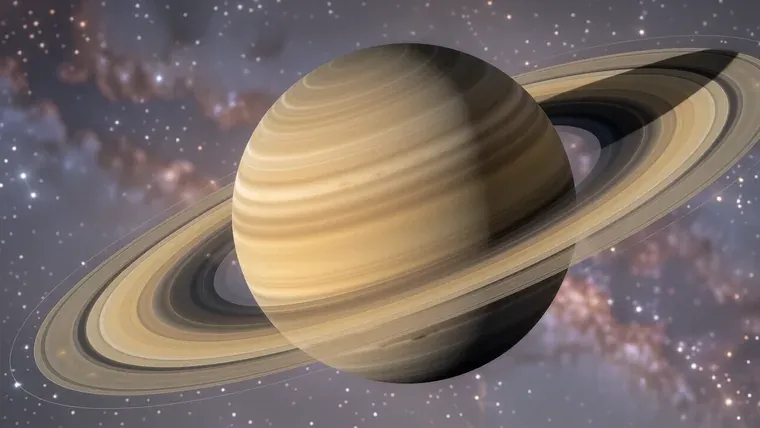
Saturn appears pale yellow or light orange to the human eye. The sixth planet from the Sun and the second-largest in the Solar System, it owes this coloration to white ammonia crystals settling on top of reddish-brown clouds made of ammonium sulfide and water vapor. While some digital images depict a blue tint, this effect stems from light scattering rather than actual pigment.
Through a backyard telescope the planet shows as a steady cream-gold dot with its rings; the Hubble Space Telescope and NASA’s Cassini orbiter resolved the true, muted palette that the naked eye cannot separate.
Atmospheric Composition and Color
The atmosphere is mostly hydrogen. It contains roughly 96% hydrogen and 3% helium. Other trace elements like methane, ethane, and phosphine exist in concentrations below 0.4% because these gases influence the specific shades seen in high-resolution photography.
Colors vary by latitude. The polar caps appear yellowish-gray. Mid-latitudes show a yellowish-white hue while the equatorial region maintains a grayish-brown tone.
The clouds are thick. They obscure any solid surface below. Because Saturn lacks a terrestrial crust, we only observe the uppermost layers of the gaseous envelope.
Ammonia is key. It forms the bright white structures. These crystals float in the upper atmosphere so that they reflect significant amounts of sunlight back into space.
Observers see stripes. These bands appear more subtle than those on Jupiter. The presence of deep-seated clouds often masks the intensity of these atmospheric streaks.
Wind Dynamics and Storm Systems
Winds move very fast. They reach speeds of 500 m/s at the equator. While most winds blow from west to east, some currents flow in the opposite direction at different depths.
The Voyager 2 mission provided data. It confirmed that wind patterns are symmetrical across the equator. This symmetry suggests that air currents might be linked to processes occurring deep beneath the visible cloud tops.
Storms are massive. A hexagonal vortex exists at the north pole. Each side of this hexagon measures approximately 13,800 kilometers because the atmospheric geometry is dictated by complex fluid dynamics.
The Great White Spot appears periodically. It occurs in the northern hemisphere every 30 years during the summer solstice. This phenomenon demonstrates how stable and long-lasting certain high-pressure systems can become.
Physical Dimensions and Density
Saturn is quite large. Its equatorial radius measures 60,000 kilometers. The planet is a flattened spheroid because its rapid rotation creates significant centrifugal force at the equator.
Rotation is fast. A single day lasts about 10.5 hours. This speed causes the equatorial diameter to be 1/10th larger than the polar diameter.
Density is extremely low. It measures 0.687 g/cm³. If you placed Saturn in a massive ocean, the planet would float because its average density is less than that of water.
Mass is immense. The total mass equals $5.68 \times 10^{26}$ kg. This weight keeps the 82 known moons in stable orbits around the gas giant.
Gravity feels normal. At the cloud tops, acceleration is 10.44 m/s². Although this value is slightly higher than Earth’s 9.81 m/s², the lack of a solid surface makes “standing” impossible.
The Ring System Structure
Rings are not solid. They consist of ice flakes and dust. Many particles are only a few centimeters wide, although some clusters reach 10 meters in diameter.
Seven rings exist. Three are major and four are minor. The innermost ring appears grayish-black while the middle ring shows white and yellowish-white sections.
Dust reflects light. This coating covers the various rings. Because the rings contain pure ice, they remain highly reflective despite the billions of years since their formation.
The Cassini spacecraft studied them. It provided detailed views of the Keeler and Maxwell gaps. These gaps exist because small “shepherd” moons exert gravitational influence on the ring particles.
Thickness is minimal. The average thickness does not exceed 150 meters. This thinness makes the rings look like a solid disk from a great distance.
Internal Heat and Composition
The core is hot. Temperatures reach 12,000 to 15,000 degrees Kelvin. This heat prevents the planet from cooling as quickly as its distance from the Sun might suggest.
Hydrogen becomes metallic. At a depth of 30,000 kilometers, the pressure forces hydrogen into a liquid metallic state. This conductive layer generates the planet’s magnetic field.
Helium rain occurs. Tiny droplets of helium descend through the hydrogen layer. As these droplets fall toward the core, they convert potential energy into thermal energy so that the interior stays warm.
Internal heat is high. Saturn radiates 2.5 times more heat than it receives from the Sun. This internal energy source drives the powerful atmospheric convection seen in the cloud bands.
Comparison with Jupiter and Earth
Jupiter is more vibrant. It shows intense reddish-brown stripes. These colors come from ammonium hydrosulfide clouds, whereas Saturn relies more on ammonia crystals for its lighter appearance.
Earth is much smaller. Saturn’s volume is 763.6 times that of Earth, making it the second-largest planet after Jupiter. While Earth is a rocky planet, Saturn remains a gas giant composed of the lightest elements in the universe.
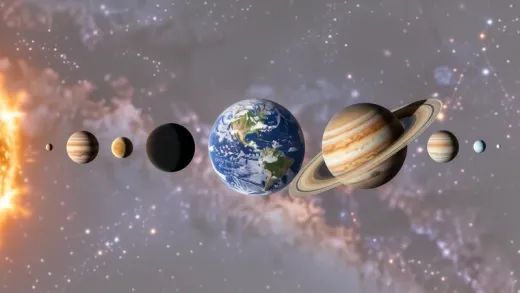
Color sets the giants apart. Uranus and Neptune glow blue-green because methane in their cold atmospheres absorbs red light, and Venus hides under reflective sulfuric-acid cloud, whereas Mercury is a bare gray rock. Saturn’s soft gold comes from ammonia haze alone, which is why it reads warmer than the outer ice giants.
Distance matters. Saturn sits about 1.43 billion km — roughly 886 million miles — from the Sun. It takes 29.7 Earth years to complete one orbit because its path is much longer than Earth’s.
The Great Red Spot differs. Jupiter’s storm is an anticyclone that has lasted centuries. Saturn’s storms, such as the Great White Spot, follow different seasonal cycles.
Massive differences exist. Saturn weighs 95 times more than Earth. This mass allows it to hold a complex system of moons, including the large, nitrogen-rich Titan.
Exploration History and Future
Galileo saw Saturn in 1610. He thought the rings were two separate moons. It took Christiaan Huygens until 1655 to realize the planet was encircled by a flat ring.
NASA’s Pioneer 11 arrived first. It was the first spacecraft to fly close to the planet, in 1979. This mission discovered the F ring, which added a new layer to our understanding of the ring system. NASA’s two Voyager probes followed in 1980 and 1981, returning the first sharp color images of the bands.
NASA’s Cassini spacecraft changed everything. Launched in 1997, it reached Saturn in 2004 and worked until 2017. During its final months the Cassini orbiter dove between the planet and its rings, then plunged into the atmosphere to take direct measurements of the gas layers that astronomers had only modeled from afar.
Titan is a target. The proposed Titan Saturn System Mission (TSSM) has a launch window opening in 2029. This mission will spend four years studying both the moon and the planet.
Moons offer clues. Enceladus has ice geysers that reach hundreds of meters high. These eruptions suggest a subsurface ocean exists, which provides a potential site for finding life.
Frequently asked questions
Why does Saturn look yellow?
Saturn appears pale yellow or light orange due to white ammonia crystals settling on top of reddish-brown clouds made of ammonium sulfide and water vapor.
What is the density of Saturn?
Saturn has an extremely low density of 0.687 g/cm³, which means the planet would float if placed in a massive ocean.
How fast do winds blow on Saturn?
Winds on Saturn are very fast, reaching speeds of up to 500 m/s at the equator.
What makes up Saturn's rings?
The ring system consists of ice flakes and dust, with many particles being only a few centimeters wide while some clusters reach 10 meters in diameter.
What is Saturn made of?
Saturn is a gas giant of roughly 96% hydrogen and 3% helium, with traces of methane, ethane, and ammonia. It has no solid surface — the pressure simply rises until hydrogen turns into a liquid metallic layer near the core.
What is Saturn's largest moon?
Titan, the second-largest moon in the Solar System, is bigger than the planet Mercury and is the only moon with a thick, nitrogen-rich atmosphere.
More in Solar System
Calculating the Earth's mass: A complex task
Learn how scientists use the gravitational constant and orbital mechanics to determine Earth's mass of approximately 5.9722 x 10^24 kg.
Discovering the current location of Voyager in interstellar space
Learn about the current location of Voyager 1 and 2, their distances from Earth, and how they navigate the harsh environment of interstellar space.
How many natural satellites does the earth possess?
Explore Earth's celestial companions, from the permanent Moon to transient quasi-satellites and cosmic dust clouds located at Lagrange points.
How many planets orbit the sun in second grade lessons
Learn how many planets orbit the sun and discover key facts about the eight official planets, from Mercury to Neptune, for students and educators.