What is the current location of the ISS and its orbit?
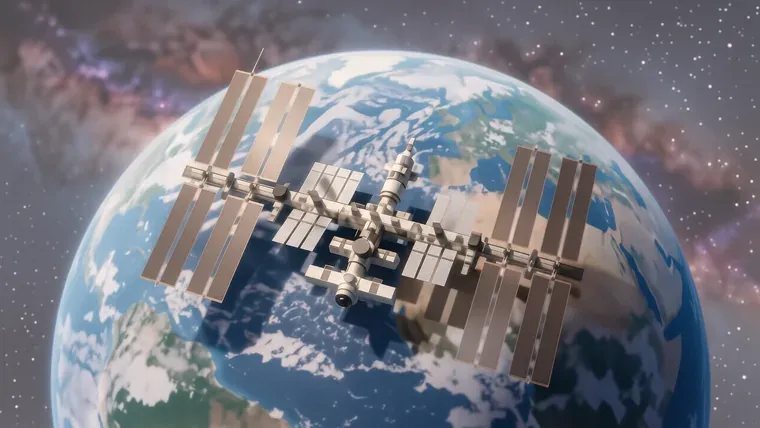
The International Space Station (ISS) currently orbits Earth at an altitude ranging from 413 km to 429 km. It travels at a velocity of approximately 27,700 km/h. This speed allows the station to complete one full revolution around the planet every 92 minutes. Because the station experiences atmospheric drag from residual particles in low Earth orbit, its altitude decreases over time. Ground stations must periodically perform reboost maneuvers to maintain a stable flight path.
Orbital Mechanics and Altitude
The ISS does not stay at a fixed height. It descends. Atmospheric friction acts as a constant braking force because the thermosphere still contains enough gas molecules to create drag. This process requires active management by Mission Control in Houston and the ATC. Without periodic boosts, the station would eventually succumb to gravity and reenter the atmosphere prematurely.
The altitude is also influenced by external factors. Space debris poses a significant risk to the structural integrity of the modules. While the film Gravity depicted a catastrophic chain reaction of collisions, real-world orbital management focuses on avoiding specific tracked fragments. NASA and Roscosmos monitor thousands of pieces of debris to ensure the station maintains a safe trajectory.
The station’s position is dynamic. It traverses oceans, continents, and mountain ranges in a continuous loop.
- Velocity: ~27,700 km/h
- Orbital Period: ~92 minutes
- Altitude Range: 413–429 km
- Daily Sunrises: 16
Physical Dimensions and Mass
The station is a massive structure. It measures 51 meters in length, 109 meters in width, and 20 meters in height. Its mass is approximately 417.3 tons. This weight fluctuates depending on the presence of docked spacecraft like the Soyuz or Dragon. A heavy vehicle attached to a docking port changes the center of mass for the entire complex.
Construction was a modular process. It began in 1999 and continued through 2010. Each segment was designed by different international partners so that they could be integrated into a single functional laboratory. The current configuration includes 14 primary modules.
The station provides a habitable volume of 1,000 cubic meters. This space supports a permanent crew of 6 or 7 individuals at any given time. Living in this environment requires strict management of air, water, and waste.
Modular Composition and International Partners
The ISS is an international assembly. It consists of modules from several space agencies. The American segment includes the Unity, Dome, Leonardo, Tranquility, Destiny, Quest, and Harmony modules. These components provide living quarters, research facilities, and docking ports for visiting vehicles.
Russian participation is equally vital to the station’s survival. The Russian modules include Zarya, Zvezda, Poisk, Rassvet, and Pirs. While the United States transitioned from the Space Shuttle program to relying on Soyuz spacecraft for crew transport, the cooperation between NASA and Roscosmos remains a fundamental aspect of the station’s operations.
Other nations contribute specialized laboratories. The European Space Agency provides the Columbus module. Japan contributes the Kibo module. These pieces are connected via the Unity modules, which act as critical connectors for the entire assembly.
Primary Modules List
- USA: Destiny, Harmony, Tranquility, Quest, Unity, Leonardo, Dome
- Russia: Zvezda, Zarya, Poisk, Rassvet, Pirs
- Europe: Columbus
- Japan: Kibo
The Future of Low Earth Orbit
The ISS is reaching the end of its operational life. NASA Administrator Bill Nelson stated during a hearing with the US House of Representatives Committee on Science and Technology that the station will be deorbited between 2030 and 2031. This decision follows years of continuous operation since the first module launched on 20 November 1998.
The deorbit process will be controlled. NASA plans to guide the station into a controlled reentry so that the debris lands in Point Nemo. This location is the most remote part of the Pacific Ocean, often called the “spacecraft cemetery” because it is the furthest point from any landmass on Earth.
Commercialization is the next phase. NASA is currently awarding contracts to private companies for the development of commercial space stations. Phil McAllister, the director of private sector partnerships at NASA, noted that the goal is to transition from government-led operations to a model supported by the private sector.
Russia has different plans. Yuri Borisov, the head of Roscosmos, announced on 12 April 2023 that Russia will continue its involvement in the ISS until 2028. The Russian segment’s termination will coincide with the construction of a new Russian orbital station. This new project is expected to be completed by 2032 and will cost approximately 600 billion rubles.
Human Presence and Commercial Spaceflight
More than 266 individuals from 20 different countries have visited the station. This exceeds the record set by the Mir space station, which saw 104 visitors. The ISS has served as a platform for both scientific research and the early stages of space tourism.
Space Adventures worked with Roscosmos to facilitate the first journeys of private citizens to orbit. Eight tourists completed these early flights, paying between 20 and 30 million dollars per trip. While these costs are high, the industry expects prices to drop as launch frequency increases.
Suborbital flights offer a different experience. Companies began providing these alternatives in 2014. These flights reach altitudes of 100 to 140 km. Travelers can see the curvature of the Earth and the thin blue line of the atmosphere without entering a full orbit.
The view from the station is unique. Astronauts use interval shooting to capture images of Earth. They observe hurricanes, auroras, and desert dust plumes from the window. One such observation recorded a vast plume of dust extending from the Egyptian deserts toward the Red Sea.
The ISS webcam provides a live look at this environment. The camera is fixed to the outer surface. It streams high-definition footage of the Earth and the station’s exterior. However, the feed will occasionally cut out when the station enters the Earth’s shadow. This occurs because the solar panels cannot generate power from sunlight during the orbital night.
The station remains a vital laboratory for now. It provides data on how long-term microgravity affects human biology. Scientists use the facility to study everything from fluid physics to bone density loss. The transition to commercial stations will require this accumulated knowledge to ensure safety in the next era of space exploration.
Frequently asked questions
How high is the International Space Station?
The ISS orbits Earth at an altitude ranging from 413 km to 429 km.
How fast does the ISS travel?
The station travels at a velocity of approximately 27,700 km/h, allowing it to complete one revolution every 92 minutes.
When will the ISS be decommissioned?
NASA plans to deorbit the station between 2030 and 2031, guiding it to a controlled reentry in Point Nemo.
What are the dimensions of the space station?
The ISS measures 51 meters in length, 109 meters in width, and 20 meters in height, with a mass of approximately 417.3 tons.
More in Solar System
Calculating the Earth's mass: A complex task
Learn how scientists use the gravitational constant and orbital mechanics to determine Earth's mass of approximately 5.9722 x 10^24 kg.
Discovering the current location of Voyager in interstellar space
Learn about the current location of Voyager 1 and 2, their distances from Earth, and how they navigate the harsh environment of interstellar space.
How many natural satellites does the earth possess?
Explore Earth's celestial companions, from the permanent Moon to transient quasi-satellites and cosmic dust clouds located at Lagrange points.
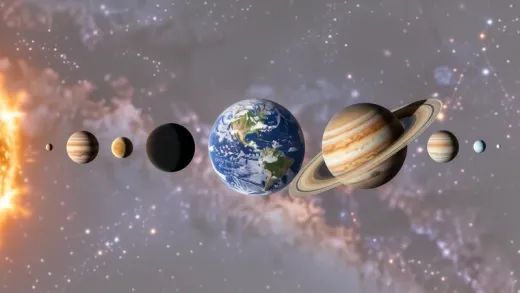
How many planets orbit the sun in second grade lessons
Learn how many planets orbit the sun and discover key facts about the eight official planets, from Mercury to Neptune, for students and educators.