What is the farthest planet from Earth?
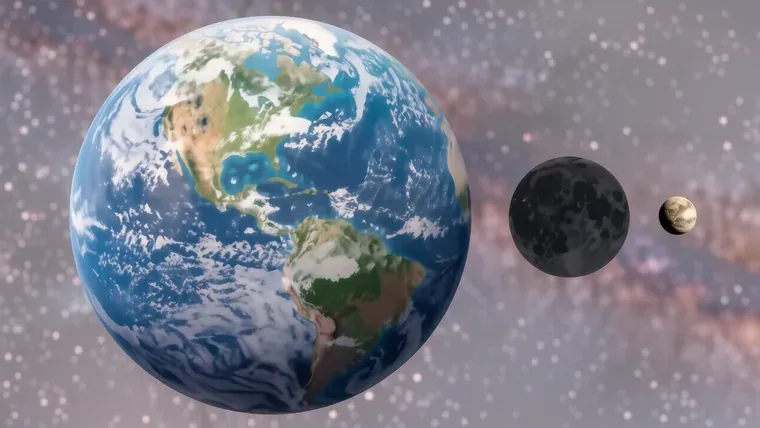
Neptune is the farthest planet from Earth in our solar system. It orbits at an average distance of 4.55 billion kilometers from the Sun, which places it approximately 30 astronomical units away from our central star. While Pluto was once categorized as the ninth planet, the International Astronomical Union reclassified it as a dwarf planet in 2006 because its orbital path lacks sufficient clearance from other Kuiper Belt objects.
The discovery of Neptune
Mathematics found this world. Astronomers did not find Neptune by looking through a lens initially, although they eventually confirmed its position using optical telescopes. In the early 1800s, observers noticed that Uranus was not following its predicted path because an unknown gravitational force was pulling on it. This deviation suggested a hidden mass existed further out in the dark.
Calculations provided the map. Urbain Leverrier, a French mathematician, calculated the exact coordinates of this suspected body so that astronomers could locate it precisely. On 23 September 1846, Johannes Galle and Heinrich d’Arré used these mathematical predictions to find Neptune within one degree of the expected location. It was a triumph of theory.
The planet is blue. This color comes from methane in the upper atmosphere because methane absorbs red light while reflecting blue wavelengths back to our eyes. The hue appears deeper than that of Uranus, although the exact chemical reason for this difference remains a subject of active debate among planetary scientists.
Neptune is distant. It sits in a region of perpetual twilight where sunlight is 900 times dimmer than what we experience on Earth.
Physical characteristics and composition
Neptune is an ice giant. It consists primarily of hydrogen and helium, but it contains significant amounts of water, ammonia, and methane ices within its interior. The planet has a mass 17.2 times greater than Earth’s, which makes it a massive presence in the outer solar system. Its density measures 1.6 grams per cubic centimeter.
The atmosphere is violent. Wind speeds on Neptune can reach 2,100 kilometers per hour because the planet possesses an internal heat source that drives intense meteorological activity. This internal energy causes the planet to emit 2.7 times more heat into space than it receives from the Sun. It is very cold. The temperature in the upper atmosphere can drop to -226.5°C.
The core is deep. Scientists estimate the core has a mass comparable to Earth, although we cannot probe its center with current technology. Deep within the mantle, conditions might be so extreme that methane breaks down into carbon, which could result in the formation of diamond rain. This process occurs because of the immense pressure found at depths of 7,000 kilometers.
Neptune has rings. These rings are faint and fragmented compared to the massive system around Saturn. They consist of ice particles and silicates so that they remain visible through high-powered telescopes.
- The Adams ring
- The Leverrier ring
- The Halle ring
Orbital mechanics and seasons
A year is long. Neptune takes 164.8 Earth years to complete a single revolution around the Sun. This slow movement means that human generations pass before the planet finishes one orbit. The most recent completed revolution occurred in 2011.
Seasons last decades. Because of the planet’s axial tilt, it experiences seasonal changes similar to those on Earth or Mars, although each season lasts roughly 40 Earth years. This creates a cycle of light and dark that operates on a timescale humans cannot easily perceive. The orbit is nearly circular. Its eccentricity is only 0.011.
Rotation is rapid. A single day on Neptune lasts approximately 16.11 hours. This fast spin helps drive the complex weather patterns observed by spacecraft like Voyager 2.
Moons and satellites of Neptune
Fourteen moons orbit Neptune. These satellites are divided into several groups based on their orbital characteristics and distance from the planet. Most of these moons are irregular in shape because they were likely captured from the Kuiper Belt rather than forming in place.
Triton is the largest. It has a diameter of approximately 3,000 kilometers and orbits Neptune in a retrograde direction. This means it moves in the opposite direction of the planet’s rotation because its original orbit was captured by Neptune’s gravity. Triton is very cold. Its surface is covered in nitrogen ice.
The inner moons are small. These include Proteus, Larissa, Naiad, Despina, Galatea, and Thalassa. They orbit closely to the planet so that their orbital periods are measured in mere hours.
- Inner Satellites: Proteus, Thalassa, Naiad, Galatea, Despina, Larissa
- Individual Satellites: Triton, Nereid
- Outer Satellites: Unnamed objects located tens of millions of kilometers away
Nereid has a strange path. It possesses the highest orbital eccentricity of any known satellite in the solar system, with a value of 0.75. This highly elliptical orbit takes it far from Neptune during certain parts of its year. It is an outlier.
Exploration and observations
Voyager 2 is the only visitor. Launched in 1977, the spacecraft reached Neptune on 25 August 1989 after traveling through the outer solar system. It flew within 48,000 kilometers of the planet to capture images of the atmosphere and the moon Triton. These photos remain our best close-up views.
We cannot see it easily. Neptune has an apparent magnitude of +8, which means it is invisible to the naked eye. You must use a telescope or high-quality binoculars to see it as a small blue disk. It looks like a star at first glance.
The search continues. While we have not sent a dedicated orbiter recently, astronomers continue to study Neptune using ground-based telescopes and adaptive optics. We want to understand the “Great Dark Spot” and why new atmospheric features appear over time. The planet is dynamic.
Current research focuses on:
- The origin of internal heat.
- The composition of the ring particles.
- The interaction between Triton and Neptune’s gravity.
The gravitational pull of Neptune shapes the Kuiper Belt. It creates gaps in the distribution of smaller objects because its mass influences the orbits of nearby debris. This influence is a constant force in the outer reaches of our solar system.
Spacecraft missions are expensive. NASA has not announced a specific date for a new Neptune mission, although the scientific community remains interested in returning to the ice giants. We must wait for better technology. The distance makes every mission a massive undertaking.
Frequently asked questions
How far is Neptune from the Sun?
Neptune orbits at an average distance of 4.55 billion kilometers from the Sun, which is approximately 30 astronomical units away.
Why does Neptune appear blue?
The planet's blue color is caused by methane in its upper atmosphere, which absorbs red light and reflects blue wavelengths back to our eyes.
How long is a year on Neptune?
A single revolution around the Sun takes Neptune 164.8 Earth years to complete.
What is the largest moon of Neptune?
Triton is the largest moon, with a diameter of approximately 3,000 kilometers and a retrograde orbit.
More in Solar System
Calculating the Earth's mass: A complex task
Learn how scientists use the gravitational constant and orbital mechanics to determine Earth's mass of approximately 5.9722 x 10^24 kg.
Discovering the current location of Voyager in interstellar space
Learn about the current location of Voyager 1 and 2, their distances from Earth, and how they navigate the harsh environment of interstellar space.
How many natural satellites does the earth possess?
Explore Earth's celestial companions, from the permanent Moon to transient quasi-satellites and cosmic dust clouds located at Lagrange points.
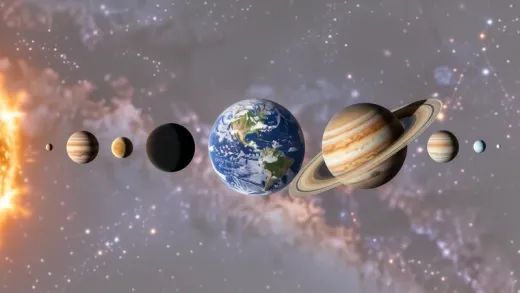
How many planets orbit the sun in second grade lessons
Learn how many planets orbit the sun and discover key facts about the eight official planets, from Mercury to Neptune, for students and educators.