What is the number of satellites orbiting Saturn?
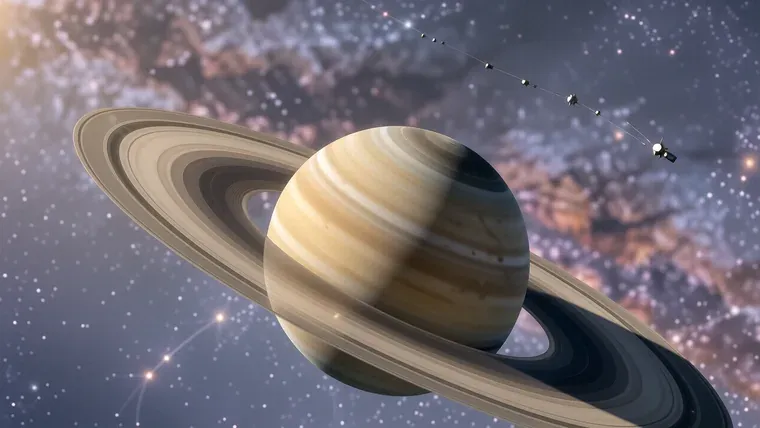
Saturn has 146 confirmed satellites. This total increased significantly in May 2023 after astronomers identified 62 new bodies orbiting the planet.
The growing census of Saturnian moons
The count changes often. Astronomers continue to find small objects because modern telescopes possess much higher resolving power than previous generations used. In 1900, observers believed Saturn had only 9 moons. This number grew to 17 by 1980, while the turn of the century brought an estimate of 30 satellites.
The tally fluctuates. Jupiter and Saturn frequently trade the title of the planet with the most satellites because new discoveries depend on the specific detection limits of current surveys. In 2019, a surge of new detections temporarily placed Saturn ahead of Jupiter. However, subsequent observations by the IAU eventually allowed Jupiter to reclaim the top position.
Most moons are tiny. Many of these bodies measure only a few kilometers across. We categorize them into regular and irregular satellites so that we can better understand their distinct orbital behaviors. Regular satellites follow predictable paths near the planet, while irregular ones often possess retrograde orbits or highly inclined trajectories.
The census is incomplete. We cannot define an exact final number because many small objects remain below our current detection thresholds.
Titan and the giants of the system
Titan is massive. It has a diameter of 5152 kilometers, which makes it the second largest moon in the solar system after Jupiter’s Ganymede. Christian Huygens first spotted this moon in 1655. It remains unique because it is the only moon known to possess a substantial, permanent atmosphere.
Titan has liquids. Methane and ethane condense on its surface to form lakes and rivers while a cycle similar to Earth’s water cycle operates across the landscape. The atmosphere appears yellowish due to the presence of hydrocarbons. Scientists study these chemical processes so that they can model prebiotic environments in the outer solar system.
Rhea is also large. It measures 1530 kilometers in diameter and sits as the second largest satellite of Saturn. This moon consists mostly of water ice with small amounts of rock, which results in a low density of 1.3 kg/cm³. Rhea possesses a thin atmosphere containing oxygen and carbon dioxide molecules.
Iapetus is distinct. It ranks as the third largest moon and displays a stark contrast between its two hemispheres. One side appears bright while the other remains extremely dark. A massive equatorial ridge reaches heights of 10 kilometers because tidal forces or ancient collisions likely shaped the terrain.
The moons vary.
- Titan (5152 km)
- Rhea (1530 km)
- Iapetus (approx. 1470 km)
- Dione (approx. 1122 km)
- Tethys (approx. 1062 km)
Enceladus and the search for life
Enceladus is small. It has a diameter of approximately 500 kilometers. Despite its size, it is one of the most active bodies in the Saturnian system because geysers erupt from fissures in its icy crust. These plumes propel saltwater into space after internal heating drives the liquid upward.
The Cassini spacecraft studied this. During flybys in 2018, the instrument detected organic molecules within the plumes ejected from the south pole. Data released in 2022 also confirmed the presence of phosphorus. These chemical signatures suggest that the subsurface ocean could potentially support microbial life.
Water is present. The moon’s high albedo comes from its incredibly reflective icy surface. It reflects nearly 100% of the sunlight it receives because the ice is so pure and clean. This reflectivity makes Enceladus one of the brightest objects in the solar system.
Hydrothermal activity may exist. Scientists hypothesize that vents on the ocean floor release heat and minerals into the water. Such environments on Earth support complex ecosystems while they remain completely isolated from sunlight.
The mechanics of rings and shepherd moons
Rings are not solid. They consist of countless particles ranging from a few millimeters to several kilometers in size. Some larger moons actually orbit within these ring structures. These include Pan, Atlas, and Daphnis, which carve distinct gaps into the debris field.
Shepherds maintain order. Prometheus and Pandora move near the F ring to regulate its structure. They act as gravitational boundaries so that the ring particles stay within a specific radial range. Without these moons, the rings would likely disperse more widely across the Saturnian system.
The rings might be remnants. Some theories suggest the ring system originated from a large icy satellite. This moon may have ventured too close to Saturn’s Roche limit millions of years ago so that tidal forces tore it apart.
Orbital resonances are common.
- Pan clears the Encke Gap.
- Atlas helps define the edge of the A ring.
- Prometheus and Pandora shepherd the F ring.
Mimas and the irregular satellites
Mimas looks familiar. Its surface is dominated by the Herschel crater, which measures 396 km in diameter. The elevated outer rim gives the moon a resemblance to the Death Star from popular fiction. It is tidally locked to Saturn, so it always shows the same face to the planet.
Mimas is relatively small. It has a diameter of 198 kilometers. Interestingly, it sits closer to Enceladus than it does to Saturn in certain orbital configurations. This proximity influences its gravitational environment.
Phebe is an outlier. It orbits at a distance of approximately 13 million kilometers from the planet. Unlike most other moons, Phebe follows a retrograde orbit because it was likely captured by Saturn’s gravity much later in its history.
Hyperion is chaotic. Its shape is highly irregular due to multiple collisions with space debris. The moon’s rotation is also difficult to predict because its internal cavities create an unstable center of mass.
Summary of orbital classifications
Satellites belong to different groups. We categorize them by their distance, inclination, and direction of travel. This helps astronomers predict how they interact with the planet and each other.
Regular satellites orbit close to the planet. They generally follow a circular path in the same direction as Saturn’s rotation. These moons formed from the original protoplanetary disk that surrounded the gas giant.
Irregular satellites stay far away. They often have highly elliptical orbits and move in directions opposite to the planet’s spin. Many of these bodies were captured by Saturn’s gravity after they entered its sphere of influence.
Trojan satellites exist in specific spots. These moons, such as Helena and Pollux, stay approximately 60 degrees ahead of or behind Saturn in its orbit. They occupy stable Lagrange points so that they do not collide with the larger moons.
Co-orbital satellites share paths. Some moons move along the same orbital track without colliding. This happens because their specific orbital mechanics prevent close encounters.
The system remains active. As telescopes improve, we will continue to refine the count of Saturn’s 146 known satellites. New discoveries often arrive in clusters after long periods of quiet observation.
Frequently asked questions
How many moons does Saturn have?
Saturn has 146 confirmed satellites. This total rose after astronomers identified 62 new bodies orbiting the planet in May 2023.
Which is the largest moon of Saturn?
Titan is the largest moon of Saturn with a diameter of 5,152 kilometers. It is the second largest moon in the solar system after Ganymede.
What makes Enceladus unique?
Enceladus is notable for its active geysers that propel saltwater into space from fissures in its icy crust. These plumes contain organic molecules and phosphorus.
What are shepherd moons?
Shepherd moons, such as Prometheus and Pandora, move near ring structures to regulate their shape. They act as gravitational boundaries to keep ring particles within a specific range.
More in Solar System
Calculating the Earth's mass: A complex task
Learn how scientists use the gravitational constant and orbital mechanics to determine Earth's mass of approximately 5.9722 x 10^24 kg.
Discovering the current location of Voyager in interstellar space
Learn about the current location of Voyager 1 and 2, their distances from Earth, and how they navigate the harsh environment of interstellar space.
How many natural satellites does the earth possess?
Explore Earth's celestial companions, from the permanent Moon to transient quasi-satellites and cosmic dust clouds located at Lagrange points.
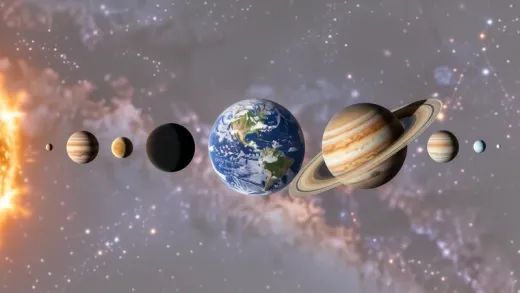
How many planets orbit the sun in second grade lessons
Learn how many planets orbit the sun and discover key facts about the eight official planets, from Mercury to Neptune, for students and educators.