What is the number of satellites orbiting the planet Pluto?
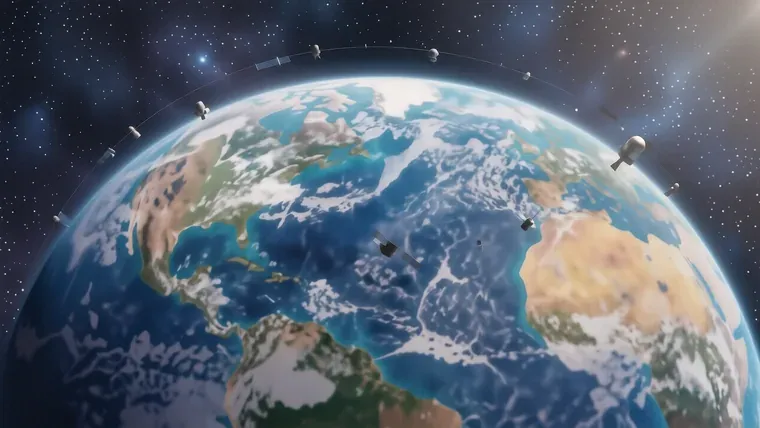
Pluto has five known satellites: Charon, Styx, Nix (Nycta), Kerberus, and Hydra. These moons orbit within the equatorial plane of the dwarf planet because their orbital paths align with Pluto’s rotation.
The Pluto-Charon Binary System
Charon is massive. It was discovered by James Christie in 1978 at the Naval Observatory. This satellite has a diameter of 1,212 ± 6 km, which is roughly half the size of Pluto itself. Because Charon is so large relative to its primary, the center of mass for the system actually lies in the empty space between the two bodies. Astronomers often classify this arrangement as a binary system rather than a simple planet-satellite relationship. It is a dual world.
The orbital dynamics are locked. Pluto and Charon exhibit synchronous rotation, so they always show the same side to one another during their revolution. This tidal locking occurred over long periods of time after the two bodies reached a stable gravitational equilibrium. The distance between their centers measures 19,596 km. This gap is significant.
Charon’s surface differs from Pluto’s. It lacks the nitrogen ice that covers much of the dwarf planet because its lower mass prevents it from retaining volatile compounds. Instead, Charon possesses a thick layer of water ice. The temperature remains extremely low. Surface temperatures hover around -220 degrees Celsius.
The origin of Charon remains a subject of debate. One leading hypothesis suggests that a side-on collision between Pluto and another large Kuiper Belt object created the debris that eventually formed Charon. This impact would have ejected fragments into orbit so that they could coalesce into the moon we observe today. The moons might be remnants.
The system is stable. While many satellites exist in the outer solar system, the Pluto-Charon system maintains a very compact orbital structure. The known satellites do not exceed an orbital radius of 65,000 km, although the theoretical limit for stable prograde orbits reaches much further. Space is mostly empty.
The Small Satellites: Nix and Hydra
Nix and Hydra were found later. The Hubble Space Telescope identified these two bodies in May 2005. They were officially named by the IAU on June 21, 2006. These moons are much smaller than Charon. They orbit at distances of 49,000 km for Nix and 65,000 km for Hydra.
Hydra is bright. Its geometric albedo reaches 0.8, which is significantly higher than the 0.38 albedo observed on Charon. This high reflectivity suggests that the surface consists of relatively pure water ice. The moon has dimensions of approximately 43 by 33 km. It looks quite white.
Nix shows color variations. While most of the small moons appear neutral, Nix displays a dark reddish area surrounding a prominent crater. Scientists cannot yet determine the exact mass of these bodies, although they estimate each moon is roughly 0.003% of Charon’s mass. The data is sparse.
The orbital resonance is precise. Hydra and Nix maintain a specific relationship where Hydra completes two revolutions for every three of Nix’s orbits. This 2:3 ratio helps stabilize their paths within the gravitational field of the Pluto-Charon system. They move in sync.
- Nix (Nycta) orbital radius: 49,000 km
- Hydra orbital radius: 65,000 km
- Nix dimensions: ~54 x 41 x 36 km
- Hydra dimensions: ~43 x 33 km
Kerberus and Styx
Kerberus was found in 2011. The Hubble Space Telescope detected this fourth satellite through a collaboration involving three different telescopes. It is quite small. The diameter of Kerberus ranges from 13 to 34 km. It orbits between Nix and Hydra.
Styx arrived last. Astronomers discovered this fifth satellite in July 2012 using the same Hubble instrumentation. It is the smallest known moon. Styx has an estimated diameter of only 10 to 25 km. Its orbital radius is approximately 42,000 km.
The moons are irregular. Because they lack sufficient mass to achieve hydrostatic equilibrium, Kerberus and Styx possess jagged, non-spherical shapes. They do not look like planets. Their orbits are nearly circular.
The discovery timeline is as follows:
- Charon: 1978
- Nix/Hydra: 2005
- Kerberus: 2011
- Styx: 2012
Orbital Resonance and Dynamics
The moons follow a pattern. The five satellites exist in near resonance with orbital period ratios of approximately 1:3:4:5:6. This mathematical regularity suggests that tidal interactions have shaped their orbits over billions of years. Gravity is the sculptor.
Small moons rotate fast. Unlike the Pluto-Charon pair, the smaller satellites have rotation periods that are much shorter than their orbital periods. Their rotation axes also tilt relative to the equator of Pluto. They spin independently.
The system is compact. The actual orbital radius of these five moons occupies less than 3% of the total stable orbital zone available in the Pluto system. This concentration of mass is unusual. It suggests a violent history.
The collision theory explains much. If a massive impact occurred in the distant past, the resulting debris disk would have eventually settled into these resonant orbits as the fragments cooled. The moons are leftovers.
Physical Composition and Surface Features
Pluto is icy. Its surface consists of nitrogen ice, methane, and carbon monoxide. The presence of tholins gives the dwarf planet its characteristic reddish-brown hue. These complex organics form when ultraviolet radiation hits methane.
Charon is different. It lacks the volatile nitrogen seen on Pluto because the temperatures are too low to maintain a thick atmosphere. Instead, it features water ice and potentially significant graphite deposits. Recent studies from 2016 support this. The surface is gray.
The small moons are bright. Nix, Hydra, Kerberus, and Styx all show high geometric albedos because they are likely covered in clean, unweathered water ice. This ice reflects most incoming sunlight. They shine in the dark.
- Pluto surface: Nitrogen/Methane/CO
- Charon surface: Water ice/Graphite
- Small moons: High-albedo water ice
The environment is harsh. Temperatures on the surface average 50 K, although the atmosphere can be up to 40 degrees warmer due to a methane-driven greenhouse effect. The cold is absolute.
Classification and Context
Pluto is a dwarf planet. The IAU reclassified it in August 2006 after the discovery of Eris and other Kuiper Belt objects. It no longer holds the title of ninth planet. This change reflected a new understanding of the solar system.
The Kuiper Belt is vast. Pluto resides in this region beyond Neptune, where many icy bodies follow similar orbital patterns. Most these objects are called plutinos because they share a 3:2 resonance with Neptune. They orbit far away.
The New Horizons mission provided clarity. In July 2015, the spacecraft flew past Pluto at a distance of approximately 12,000 km to capture high-resolution data. This mission revealed a complex landscape of glaciers and mountains. It changed our view.
The name was chosen by a child. Venetia Burney suggested “Pluto” in 1930 because the distant, dark object reminded her of the Roman god of the underworld. Her grandfather sent the suggestion to the observatory. The name stuck.
Pluto’s mass is low. It is roughly six times less massive than Earth’s Moon. This small scale makes it difficult to study from Earth, although the New Horizons flyby provided the first close-up look at its terrain. We are still learning.
Frequently asked questions
How many moons does Pluto have?
Pluto has five known satellites: Charon, Styx, Nix (Nycta), Kerberus, and Hydra.
What is the relationship between Pluto and Charon?
Charon is so large relative to Pluto that the center of mass lies in the space between them, making the pair a binary system with synchronous rotation.
When were Pluto's smaller moons discovered?
Nix and Hydra were identified by the Hubble Space Telescope in May 2005, while Kerberus was found in 2011 and Styx in 2012.
What are the surfaces of Pluto and Charon made of?
Pluto's surface consists of nitrogen ice, methane, and carbon monoxide, whereas Charon is primarily covered in a thick layer of water ice.
More in Solar System
Calculating the Earth's mass: A complex task
Learn how scientists use the gravitational constant and orbital mechanics to determine Earth's mass of approximately 5.9722 x 10^24 kg.
Discovering the current location of Voyager in interstellar space
Learn about the current location of Voyager 1 and 2, their distances from Earth, and how they navigate the harsh environment of interstellar space.
How many natural satellites does the earth possess?
Explore Earth's celestial companions, from the permanent Moon to transient quasi-satellites and cosmic dust clouds located at Lagrange points.
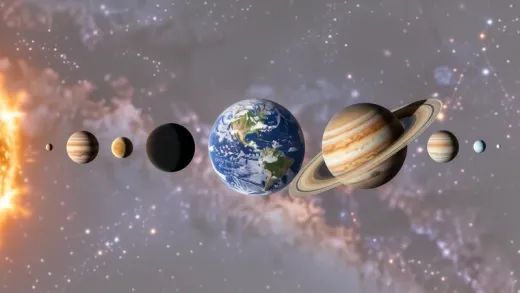
How many planets orbit the sun in second grade lessons
Learn how many planets orbit the sun and discover key facts about the eight official planets, from Mercury to Neptune, for students and educators.