What is the temperature of Earth?

The average temperature of Earth’s surface is 14.8°C. This value fluctuates based on latitude, season, and altitude because the planet receives uneven solar radiation across its spherical geometry.
Surface Extremes and Atmospheric Regulation
Earth maintains a habitable thermal range. It stays relatively stable because the atmosphere traps heat through various greenhouse processes while shielding the surface from direct cosmic radiation. Without this layer, the planet would likely freeze into a permanent ice ball. The temperature varies.
NASA’s Aqua satellite uses the Atmospheric Infrared Sensor (AIRS) to monitor these shifts. This instrument measures infrared wavelengths so that scientists can map thermal distributions across clouds and oceans. In April 2003, AIRS data showed a wide spectrum ranging from -81°C in dark blue zones to 47°C in red zones. Data is precise.
The atmosphere acts as a buffer. While the sun provides the primary energy, ocean currents and wind patterns redistribute that heat across the globe so that equatorial regions do not become uninhabitable. This movement prevents extreme thermal gradients between the poles and the equator. Heat moves constantly.
Temperature records often face scrutiny. For 90 years, El Aziziya in Libya held a record of 58°C from September 13, 1922, although the World Meteorological Organization (WMO) removed this entry in 2012 after experts found the measurement inaccurate. Scientific rigor matters.
The current records are different. Greenland Ranch in Death Valley, California, recorded an air temperature of 56.7°C on July 10, 1913. This remains a primary benchmark for atmospheric heat. Surface temperatures can go higher. In 2004 and 2005, satellite data identified a surface temperature of 70.7°C in the Lut Desert in Iran.
Subsurface Heat and Geothermal Gradients
The ground gets hotter with depth. It follows a predictable gradient because the density of the crust increases as you descend toward the core. On average, the temperature rises by 3°C for every 100 meters of descent. This rule is consistent.
Geothermal heat comes from several sources. Radioactive decay of isotopes and tectonic processes in the mantle generate significant energy while tidal friction from the Moon contributes a smaller amount. These internal factors provide a baseline heat that does not rely on sunlight. Heat rises upward.
The rate of increase varies by location. In certain parts of the United States, the temperature climbs by 100°C for every 1000 meters because the local crustal structure allows for higher thermal conductivity. South Africa shows the opposite trend. There, the increase stays below 6°C over a similar depth.
Deep layers reach extreme levels. Once you pass 20 km, the rate of heating slows down slightly although the absolute temperature continues to climb toward the mantle. At depths between 35 and 40 km, temperatures hover around 1400°C. The core is hotter.
The inner core reaches approximately 6000°C. This value matches the surface temperature of the Sun because the immense pressure and gravitational differentiation force energy into a concentrated center. We cannot measure this directly. We rely on seismic data and mathematical models to estimate these deep thermal states.
Planetary Comparisons and Cosmic Scales
Earth is temperate. It occupies the habitable zone where liquid water can exist, whereas Mercury experiences swings from +465°C to -184°C because it lacks a thick atmosphere to retain heat. Venus is much hotter. Its dense atmosphere creates surface temperatures of +460°C.
Mars stays cold. While its equator might reach +20°C, the poles remain frozen at -153°C because the thin atmosphere cannot sustain warmth. Uranus holds the record for the coldest planet in our solar system. It plunges to -224°C.
The Sun dominates our local system. Its surface stays at 5500°C, but the core reaches 15 million °C so that nuclear fusion can continue uninterrupted. This energy drives all life on Earth. A single iron ball heated to such levels would destroy everything within 2000 kilometers.
Stars exceed solar temperatures. A white dwarf in the Red Spider Nebula emits light at 300,000°C, which is over 50 times hotter than the Sun’s surface. Quasars are even more intense. The gas surrounding a quasar can reach 80 million °C during its active phase.
Humanity explores the limits of cold. Scientists at the Massachusetts Institute of Technology (MIT) cooled molecules to 500 nanokelvins recently. This is just a fraction above absolute zero, which is defined as -273.16°C. Motion stops there.
Subatomic Heat and the Planck Limit
The highest temperatures exist in particle collisions. At the Large Hadron Collider in Switzerland, particles reach velocities near the speed of light so that their collisions generate 4 trillion degrees Celsius. This exceeds the heat of a supernova. Particles melt.
The Big Bang was hotter still. During the first tiny fraction of a second, the universe reached the Planck temperature, which is approximately 1.416808 x 10^32 Kelvin. This is the theoretical limit of heat. It is massive.
Physics changes at these scales. If energy density reaches the Planck standard, it might create a kugelblitz, which is a black hole formed entirely from radiation rather than matter. Such events challenge our current understanding of gravity. Space-time bends.
The universe has a floor. Absolute zero represents the point where all molecular motion ceases because there is no kinetic energy left to transfer. We have approached this limit in labs. We have not reached it.
Long-term Trends and Climate Shifts
Earth’s average temperature has risen by 0.8°C since the 1880s. This warming trend is most evident in the last decade because greenhouse gas concentrations have increased significantly. Glaciers are melting.
The planet undergoes cycles. Scientific research indicates Earth has experienced five ice ages over 2.4 billion years, although we are currently exiting the most recent one. The current warming is faster than previous transitions.
Sea levels respond to heat. As glaciers melt, the volume of the oceans increases so that coastal regions face higher flooding risks. This process is a direct consequence of the rising global mean temperature. Water expands too.
Thermal stability exists at specific depths. A band in the crust maintains constant temperature throughout the year depending on latitude, with depths ranging from 5 meters in the tropics to 30 meters in high latitudes. This zone provides a stable environment.
Measurement accuracy is vital. Meteorologists compare new records against 200 years of data because historical monitoring was not consistent before that period. We must track changes carefully.
The deepest accessible measurement comes from the Kola well. At 12 kilometers deep, it probes the outer crust to help scientists understand how heat moves through different rock types. The core remains a mystery. Deep drilling provides only a small window into the planet’s total thermal energy.
Frequently asked questions
What is the average temperature of Earth's surface?
The average temperature of Earth's surface is 14.8°C. This value fluctuates based on factors like latitude, season, and altitude.
How hot is the Earth's inner core?
The inner core reaches approximately 6000°C, a temperature that matches the surface of the Sun due to immense pressure and gravitational differentiation.
What is the geothermal gradient in the Earth's crust?
On average, the ground temperature rises by 3°C for every 100 meters of descent, though this rate can vary significantly by location.
How does Earth's temperature compare to Venus and Mars?
Earth is temperate, while Venus is much hotter with surface temperatures of +460°C. In contrast, Mars is colder, with poles reaching -153°C.
More in Solar System

Calculating the Earth's mass: A complex task
Learn how scientists use the gravitational constant and orbital mechanics to determine Earth's mass of approximately 5.9722 x 10^24 kg.

Discovering the current location of Voyager in interstellar space
Learn about the current location of Voyager 1 and 2, their distances from Earth, and how they navigate the harsh environment of interstellar space.

How many natural satellites does the earth possess?
Explore Earth's celestial companions, from the permanent Moon to transient quasi-satellites and cosmic dust clouds located at Lagrange points.
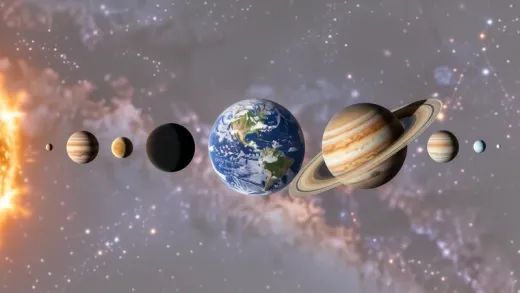
How many planets orbit the sun in second grade lessons
Learn how many planets orbit the sun and discover key facts about the eight official planets, from Mercury to Neptune, for students and educators.