What is the total number of observable stars in the sky?
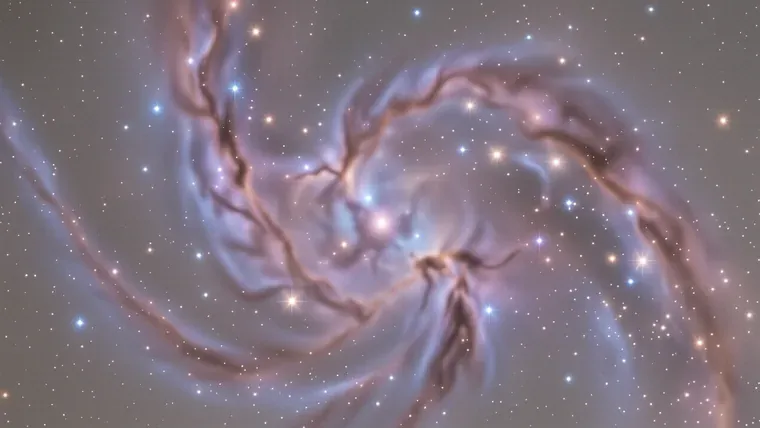
The human eye can detect approximately 6,000 stars across the entire celestial sphere under ideal conditions. This number drops significantly in urban environments like Moscow, where light pollution limits visibility to only 150–200 stars. While the naked eye sees a tiny fraction of the cosmos, the total number of stars in the observable universe reaches an estimated $10^{22}$ or 10 sextillion. This calculation assumes roughly 100 billion galaxies exist, each containing between 100 and 400 billion stars according to data from the Hubble Space Telescope.
Naked Eye Visibility and Light Pollution
The sky is dark. Mostly. Most people living in cities never see the true depth of the Milky Way because artificial light creates a gray haze that washes out faint stellar magnitudes. In a metropolitan area, you might only spot 200 stars on a clear night. This occurs because the scattered photons from streetlights raise the ambient brightness of the atmosphere.
Visibility changes with location. It varies. If you travel to a high desert near the equator, the view improves drastically because the lack of moisture and light allows for much higher atmospheric transparency. Under these specific conditions, an observer might see up to 1,500 stars at once. This represents only about one-quarter of the total possible naked-eye stars visible from Earth.
The horizon matters too. It limits sight. Even in a perfect dark-sky site, you cannot see all 6,000 stars simultaneously because the Earth itself blocks half of the celestial sphere. You only see the hemisphere facing your position. Furthermore, trees, hills, and buildings often obscure the stars sitting near the horizon line.
The atmosphere is thick. It scatters light. Near the horizon, the air density increases so that starlight must pass through a much larger volume of gas and dust before reaching your eyes. This effect makes stars appear dimmer or causes them to twinkle violently.
- Urban visibility: 150–200 stars
- Dark sky visibility: ~1,500 stars
- Theoretical maximum: ~6,000 stars
The History of Stellar Magnitude
Hipparchus was first. He cataloged stars. Around 150 BCE, the Greek astronomer Hipparchus of Nicaea created the first systematic star catalog to document the celestial bodies he observed. He recorded 1,025 stars with specific coordinates and brightness levels. This work established the foundation for how we measure light today.
He used six classes. They were simple. Hipparchus divided his observations into six distinct magnitudes because he wanted a way to rank stars by their perceived brilliance. The brightest stars received a magnitude of 1, while the dimmest visible objects were assigned a magnitude of 6. This system remains the basis for modern astronomical measurements.
The numbers were specific. He was precise. In his original catalog, Hipparchus noted that 15 stars held the highest importance, whereas 474 stars fell into the fourth magnitude category. He also included several nebulae in his sixth-magnitude group. His classification relied entirely on human visual perception.
Modern science changed things. We use math. While Hipparchus used visual estimation, contemporary astronomers utilize bolometric and photographic measurements so that they can account for the actual energy output of a star. We now distinguish between apparent magnitude, which is how bright a star looks from Earth, and absolute magnitude, which measures its true luminosity at a standard distance of 10 parsecs.
The Sun is bright. It is -26.7 magnitude. In contrast, the star Betelgeuse has an apparent magnitude of approximately 0.5. This massive difference in brightness illustrates why we cannot see most stars without help.
Scaling Up with Optical Instruments
Binoculars help a lot. They add detail. Using an average pair of binoculars increases the number of visible stars to approximately 10,000 because the lenses gather more light than the human pupil. This allows you to see into the 9th or 10th magnitude range.
Telescopes reveal more. They are powerful. A high-quality amateur telescope can bring roughly 2 million stars into view by detecting objects in the 11th to 12th magnitude range. Professional observatories use much larger instruments to push these limits even further.
The scale is immense. It grows fast. If you could divide the sky into squares the size of a full Moon, a powerful telescope would reveal 10,000 stars within every single one of those 200,000 squares. This density explains why deep-field images from the Hubble Space Telescope look so crowded with light.
- Naked eye: ~6,000 stars
- Binoculars: ~10,000 to 200,000 stars
- Amateur telescope: ~2,000,000 stars
- Professional observatory: Billions of stars
The VLT is huge. It sits in Chile. The Very Large Telescope (VLT) in the Atacama Desert uses four main 8.2-meter telescopes to peer into the deepest parts of space because the high altitude provides exceptionally clear air. This facility can detect objects as faint as magnitude 27.
Galactic and Universal Estimates
Our galaxy is large. It is a spiral. The Milky Way contains an estimated 100 to 400 billion stars, although this number remains uncertain due to the difficulty of counting dim red dwarfs hidden by interstellar dust. We reside within this barred spiral structure.
Galaxies are many. They are everywhere. Astronomers have identified approximately 100 billion galaxies in the observable universe because deep-space surveys like those conducted by the Hubble mission have revealed vast numbers of distant systems. If we multiply the average number of stars per galaxy by the number of galaxies, the total is staggering.
The math is simple. It yields huge numbers. A conservative estimate suggests there are $10^{22}$ stars in the universe, which is a number so large that it is difficult to visualize. Some models suggest even higher counts if we account for undiscovered dwarf galaxies.
Stars are not alone. They exist in groups. Many stars are actually binary or multiple systems where two or more stars orbit a common center of gravity. The Sun is a solitary star, which makes it somewhat different from the majority of its neighbors.
The limit is set. It is 45.7 billion light-years. This distance represents the edge of the observable universe because light from objects beyond this radius has not had enough time to reach Earth since the Big Bang. We cannot see further than this boundary.
Naming and Identifying Celestial Objects
Names carry history. They are old. About 300 stars retain traditional names derived from Sumerian, Arabic, or Greek sources, such as Sirius or Vega. These names often reflect the cultural heritage of the people who first mapped the sky.
Greek letters are common. They follow brightness. When a star does not have a proper name, astronomers use the Bayer designation system, which assigns Greek letters based on the star’s magnitude within a constellation. For example, Deneb is the “alpha” star of Cygnus.
Some stars are new. They were discovered. Astronomers like Barnard or Kapteyn have had stars named after them because they were the first to identify these specific objects using advanced instrumentation. These stars are typically too faint to be seen without a telescope.
- Proper names: ~300 stars
- Bayer designations: Thousands of stars
- Discoverer names: Dozens of specific stars
The sky is vast. It is deep. Even as we improve our telescopes, the amount of light blocked by cosmic dust ensures that much of the universe remains hidden from our direct view. We must use infrared technology to see through these clouds.
Frequently asked questions
How many stars can a person see with the naked eye?
Under ideal conditions, the human eye can detect approximately 6,000 stars across the entire celestial sphere. However, in urban environments, light pollution may limit visibility to only 150–200 stars.
How many stars are estimated to be in the observable universe?
The total number of stars in the observable universe is estimated to reach approximately 10^22, or 10 sextillion. This calculation is based on roughly 100 billion galaxies containing between 100 and 400 billion stars each.
What is the difference between apparent and absolute magnitude?
Apparent magnitude measures how bright a star appears from Earth, while absolute magnitude measures its true luminosity at a standard distance of 10 parsecs.
How many stars can be seen using a telescope?
A high-quality amateur telescope can bring roughly 2 million stars into view by detecting objects in the 11th to 12th magnitude range. Professional observatories can detect even fainter objects, reaching magnitudes as low as 27.
More in Stars
How far away is the nearest star in light years?
Discover how far Proxima Centauri is from Earth and learn about its physical characteristics, planetary system, and distance measurements.
Methods used by scientists to calculate the distance to stars
Explore how astronomers use the cosmic distance ladder, from trigonometric parallax to standard candles and redshift, to measure stellar distances.
Reasons for the descent of stars from the heavens and their final
Learn why meteoroids appear as falling stars, how friction creates light during atmospheric entry, and where these cosmic fragments ultimately end up.
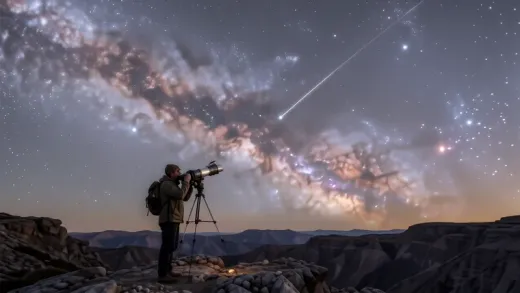
Shooting stars: An enigmatic phenomenon explained
Discover the science behind shooting stars, from the mechanics of atmospheric entry to the chemical composition of meteorites and predictable meteor showers.