What is the speed of gravity?
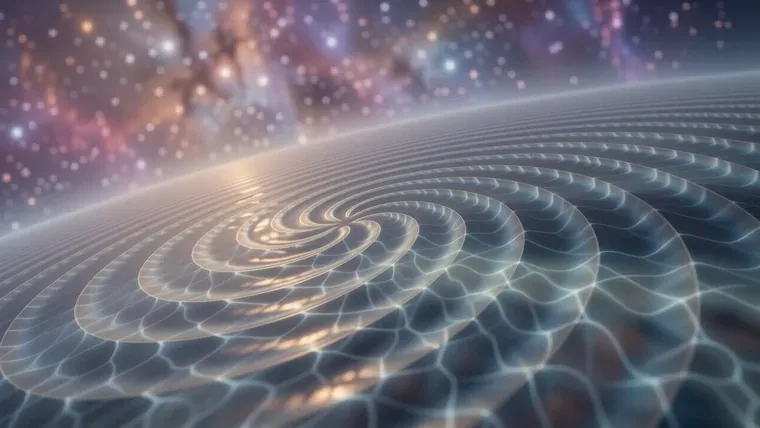
In General Relativity, the velocity of gravity is exactly c, the speed of light in a vacuum, which is measured at 299,792,458 meters per second. This value represents the rate at which gravitational influences and metric perturbations propagate through spacetime. While Newtonian mechanics assumes gravity acts instantaneously across any distance, modern physics dictates that no information or force can travel faster than this universal limit.
Theoretical Frameworks of Gravitational Speed
Newtonian gravitation does not include a finite speed for gravity. It treats the force as an instantaneous interaction between masses. This model fails when considering large distances or high velocities because it ignores the time required for a change in position to affect a distant object. Pierre-Simon Laplace noted this discrepancy in his 1797 work, Exposition of the World System. He calculated that the speed of gravity must be at least 50 million times the speed of light based on the lunar motion and its secular accelerations.
The model is incomplete. Gravity is not instant.
General Relativity (GTR) changes this entirely by identifying the gravitational field with the metric tensor. In this framework, gravity is not a force acting through space but is the curvature of spacetime itself. Because the metric tensor defines the geometry of the universe, any change in that geometry must propagate at a finite speed. This speed is c.
The velocity is constant. It is light.
Quantum theories propose a different mechanism. They suggest gravity is mediated by gravitons, which are the discrete quanta of the gravitational field. In these models, the velocity of gravity is synonymous with the velocity of these particles. Although most mainstream models align this with c, alternative theories like the Lorentz-Invariant Theory of Gravity (LITG) incorporate specific variables into their fundamental equations. These theories suggest that factors such as mass density and the velocity of mass flow influence the gravitational field’s behavior.
Some theories vary. They deviate from c.
Empirical Measurements and Observations
Measuring the speed of gravity requires observing massive objects in motion. In 2007, Edward Fomalont and Sergei Kopeikin conducted a landmark experiment using radio interferometry. They observed the distant quasar QSO J0842+1835 as its light passed near Jupiter. Because Jupiter moves in its orbit at an average speed of 13.1 km/s, its gravitational field undergoes periodic changes that affect the passing light. This allowed researchers to test how quickly the gravitational influence of a moving body propagates through the solar system.
The experiment was precise. It used radio telescopes.
Another method involves detecting gravitational waves. These are ripples in the metric of spacetime caused by accelerating masses. On 14 September 2015, the LIGO Scientific Collaboration and the Virgo Collaboration detected GW150914, a signal from the merger of two black holes. This event provided direct evidence that gravitational disturbances travel at the speed of light. The detection occurred after 100 years of theoretical prediction following Einstein’s work.
Waves move through space. They carry energy.
Researchers also look to gyroscopes to measure gravity’s effects. The Gravity Probe B mission, which operated during 2004 and 2005, aimed to measure the precession of gyroscopes near Earth’s poles. This precession is caused by the frame-dragging effect, where a rotating mass twists the surrounding spacetime. In both General Relativity and LITG, the angular velocity of this precession is tied to the torsion field.
The satellite orbited Earth. It measured spin.
Torsion and Alternative Gravitational Models
Alternative models often introduce the concept of a torsion field. In these frameworks, gravity is not just about curvature but also involves the twisting of spacetime. The Lorentz-Invariant Theory of Gravity (LITG) uses specific SI units to describe how mass density and current density interact with this torsion. This approach suggests that the velocity of gravitational propagation might be determined by the distance from a central mass to a measuring device, such as a gyroscope.
Torsion is a twist. It affects motion.
The theory of infinite nested matter proposes that gravity may operate differently at various scales. While gravity at a macroscopic level follows General Relativity, there may be much stronger gravitational effects at the atomic level. In these localized environments, the speed of gravity might not be identical to c. This would imply that our current understanding is a subset of a larger, more complex hierarchy of physical laws.
Scales change everything. Atoms behave differently.
One experimental setup involves a lead superconducting disk with a diameter of 9.1 cm. When this disk rotates, it should theoretically create a torsion field detectable by a UG-2 ring laser gyroscope. This gyroscope is significantly larger, measuring approximately 35 meters in diameter. By measuring the frequency shift in the laser, scientists hope to establish a relationship between the rotation and the resulting gravitational torsion.
The disk is small. The laser is large.
Relativity, Time, and Gravitational Potential
Gravity affects the flow of time. This phenomenon is known as gravitational time dilation. According to General Relativity, time passes more slowly in regions of higher gravitational potential. An observer near a massive object, such as a black hole, will experience time at a different rate than an observer in empty space. This is not a mechanical error in clocks but a fundamental property of the universe.
Time is relative. It is not absolute.
The relationship between velocity and time is also critical. As an object’s velocity increases, its internal clock slows down relative to a stationary observer. This is described by special relativity. If an object is in free fall, it accelerates as it approaches a mass. Because the velocity increases, the rate of time passage also changes.
Clocks slow down. Motion dictates this.
Consider a photon bouncing between two mirrors on a moving platform. To a person on the platform, the photon moves perpendicularly. However, to a stationary observer, the photon follows a diagonal or triangular path. This path is longer than the vertical distance between the mirrors. Because the light must travel a greater distance to complete one “tick” of the clock, the interval between reflections increases.
The path grows longer. The second stretches.
Gravity complicates this further by altering the very geometry the photon travels through. As an object falls toward a planet, it enters a region where the metric is more heavily curved. This curvature dictates that the “proper time” measured by the falling object differs from the time measured by someone far away. There is no single “true” time that applies to all observers in the universe.
Observers disagree. They see different times.
The Role of Gravitons and Quantum Gravity
The search for a unified theory requires reconciling General Relativity with quantum mechanics. In the standard model, forces are carried by particles. For gravity, this particle is the graviton. While we have not yet directly detected a single graviton, their existence is a requirement for most quantum gravity theories. The velocity of these particles would define the speed of gravitational information transfer in a quantized universe.
Gravitons are tiny. They carry force.
If gravity is quantized, then the smooth spacetime of Einstein is actually a granular structure at the Planck scale. This granularity suggests that the “speed” of gravity might be an emergent property rather than a fundamental constant. At extremely high energies or very small distances, the propagation of gravitational influence could encounter fluctuations that deviate from the constant c.
Space is not smooth. It has texture.
The interaction between mass and the graviton field is what we perceive as weight. In modernized Le Sage models, the graviton field acts as a mechanism for generating both mass and gravitational force. These models suggest that the vacuum itself has a charged component that contributes to the origin of electric and gravitational forces. Such theories attempt to explain why gravity is so much weaker than the other fundamental forces.
Forces are imbalanced. Gravity is weak.
Current research continues to push the limits of measurement. Whether through the detection of subtle shifts in laser frequencies or the observation of distant cosmic collisions, we are refining our understanding of how gravity moves. Every new data point from instruments like JWST or advanced LIGO arrays helps constrain the possible values for gravitational velocity. The goal remains to determine if c is a strict limit or a local approximation of a more complex reality.
The universe is vast. We keep measuring.
Frequently asked questions
How fast does gravity travel?
In General Relativity, the velocity of gravity is exactly c, the speed of light in a vacuum, which is 299,792,458 meters per second.
Does Newtonian physics account for the speed of gravity?
No, Newtonian mechanics assumes gravity acts instantaneously across any distance, whereas modern physics dictates it follows a finite limit.
How was the speed of gravity empirically proven?
The LIGO and Virgo collaborations provided direct evidence by detecting gravitational waves from the merger of two black holes in 2015.
What are gravitons in relation to gravity's velocity?
Gravitons are proposed discrete quanta of the gravitational field, and their velocity would define the speed of gravitational information transfer.
More in Solar System
Calculating the Earth's mass: A complex task
Learn how scientists use the gravitational constant and orbital mechanics to determine Earth's mass of approximately 5.9722 x 10^24 kg.
Discovering the current location of Voyager in interstellar space
Learn about the current location of Voyager 1 and 2, their distances from Earth, and how they navigate the harsh environment of interstellar space.
How many natural satellites does the earth possess?
Explore Earth's celestial companions, from the permanent Moon to transient quasi-satellites and cosmic dust clouds located at Lagrange points.
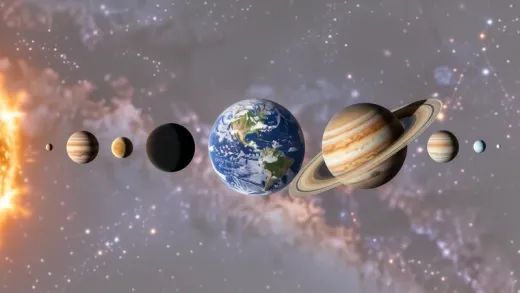
How many planets orbit the sun in second grade lessons
Learn how many planets orbit the sun and discover key facts about the eight official planets, from Mercury to Neptune, for students and educators.