Which planet has two natural satellites?
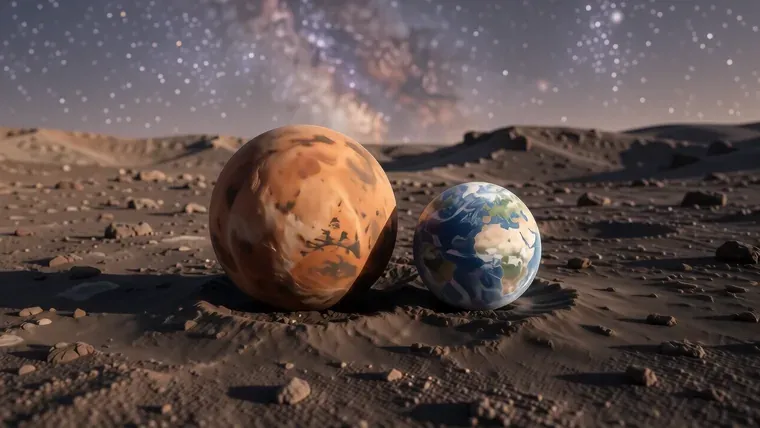
Mars is the only planet in our solar system that possesses exactly two natural satellites. These bodies are Phobos and Deimos. While other planets possess vast systems of dozens or even hundreds of moons, the Martian system remains small and distinct.
The Martian Duo: Phobos and Deimos
The two moons of Mars are small. They orbit much closer to their parent planet than any major moon in the outer solar system. Phobos is the larger of the two, while Deimos is significantly smaller and more distant from the Martian surface.
Phobos orbits Mars very rapidly. It completes a single revolution in approximately 7.6 hours because its proximity to the planet requires high orbital velocities to maintain stability. This rapid transit means that observers on the Martian surface would see Phobos rise and set multiple times during a single Martian day. Deimos follows a much slower path. Its orbital period lasts roughly 30 hours, which creates a very different visual experience for any potential observer on the surface.
The composition of these moons remains a subject of study. They appear to be irregular compared to the massive, spherical satellites like Earth’s Moon or Jupiter’s Ganymede. Most astronomers categorize them as small, irregularly shaped bodies that may have been captured asteroids.
- Phobos is the inner moon.
- Deimos is the outer moon.
- Both moons lack significant atmospheres.
The Complexity of Saturnian Satellites
Saturn holds a massive collection of moons. Christiaan Huygens first identified Titan in 1655. This discovery changed our understanding of planetary systems because it revealed that a single planet could host a world as complex as a planet itself. Titan is larger than the planet Mercury. It possesses a thick atmosphere composed mostly of nitrogen and some methane.
The Saturnian system is dense. Cassini discovered several moons, including Dione, Rhea, and Japet, while Herschel identified Mimas and Enceladus. The sheer number of satellites makes Saturn one of the most complex gravitational environments in the solar system.
Titan is unique. Its surface temperature sits at approximately -180°C. At this extreme cold, methane behaves like water does on Earth by forming clouds, rain, and even liquid lakes. This chemical cycle creates a landscape that is eerily similar to terrestrial geology, although the materials involved are entirely different.
The orbits of Saturn’s moons vary significantly. Most satellites follow a direct orbital path, but the moon Phebe is an exception. It follows a large, eccentric orbit in the opposite direction of the planet’s rotation. This retrograde motion suggests that Phebe was likely a captured object from the Kuiper Belt rather than a body that formed alongside Saturn.
Uranus and the Shakespearean Moons
Uranus possesses 27 known satellites. The system is divided into two distinct groups: 15 regular satellites and several irregular ones. The regular satellites, such as Ariel, Umbriel, Titania, Oberon, and Miranda, travel in nearly circular orbits within the equatorial plane of the planet. These bodies were discovered through ground-based observations by astronomers including Lassell and Herschel.
Miranda is particularly strange. It has a diameter of approximately 500 km. The surface of Miranda is covered in deep valleys and steep cliffs that suggest a violent history. Some theories propose that Miranda formed from the fusion of several large stone fragments after a massive collision occurred.
The irregular moons of Uranus follow different naming conventions. Many of these satellites are named after characters from the plays of William Shakespeare. During the 1986 Voyager flyby, nine satellites were identified and given names such as Cordelia, Ophelia, Bianca, and Desdemona. This naming tradition helps distinguish the smaller, more distant bodies from the larger, regular moons.
The orbital plane of Uranus is an anomaly. It deviates significantly from the average plane of other planetary orbits. This tilt affects how the satellites interact with the planet’s rings. The rings themselves are composed of small particles that differ structurally from the massive ice structures found in Saturn’s ring system.
- Miranda: 500 km diameter.
- Titania: One of the largest Uranian moons.
- Puck: Discovered by Sinnott in 1985.
Neptune, Triton, and Retrograde Motion
Neptune has 13 confirmed satellites. The most prominent member of this group is Triton. Triton was discovered only 17 days after the planet itself was identified. It is a massive body with a diameter of approximately 2,706 kilometers. This size makes it larger than both Pluto and Eris.
Triton moves backward. It orbits Neptune in a retrograde direction, which means it rotates in the opposite sense of the planet’s rotation. This specific characteristic is a strong indicator that Triton did not form from the original accretion disk of Neptune. Instead, it was likely a Kuiper Belt object captured by Neptune’s gravity long after the solar system stabilized.
The surface of Triton appears young. During the Voyager 2 flyby, the spacecraft recorded only 179 impact craters on its surface. This low crater count is striking when compared to Miranda, which has 835 craters despite having a surface area that is only about 3% of Triton’s. A lack of craters suggests that geological processes like cryovolcanism are actively resurfacing the moon.
Nereid is another notable Neptune satellite. It follows a highly elongated orbit. The distance between Nereid and Neptune varies from 1.5 million kilometers to 9.6 million kilometers. This high eccentricity makes its orbital path much more unstable than the circular paths seen in the Galilean moons of Jupiter.
Models of Satellite Formation
How do these moons form? Astronomers use different models to explain the variety of satellite systems observed. O.J. Schmidt proposed a concept in his 1957 work, Four Lectures on the Theory of the Origin of the Earth, which describes how particles approach a planetary embryo. As these particles collide, some are ejected into orbits that eventually stabilize into moons through a process called coaccretion.
Coaccretion is a common explanation for regular moons. These moons form from a disk of debris that shares the same plane as the planet’s equator. This explains why moons like Ganymede or Titan have such predictable, circular orbits. However, this model fails to explain irregular moons like Phoebe or Triton.
Other mechanisms exist. For the Earth-Moon system, many scientists favor a catastrophic origin model. This theory suggests that a Mars-sized object struck the early Earth, and the resulting debris coalesced to form the Moon. In the asteroid belt, satellite formation is driven by destructive collisions rather than gradual accretion.
The diversity of these systems remains a central question in cosmogony. We see massive moons like Ganymede and tiny, irregular fragments like those orbiting Mars. Each system tells a different story about the early solar system.
| System | Largest Moon | Mass Ratio (Moon/Planet) |
|---|---|---|
| Earth-Moon | Moon | 0.0125 (approx 1/80) |
| Neptune-Triton | Triton | 0.055 |
| Saturn-Titan | Titan | 0.044 |
| Jupiter-Ganymede | Ganymede | 0.038 |
Comparing Moon Sizes and Ratios
The scale of satellites varies wildly. Some moons are larger than planets. Titan and Ganymede both exceed the size of Mercury. This creates a massive range in what we define as a “satellite” versus a “planet.”
Mass ratios provide a way to compare these systems. The Earth-Moon system is an outlier because the Moon is quite large relative to Earth. In contrast, most planets have satellites that are at least 10,000 times less massive than the primary body. The Neptune-Triton system shows the second-highest ratio after Earth.
Dwarf planets also host moons. Pluto has Charon, which is a massive companion. Charon’s diameter is 0.52 times that of Pluto, and it contains 12.2% of the system’s mass. This ratio is much higher than what we see in the major planetary systems. Other dwarf planets with satellites include Orcus, Haumea, Quaoar, Makemake, Gonggong, and Eris.
The total count of known satellites continues to grow. As of November 2021, astronomers had identified 442 minor planets that possess their own natural satellites. This number includes small moons orbiting larger asteroids in the belt.
The study of these bodies requires constant observation. New satellites are frequently found using older data. For example, images from the 1986 Voyager mission were re-examined in 1999 to identify the satellite S/1986 U10 orbiting Belinda. This demonstrates that even decades-old data can provide new insights into the architecture of the solar system.
Frequently asked questions
What are the names of Mars' two moons?
The two natural satellites of Mars are Phobos and Deimos. Phobos is the larger, inner moon, while Deimos is smaller and orbits further away.
How long does it take Phobos to orbit Mars?
Phobos completes a single revolution around Mars in approximately 7.6 hours due to its close proximity to the planet.
Which moon is larger, Titan or Triton?
The article notes that Titan is larger than the planet Mercury, while Triton has a diameter of approximately 2,706 kilometers.
Why does Triton have a retrograde orbit?
Triton's retrograde motion suggests it was likely a Kuiper Belt object captured by Neptune's gravity rather than forming from the original accretion disk.
More in Solar System
Calculating the Earth's mass: A complex task
Learn how scientists use the gravitational constant and orbital mechanics to determine Earth's mass of approximately 5.9722 x 10^24 kg.
Discovering the current location of Voyager in interstellar space
Learn about the current location of Voyager 1 and 2, their distances from Earth, and how they navigate the harsh environment of interstellar space.
How many natural satellites does the earth possess?
Explore Earth's celestial companions, from the permanent Moon to transient quasi-satellites and cosmic dust clouds located at Lagrange points.
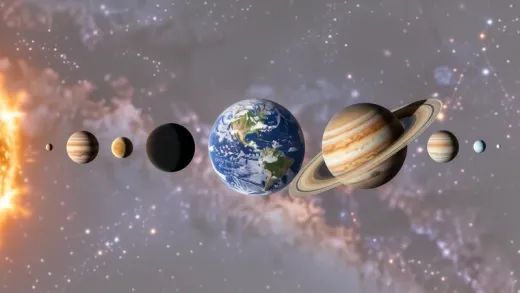
How many planets orbit the sun in second grade lessons
Learn how many planets orbit the sun and discover key facts about the eight official planets, from Mercury to Neptune, for students and educators.