Which planet is Enceladus a satellite of?
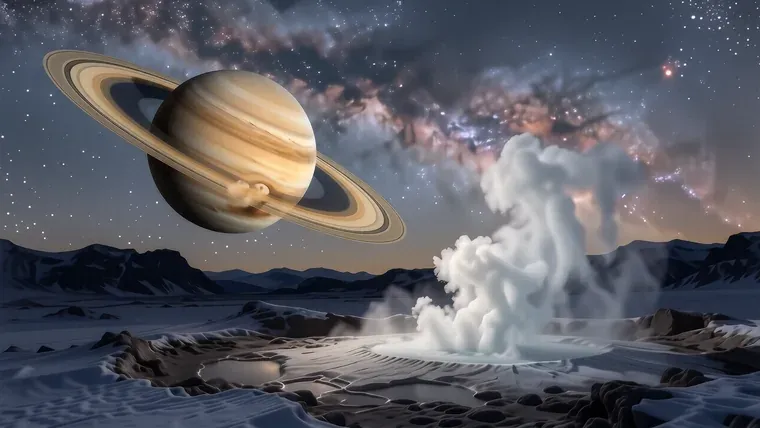
Enceladus orbits the planet Saturn. It is a small, icy moon with a diameter of 505 kilometers. While it appears tiny compared to the gas giant, its geological activity suggests a complex interior containing a global subsurface ocean.
Orbital Dynamics and Discovery
William Herschel discovered the moon on 28 August 1789. He used a 1.2 meter telescope to spot the object during Saturn’s equinox. This timing was helpful because the reduced glare from the rings allowed him to see the small satellite more clearly. It is bright. Very bright.
The moon maintains a nearly circular orbit around Saturn. Its orbital eccentricity sits at 0.0047, which keeps its distance relatively stable. It orbits at an average distance of 238,037 kilometers from its parent planet. This movement takes 1.37 days to complete. The speed is high. It travels at 45,487.3 km/h.
Gravity drives the heat. Enceladus exists in a 2:1 orbital resonance with the moon Dione. This relationship creates constant gravitational tugging because the moons pass each other at regular intervals, which prevents the orbit from circularizing completely. Tidal forces generate internal friction. Friction creates heat.
The moon is tidally locked. One side always faces Saturn. This rotation matches its orbital period perfectly so that the same hemisphere remains directed toward the planet at all times. It is stable. Mostly.
The Icy Surface and Topography
The surface reflects most light. Enceladus has an albedo that reaches approximately 90% to 99%. This high reflectivity occurs because the moon is covered in a thick, pristine layer of water ice that lacks significant dust contamination. It is white. Pure white.
Five distinct landscapes define the terrain. These include craters, plains, scarps, depressions, and grooves. Some regions appear smooth while others show heavy deformation from ancient impacts. Craters can reach 35 kilometers in width. They are rare. Most of the surface looks young because frequent resurfacing through cryovolcanism erases older impact sites.
Rift canyons cut the crust. These fractures stretch up to 200 kilometers in length. They often span widths of 5 to 10 kilometers and reach depths of 1 kilometer. The “tiger stripes” are prominent. They sit at the south pole. These fissures act as conduits for material because the tidal heating creates localized weaknesses in the icy shell.
The landscape changes by region. The northern hemisphere is older and more cratered. The southern pole is much younger. It has an estimated age of less than 500,000 years. This area features four major faults that measure approximately 130 kilometers each.
The terrain is rugged. Some areas show chevron-like patterns where fractures intersect at specific angles. These formations are sharp. They look like scars on the ice.
Subsurface Ocean and Geyser Activity
Water hides beneath the ice. Data from the Cassini mission suggests a global ocean exists between 26 and 31 kilometers deep. This ocean remains liquid because ammonia acts as an antifreeze, which prevents the water from freezing even at extremely low temperatures. It is salty. Very salty.
Geysers erupt from the south pole. These plumes shoot water vapor and icy particles into space at velocities of 2,189 km/h. The jets reach heights of 500 kilometers. They are powerful. They feed Saturn’s E-ring. This ring extends roughly one million kilometers because the particles expelled from Enceladus provide a constant supply of fresh material.
The plumes contain chemicals. Cassini detected methane, carbon dioxide, molecular nitrogen, and formaldehyde in the vapor. It also found propane and acetylene. These organic compounds are vital. They suggest chemical complexity. Scientists study these emissions so that they can analyze the ocean’s composition without landing a probe on the surface.
Thermal anomalies exist. In 2005, Cassini observed heat release near the south pole that solar heating could not explain. The temperature at the fractures is roughly 20 Kelvin warmer than predicted. This heat supports life. Life needs heat.
The ocean has distinct layers. The upper layers stay around +1°C. Deeper water reaches -45°C. This temperature gradient exists because the pressure and chemical composition change as you move toward the rocky core. It is cold. Very cold.
Chemical Composition and Habitability
Hydrothermal activity occurs on the seafloor. Water interacts with a rocky core through a process called serpentinization. This reaction involves solid rocks like olivine and releases hydrogen into the water. Hydrogen is energy. It is fuel.
Microbes could survive here. On Earth, methanogens consume hydrogen and carbon dioxide to produce methane. Enceladus shows similar chemical signatures in its plumes. The environment is promising. It is active. This potential for life makes the moon a primary target for future exploration missions.
Salt is present in the ice. Frank Postberg from the Max Planck Institute for Nuclear Physics analyzed particles from the E-ring. He found that about 6% of these particles contain salts like sodium chloride. The salt comes from below. It rises through the plumes. This proves the ocean is in direct contact with a rocky, mineral-rich seafloor.
The atmosphere is thin. It consists of 91% water vapor. Nitrogen makes up 4%, while carbon dioxide accounts for 3.2%. Methane provides another 1.7%. The atmosphere stays present because the geysers continuously replenish the gases that would otherwise escape into space.
Complexity is high. Organic matter is abundant in the plumes. This complexity suggests a stable chemical environment.
Exploration History and Future Missions
Voyager 2 provided early data. In 1981, it revealed that Enceladus was geologically active despite its small size. This discovery caused confusion because scientists expected such a small body to be cold and dead. It was active. Surprising activity.
Cassini changed everything. The NASA spacecraft arrived in 2004 and performed many close flybys. It reached within 1,839 kilometers of the moon during its final encounter in 2015. Cassini provided maps. It provided chemistry. This mission confirmed the existence of the subsurface ocean through gravity measurements and plume sampling.
Future missions are planned. The European Space Agency considered the TandEM mission in 2007. NASA also explored the Enceladus Joint Saturn Moon mission (EJSM) in 2009. Scientists want to land. They want samples. A lander could retrieve material directly from the surface to search for biological signatures.
The search continues. We look for life. We look for water. The moon remains a priority because its accessible ocean offers a unique opportunity to study habitability in the outer solar system.
Enceladus is small. It is icy. It is alive with activity. The moon’s ability to maintain a liquid ocean through tidal heating and chemical antifreeze makes it one of the most significant bodies in our solar system.
Frequently asked questions
What planet does Enceladus orbit?
Enceladus is a satellite that orbits the planet Saturn. It maintains a nearly circular orbit at an average distance of 238,037 kilometers from its parent planet.
Does Enceladus have an ocean?
Yes, data from the Cassini mission suggests a global subsurface ocean exists between 26 and 31 kilometers deep. This liquid ocean is maintained by ammonia acting as an antifreeze.
What causes the geysers on Enceladus?
Tidal heating creates localized weaknesses in the icy shell, allowing geysers to erupt from the south pole. These plumes shoot water vapor and icy particles into space at velocities of 2,189 km/h.
How bright is the surface of Enceladus?
Enceladus has an extremely high albedo, reflecting approximately 90% to 99% of light. This is due to its thick, pristine layer of water ice.
More in Solar System
Calculating the Earth's mass: A complex task
Learn how scientists use the gravitational constant and orbital mechanics to determine Earth's mass of approximately 5.9722 x 10^24 kg.
Discovering the current location of Voyager in interstellar space
Learn about the current location of Voyager 1 and 2, their distances from Earth, and how they navigate the harsh environment of interstellar space.
How many natural satellites does the earth possess?
Explore Earth's celestial companions, from the permanent Moon to transient quasi-satellites and cosmic dust clouds located at Lagrange points.
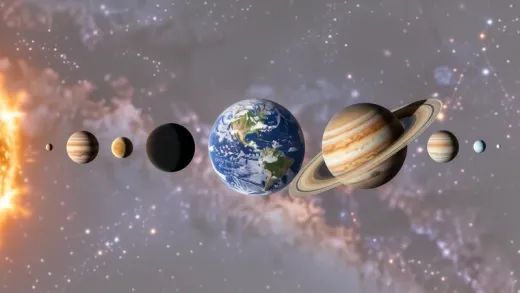
How many planets orbit the sun in second grade lessons
Learn how many planets orbit the sun and discover key facts about the eight official planets, from Mercury to Neptune, for students and educators.