Who was the first person to invent the telescope?
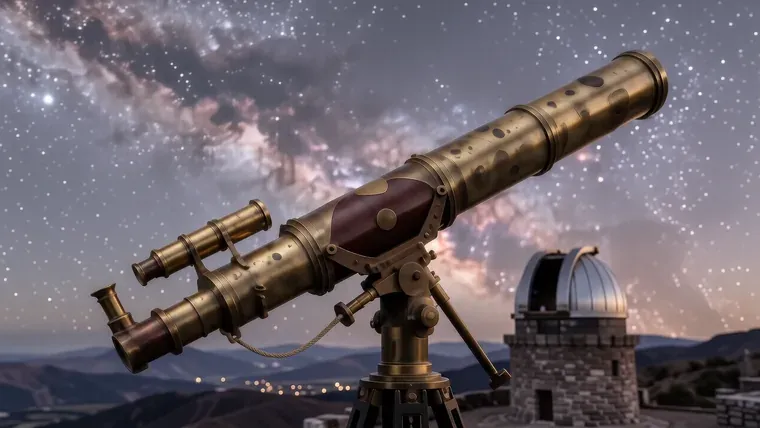
No single individual holds the title of inventor. While Hans Lippershey filed the first patent for a lens-based tube in 1608, he likely refined existing Dutch optical concepts rather than creating them from nothing. Galileo Galilei transformed the device into an astronomical tool in 1609, although Thomas Digges had experimented with convex lenses and concave mirrors as early as 1450.
The Dutch Patent and Early Attempts
The history is messy. Many craftsmen worked on similar devices during the early 17th century. Hans Lippershey of the Netherlands applied for a patent in 1608 because he wanted to protect his design of a telescope tube containing two lenses. His application failed. The patent office rejected it because they deemed the device too simple to merit legal protection.
Lippershey was not alone. Other Dutch opticians, including Zacharias Jansen of Middelburg and Jacob Metius of Alkmaar, developed similar instruments at nearly the same time. Competition was fierce. Although Lippershey did not secure a patent, his efforts popularized the instrument across Europe. By the end of 1609, small telescopes had spread through France and Italy.
Earlier attempts existed. Thomas Digges attempted to magnify stars in 1450 using a convex lens and a concave mirror. This was not a complete telescope. He lacked the patience to refine the apparatus so that it could provide consistent views of the heavens. Consequently, his work faded into obscurity while his writings on the heliocentric system remained influential.
Leonardo da Vinci also left traces. His 1509 notes in the Atlantic Codex suggested creating spectacles for observing the full moon. He did not build a working device. His sketches provided a conceptual foundation even though he never realized a functional optical tube.
Galileo and the Astronomical Shift
Galileo changed everything. He was an Italian mathematician. When he heard news of the Dutch patent attempts in 1609, he decided to build his own version immediately. He achieved a magnification of three times initially. Later, he improved the design so that it reached eightfold magnification.
The instrument grew. His final version measured approximately one meter in length with a lens diameter of 4.5 cm. This refractor was quite simple. Although it suffered from optical misalignments, it allowed him to see things no human had witnessed before. He identified mountains on the Moon and observed the four largest satellites of Jupiter.
He saw much. Galileo used his improved lenses to confirm the spherical shape of the Moon. He also observed the phases of Venus and sunspots. These observations provided physical evidence for the heliocentric model because they proved that celestial bodies were not perfect, unchanging spheres.
The name was new. In 1611, the Greek mathematician Giovanni Demissiani suggested the term “telescope.” Before this, people called them perspicillum. This change helped standardize the language of astronomy.
Galileo’s work was rapid. He moved from a 3x magnification to a 32x magnification in a short period. His success drove a massive demand for better optics across the continent. Astronomers realized that the sky held secrets that were previously invisible to the naked eye.
The Era of Long Refractors
Lenses had limits. Early astronomers wanted more power. To increase magnification, they needed longer focal lengths. This led to the construction of incredibly long tubes. Some telescopes reached 70 meters in length because researchers believed that increasing the distance between lenses would reduce chromatic aberration.
These tubes were difficult. They were heavy and cumbersome. Astronomers had to invent tripods so that the long instruments could remain stable during observations. Even with stability, the wind often distorted the image. The physical scale of these refractors made them impractical for many researchers.
Glass quality was poor. Manufacturers struggled to produce large, clear lenses. In 1656, Christian Huygens built a telescope that was over 7 meters long. It had an aperture of approximately 150 mm. This device achieved 100x magnification, which is comparable to many modern beginner telescopes used today.
The scale increased further. During the 1670s, builders constructed a 45-meter telescope. This instrument provided a wider field of view than previous models. However, the reliance on lenses meant that chromatic aberration—the rainbow-like blurring around bright objects—remained a constant problem.
Newton and the Reflecting Revolution
Mirrors changed the game. Isaac Newton found a different way to gather light. He realized that using a concave mirror could eliminate the color distortion caused by lenses. His first reflecting telescope had a diameter of only four centimeters. It was quite small.
Newton used alloys. In 1704, he produced a 30mm diameter mirror using a mixture of copper, tin, and arsenic. This specific material helped create a clearer image than previous glass attempts. His original instrument is still kept in the Astronomical Museum in London.
Reflectors took time to catch on. It was not until 1720 that British opticians built the first fully operational reflector with a 15-centimeter diameter. This was a major milestone. Although Newton’s principle worked, the industry needed better ways to polish large mirrors before reflectors became the standard.
The 18th century saw glass evolution. In 1758, scientists invented lightweight crown glass and heavy flint glass. These two types of glass allowed for the creation of achromatic lenses. J. Dollond used these materials to create the Dollond lens, which significantly improved refractor performance.
Reflectors eventually won. They were more compact than the 40-meter long refractor tubes that had previously dominated. By the end of the 18th century, large reflectors began replacing the massive, awkward refractors. This shift allowed for more portable and efficient astronomical research.
The Giants of the 19th and 20th Centuries
Observatories grew massive. In 1824, a typical large lens was only 24 centimeters in diameter. By 1866, that size had doubled. The Yerkes refractor, completed in 1897, represented the peak of refractive technology. These instruments required enormous buildings to house them.
Russia contributed heavily. The Pulkovo Observatory became a center for excellence. It featured a 76-centimeter reflector in 1885. Later, the Special Astrophysical Observatory in Russia utilized Newton’s single concave mirror principle starting in 1974.
The BTA was huge. In 1976, Soviet scientists built the Bolshoi Telescope Azimutalny (BTA). It featured a 6-meter mirror. This telescope held the title of the world’s largest until the end of the 20th century because it utilized a computerized alt-azimuth system for guidance.
The mirror aged. The BTA has lost about 30% of its original quality over time. It is now largely a historical monument. Modern science moved toward even larger, segmented mirrors.
The Keck telescopes arrived. In the United States, KECK I and KECK II were built in 1994 and 1996. They sit on Mauna Kea in Hawaii. Each telescope has a 10-meter diameter mirror made of 36 hexagonal segments so that they function as a single reflective surface. These massive structures weigh over 300 tons each.
Space-Based Observation
The atmosphere is a barrier. It distorts light and blocks certain wavelengths. To solve this, we sent telescopes into orbit. The Hubble Space Telescope launched in April 1990. It orbits Earth to avoid the interference of the atmosphere.
Hubble sees clearly. It allowed scientists to measure the expansion of the universe more accurately. It also confirmed the existence of dark matter. The telescope was unique because it was the first man-made object to undergo direct repairs in space, with its fifth repair occurring on 11 May 2009.
Other wavelengths require space. X-rays and gamma rays cannot pass through our atmosphere effectively. The Swift orbiting X-ray telescope investigates gamma-ray bursts. It can start recording data within one minute of detecting a burst because it is positioned above the air.
The James Webb Space Telescope (JWST) represents the current frontier. NASA launched it with a 6.5-meter mirror. It operates in the infrared spectrum to see through cosmic dust. This mission builds on the legacy of every optical breakthrough since Galileo’s first tube.
We continue to look up. From the tiny lenses of 1608 to the massive segmented mirrors of Hawaii, the tools have changed. The fundamental goal remains the same. We use light to understand where we came from and where the universe is going.
Frequently asked questions
Who actually invented the telescope?
No single person is credited with the invention. Hans Lippershey filed the first patent for a lens-based tube in 1608, though other Dutch opticians like Zacharias Jansen and Jacob Metius were working on similar devices.
How did Galileo Galilei improve the telescope?
Galileo improved the design to increase magnification from an initial 3x to as high as 32x. His instruments allowed him to observe lunar mountains, Jupiter's moons, and the phases of Venus.
What is the difference between a refractor and a reflector?
Refractors use lenses to gather light and often required extremely long tubes to reduce chromatic aberration. Reflectors, pioneered by Isaac Newton, use concave mirrors to eliminate color distortion and are more compact.
When was the term 'telescope' first used?
The term was suggested in 1611 by the Greek mathematician Giovanni Demissiani. Before this, the instruments were commonly referred to as perspicillum.
More in Stargazing
The benefits of an apochromatic refractor
Learn how an apochromatic refractor uses ED glass and multiple lens elements to eliminate chromatic aberration for high-resolution astrophotography.
How to start choosing the perfect telescope for beginners
Learn how to select the right telescope by comparing refractors and reflectors, understanding aperture, and matching equipment to your observation goals.
Differentiating between refractor and reflector telescopes
Learn the key differences between refractor and reflector telescopes to choose the right optical design for planetary viewing or deep-sky observation.
A beginner's guide on how to use Stellarium
Learn how to use Stellarium to simulate the night sky, configure geographical coordinates, and optimize visual settings for celestial observation.